Categories
News ordinances

How We Blocked Flock In Cambridge

Cambridge and Somerville and Boston, as a result of prior work by Digital Fourth, ACLU of MA and others, have “surveillance oversight ordinances” that put procedural hurdles in the way of police adoption of surveillance technologies.

Under these ordinances, for something like Flock Safety, city agencies are legally obliged to disclose to City Council that they are intending to deploy any surveillance technology. They must explain what the technology is; what will happen to the data from it (collection, retention, sharing, destruction); and whether they believe it will have a differential impact on any group within the City. That report must be presented at a public hearing, and the City Council is empowered to say yes or no to the technology.

In the context of this ordinance in Cambridge, unfortunately, a lot depends on who chairs the Public Safety Committee, and how close they are to the cops. We made very little headway in blocking surveillance technologies from January 2023 through to the summer of 2024, because the chair of Public Safety, Paul Toner, was the most powerful Councilor and was very tight with the cops. He waved through anything they asked for. He was very reluctant to schedule separate public hearings for new technologies. In February 2025, therefore, he made sure that Flock would be approved, and the three City Councilors with genuine concerns (including DSA-endorsed Jivan Sobrinho-Wheeler), weren’t able to prevail. We brought six people to give public testimony against it.

At the same time, we were fighting the City on a proposal to allow Cambridge PD to deploy drones. We worked closely with ACLU of MA, and Councilors were worried enough that Toner had to schedule a hearing. At the hearing, we focused on the fact that Cambridge PD hadn’t bothered to develop or disclose a policy on drone use, so whatever they were saying about how drones would or would not be used wasn’t binding. We recommended that Cambridge PD go and draft a policy, consult with us and with ACLU, and bring the policy back to City Council, whereupon City Council would consider whether the proposal to deploy drones was reasonable. Remarkably, City Council agreed, against Toner’s objections. It was a sign of things to come. Over a year later, Cambridge PD has not moved forward with that proposal.

In May through to June, things began to shift regarding Flock. Our national folks monitor surveillance, privacy and Fourth Amendment news very closely. The news broke that Flock had helped a Texas cop chase down a woman suspected of having an abortion. Councilor Sobrinho-Wheeler, responding to that news, filed a policy order for reconsideration of the Flock deployment, backed up by Nolan and Siddiqui. Because we were monitoring the agendas for City meetings in general, we saw that the Pole and Conduit Commission was proposing to approve the actual installation of Flock equipment. We saw an opening, and mobilized to get the Pole and Conduit Commission to delay approval of actual installation till after City Council had considered Sobrinho-Wheeler’s policy order.

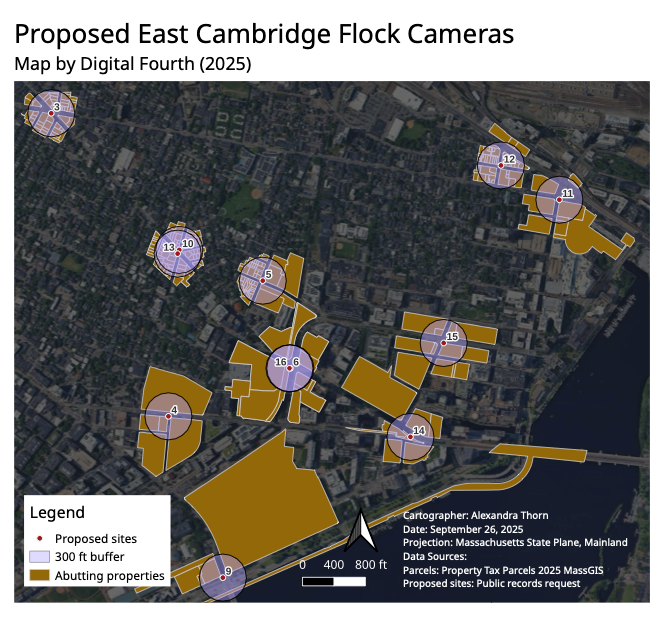
Flock had to disclose to that Commission the exact locations where they planned to put in the cameras. That gave our advocacy lots of ammunition. Bad news kept flooding in for Flock Safety, and we made sure City Councilors, the City Manager and the Pole and Conduit Commission members had that information. Then, on July 8, a scandal that had been circulating around City Hall for around a year broke, and Paul Toner announced his future resignation, and was stripped of his committee chairmanships. Toner was replaced as chair of Public Safety by his vice-Chair Angie Wilson. She scheduled consideration of Sobrinho-Wheeler’s policy order for September. We organized speakers for that session. Toner still strenuously objected to revoking Flock’s contract, so it was agreed to suspend it, pending a review by the City Manager. We submitted for this hearing a thorough analysis of where the cameras were to be deployed, because Flock had had to disclose to the Pole and Conduit Commission exactly where they were planning to put them up; we made the argument that the ALPR cameras were heavily focused on East Cambridge in a way that would deeply and differentially affect the residents of public housing complexes in that area.

The review returned to the Council on December 9, and Wilson invited Gideon Epstein of ACLU of MA and Alex Marthews of Digital Fourth to provide expert testimony, like we had done in 2018-21 under Toner’s predecessor. Then, unexpectedly, at the start of the meeting, Cambridge PD and the City Manager’s office recommended revocation of the Flock contract. They had just found out that morning that Flock Safety was in breach of the contract terms. The City had suspended the contract and made very clear that no equipment was to be installed, but a Flock technician had gone ahead and reinstalled two cameras anyway. What with that, and our and ACLU’s expert testimony, and nine out of ten public testimonies being thoroughly opposed to Flock, the writing was finally on the wall. Public Safety Committee recommended revocation, and given the City Manager’s and the police’s posture, it was a given that the full Council would wave through the revocation.

The City Council still preserved, and the City Manager is even now trying to preserve, the underlying City approval for the use of ALPR in general, but now without a specific vendor in mind, and therefore without any specifics on where it would deploy or what the policies would be. The onus is now on the City/Cambridge PD to identify an ALPR vendor that won’t pose significant privacy issues.

Categories
Mission News privacy shotspotter

End Cambridge’s Use of ShotSpotter Once and for All

[This alert is from The Black Response; Digital Fourth is a member of “Stop ShotSpotter Camberville,” a coalition of community groups opposed to this surveillance technology.]

“On Monday, May 11, 2026, at 5:30 p.m., the Cambridge City Council is scheduled to vote on a policy order to end the City’s use of ShotSpotter microphones and remove the devices from Cambridge neighborhoods.

ShotSpotter is a network of microphones installed across the Port and Riverside (Coast) neighborhoods (see ShotSpotter dashboard). The system is marketed as a technology that detects loud sounds and alerts police to possible gunfire.

However, during the April 29 Public Safety Committee hearing (video not yet available), it became clear to council members and attendees that ShotSpotter is continuously listening. The Cambridge Police Department explained that when ShotSpotter detects a gunshot, the company provides them with an audio clip containing one second before and one second after the sound. This raised significant concerns because the existence of audio from before the alleged gunshot indicates that the system is actively listening at all times. [Not only that, but ShotSpotter records continuously over a 48-hour period; Cambridge PD acknowledged that that was so, and that recordings from within that timeframe were “useful for evidence.” – Digital Fourth]

Boston University Professor Spencer Piston emphasized the distinction between continuous recording and the alert that the police eventually receive, noting that while ShotSpotter may not permanently store all audio, the technology still relies on constant monitoring in order to generate alerts. This raises serious concerns.

Additional concerns were raised about the structure and oversight of the program in Cambridge. The current ShotSpotter system is funded through a Department of Homeland Security (DHS) grant, the same federal department that oversees ICE. Harvard Law School Professor Mason Kortz testified that the City of Cambridge is not itself a party to the current ShotSpotter contract operating in the city. As a result, city officials have reportedly faced difficulties obtaining and reviewing the contract. Since we are not party to the contract, residents lack clear protections regarding how data may be accessed, shared, or used.

The ACLU of Massachusetts, represented by lawyer Gideon Epstein, explained why ShotSpotter appears inconsistent with the standards established under Cambridge’s surveillance technology ordinance, a framework the ACLU helped develop.

Taken together, these concerns paint a troubling picture. Cambridge’s use of ShotSpotter may create risks that sensitive surveillance data could be accessed by federal agencies, including ICE, potentially undermining Cambridge’s commitments as a sanctuary city and Welcoming Community.

Four of the five members of the Cambridge Public Safety Committee, Councillors Al Zubi, McGovern, Nolan, and Sobrinho-Wheeler, have sponsored and submitted a policy order for the Monday, May 11, 2026 City Council meeting to remove ShotSpotter from Cambridge. The ShotSpotter policy order is the second item on the agenda: POR 2026-98.

We encourage community members to sign up for public comment and send letters in support of the policy order and to attend the meeting if possible. Please join us in supporting this important step toward ending Cambridge’s use of ShotSpotter.

Categories
cameras Mission News Police body-worn cameras

Lack of Police Oversight Board Delays Body-Worn Camera Adoption in Somerville

[Narrative reposted by permission of Derrick Rice]

On Friday April 24th, a working group of Somerville residents concerned about body-worn cameras [“BWCs”] delivered this letter to City Council, co-signed by 22 community leaders and organizations. The letter outlines the gaps between widely recognized BWC policy requirements and the City of Somerville’s proposed BWC Surveillance Technology Impact Report (“STIR”), which functions as the legally binding use policy). It also emphasizes the importance of developing a BWC use policy with public engagement and defining the policy prior to collective bargaining.

On Tuesday April 28th, we were sponsored by Councilor Scott to speak at City Council’s Legislative Matters Committee meeting. Derrick Rice presented, summarizing some of the policy concerns and emphasizing the procedural concerns. The Legislative Matters Committee then deliberated the BWC STIR. You can watch the video here (presentation @ 49m38s, deliberation @ 1h05m to 1h37m). 

Derrick: “From what we in the public are able to see, there is a real cause for concern in this moment. … We have six years of task forces studies in this council’s past deliberations have converged on a clear answer to the question of how body-worn cameras should be governed if adopted, yet we don’t see elements of that adequately represented in the STIR presented by the city. The city’s own studies and past commitments have led us to expect community transparency and input on this policy, yet we’re being caught off guard by the mayor’s request for funding and STIR approval prior to any public engagement. I am one of many people appealing to you to use your authority over the STIR to help ensure we meet these held standards of transparent policy and public engagement.”

Throughout deliberation, all councilors communicated some degree of apprehension with the BWC STIR. Ultimately, they agreed to hold the item in committee, effectively declining to seriously consider approval at this time. (Want to know what they said? See the addendum below!)

What’s Next

The City Council’s Legislative Matters Committee has opposed the BWC STIR for now, but Mayor Wilson’s administration could push for its approval at any time. We will be watching carefully to see if and how the City responds to our letter or changes its process with regard to collective bargaining negotiations and BWC policy.

In the interim, community members have circulated a variety of content regarding the consideration of Body Worn Cameras:

Somerville residents can sign up for future updates by filling out this form.

With neighborly love,

Derrick Rice (he/him)

e: local.derrick@rice.io

Want to be more involved? Have something to add? Spot an error? Please get in touch!


Addendum: What They Said

Here’s what the councilors on Legislative Matters had to say on April 28th: 

Councilor Mbah: “I’m a proponent of body-worn cameras, but now the more I hear about this conversation I just also want to make sure that those loopholes that continue to surface have to be closed. We have to do it right. So, you’ve really articulated a lot of stuff that is also — I mean, it almost feels like common sense. If anybody wants public safety, they should be able to accept those things. They should be able to accept that this is all about accountability”

Councilor Strezo: “I would like to have the administration respond about the concept — because there is a good point that is brought up — about the police oversight board. … The administration had to have seen this coming with the body-worn cameras talk. All the research that I’ve seen has mentioned that this is an important element to implementation of the body-worn cameras. We need that oversight board.”

Councilor Ewen-Campen: “This is different from every other impact report we’ve done because it’s the subject of collective bargaining. …  this council has an executive session — had conversations about this topic — but the public hasn’t seen any of that, right? …  I’m concerned about the kind of putting the cart before the horse; that it’s not come as a surprise to anyone that the use policy is really, really important to me, to my colleagues on the council, to the public, and to not be able to have a detailed conversation about it before we’re asked to approve it in public is really, really hard”, adding “given the budget conversations we’re having this year, I’m extremely apprehensive about that.”

Councilor Davis: “Aside from all of the sort of the tactical issues that are raised with trying to review a document that we can’t change that relates to some discussion that may be happening that we can’t really materially impact. — I guess I will repeat [Councilor Ewen-Campen] a little bit. — This is a backwards way of doing it.”

Councilor Scott: “As I look at the impact report, I am certainly in agreement that there are a few glaring omissions here. …  one thing I’m absolutely convinced of is that there is no pathway for this to be a beneficial technology implementation without meeting at least these baseline requirements that have been presented, both in the Good Counselors 2022 memo and the legion of sources that was cited here, which I do want to call out again, included the cop staffing study that the city paid for in 2022 that was done by an outside consultant that included a chief of police”, later adding “I firmly believe that we must have a civilian oversight body in order for this to be of any positive effect.”

Councilor Scott went on to clarify with Legislative Liaison Raddassi (representing the administration), that the city’s ongoing negotiations with the police unions will constrain what can or cannot be in the BWC policy. These are discussions that we — the public — have no transparency into, despite the clear impact it has on all of us.

Legislative Liaison Raddassi: “The collective bargaining agreement will set the limits of what can be included in a surveillance use policy. …Those conversations have been happening in executive session with this council around some of the policy considerations that councillors have raised. And so again, this STIR is based on the current body-worn camera policy because it’s basically the only thing we can debate about in public at the moment.”

Councilor Scott: “I think I heard, I just want to make sure I repeat accurately what you said, that the outcome of collective bargaining will serve as a top-end constraint over what could be pursued in terms of access and policies in that use policy.”

Legislative Liaison Raddassi: “Correct.”

Councilor Scott: “Okay. Well, from my standpoint, that’s just entirely backwards of where we should be doing this as a city. The city council has a very specific role in this process. … I am inclined not to support this in its current stance. I would encourage the city to go back and rethink their approach to this.”

Categories
cameras immigration News privacy

Cambridge Suspends Flock, But May Revive It Dec. 9

On Monday, October 20th, the Cambridge City Council voted to temporarily halt the city’s use of automatic license plate reader technology, including Flock Safety, because of concerns about privacy and data sharing with the federal government. 

Many community members offered oral public testimony, including members of Digital Fourth, the ACLU, collaborators, and other concerned citizens. Much of this testimony focused on issues with Flock Safety specifically, especially their issues with Flock’s recent history of sharing information with federal agencies. 

Members of the city council, including those who had voted in favor of moving forward with Flock Safety in February, were surprised and concerned by the issues with Flock Safety that were raised during public comment. Specifically, they were concerned by the idea that the information collected by Flock Safety cameras owned by Cambridge might be shared with Customs and Border Protection and Immigration and Customs Enforcement. Council Member Marc McGovern, who had initially voted in favor of Flock Safety in February, stated his concern about the testimony shared about the breaches of contract committed by Flock Safety against communities like Evanston, IL. McGovern said that “there are all sorts of loopholes in the control that we became more aware of over time.” 

After over an hour of public comment, the council voted unanimously to refer the issue to the Public Safety committee, and in the meantime, to suspend or revoke the use of Flock cameras. Many councilors expressed the desire to allow time for more public comment. 

The Cambridge Police Department has stated that none of the Flock Safety cameras are operational. Volunteers with Digital Fourth independently verified that the cameras have been removed. 

The governor’s thoughts on the development were shared in a recent CBS News article. She stated that “cameras are ubiquitous” and came out unambiguously in support of “responsible surveillance technology …when it comes to the investigation and deterrence of crime.” It remains to be seen what the Cambridge City Council and the Public Safety Committee will decide constitutes “responsible use.” 

Several members mentioned the possibility of working with a different automatic license plate reader company. However, recent reports have detailed issues of data sharing by other automatic license plate reader companies, as well. According to a recent report by 404 Media, an app recently demoed by Immigration and Customs Enforcement (ICE) allows officers to scan a license plate with their phones and cross-check it with millions of other records, like marriage records, license data, vehicle ownership, voter registrations, and ALPR data. This app partners with another ALPR company, Motorola Solutions. Though Flock has a particularly spotty record, when a municipal police department partners with an ALPR company, it is always difficult to confirm that the data collected by the cameras will not be used for purposes that the police department would not approve of. Even if an ALPR company seems to be using the data that they collect ethically at one point, this does not preclude them from changing their policies in the future. 

On December 9th, the city will discuss the Flock Safety at a Public Safety Committee meeting from 12pm-2pm. Invited panelists will include a Cambridge-based Digital Fourth representative, representatives from the ACLU, the Cambridge Police Department, and Flock Safety. 

As the Cambridge City Council prepares to turn over after the recent election, it is a vital time for privacy-concerned residents of Cambridge to make their voices heard. 

Categories
cameras Mission News

Let’s Stop Cambridge From Getting Flocked Up

Recently, Cambridge residents have been receiving communications in their mailboxes that new “Flock Safety” cameras are being installed in their neighborhoods. 

Flock Safety (“Protect Your Community With 24/7 Coverage That Never Sleeps!”) is a surveillance company which produces and installs, among other products, cameras with automatic license plate reader (ALPR) capabilities. Flock is marketed as an all-encompassing “privacy solution […] boosting efficiency and reducing crime” for municipalities.

There are, however, serious privacy concerns with Flock’s systems. Despite months of denying contracts with federal agencies, Flock recently revealed that it has a contract with Customs and Border Patrol (CBP) and shares ALPR data without the consent of local officials. This week, it was also revealed that they had been sharing data with ICE, Homeland Security Investigations, the Secret Service and, for good measure, NCIS. Due to the company sharing data in violation of Illinois law, the state of Illinois recently terminated their contracts with Flock. After Evanston, IL, ordered Flock to shut down its use of ALPR cameras in the city, Flock reinstalled the cameras without permission, prompting Evanston to send a cease-and-desist letter. This week, Eugene, OR, also paused its Flock deployment as a result of privacy concerns.

As other states and municipalities reckon with Flock’s dishonest data sharing policies, Cambridge should take a long look at their own contract. This is the state of play in Greater Boston for now, as far as we know. The City of Boston launched a pilot contract with Flock in 2024, but has not yet, to our knowledge, proceeded to a full rollout. Flock cameras are appearing in Brookline and on the Watertown-Waltham line. Cambridge City Council, at the urging of Cambridge PD and embattled Councilor Paul Toner, approved Flock Safety for use in February 2025, and Flock opened an office in Boston in August 2025. Now, resistance is mounting in the Greater Boston Area due to concerns about data sharing, and Cambridge residents are being confronted with the implications of Flock in their own neighborhoods. 

So far, 16 Flock ALPR camera locations have been proposed in Cambridge (the blue pins):

The densest deployment is planned for East Cambridge, near the public housing at Newtowne Court, Washington Elms and Roosevelt Towers, as well as Kendall Square and MIT. The other proposed locations are on major thoroughfares into and out of Cambridge, including nearly all routes of travel between Cambridge and Boston. This raises the concern that it will become very difficult for local residents to move about without having their license plate information, and thereby in many cases their patterns of life, captured. 

Depending on the city’s contract with Flock relating to data retention, these residents’ patterns of movement may be visible to both the Cambridge Police Department and other agencies using Flock’s database. This is particularly concerning because Flock has developed an AI tool which reports suspicious vehicle movement patterns to local law enforcement. This is to say, artificial intelligence may have a hand in not only assisting police with searching networks for particular crimes or “hits,” but in deciding what is suspicious in the first place and flagging potentially innocent residents based on algorithmically determined criteria. Citizens should not be subject to the whims of an algorithm determined by a private company whose policies are not transparent or subject to the same rigorous checks that a government administration would be. Flock has given Cambridge no reason to trust in the idea that their algorithms are effective and unbiased, and has in fact provided more reason to suspect the contrary. 

There’s a further issue. The City of Cambridge Surveillance Use Policy directs the City to pay attention to whether any communities are being “disproportionately impacted” by the deployment of any surveillance technology, especially “low-income communities, communities of color, or any community that is marginalized in the City.” Based on the proposed camera locations, it’s obvious that the movement patterns of residents of Strawberry Hill and West Cambridge traveling, for instance, to Harvard Square, would not be as regularly captured as would the movements of East Cambridge residents. The City has not considered whether there are disproportionate impacts of this kind; the Council, in approving it, relied simply on a declaration by Cambridge PD that there weren’t any.

A key privacy practice is data minimization: Limiting data collection to the minimum required, and not retaining data for longer than it is required. Flock’s website discloses that the local law enforcement agencies that contract with them may store data themselves, but Flock itself stores all license plate data for 30 days. As a result, in accordance with their data sharing record, Flock data may be visible for a significant window to out-of-state law enforcement, Immigration and Customs Enforcement (ICE), CBP, the Department of Homeland Security, or other federal agencies, either through the pilot data-sharing scheme Flock now claims to have suspended, or through requests by federal agencies to local and state law enforcement who themselves have Flock contracts. 

Federal agencies may also have the opportunity to access Flock ALPR data through the Boston Regional Intelligence Center and through informal favors granted by local members of the Joint Terrorism Task force, which has recently been directed by Trump in a presidential memorandum to conduct investigations of groups which espouse “anti-fascist,” “anti-capitalist,” “anti-American” or “anti-Christian” viewpoints. The actions of the current federal administration make it even more urgent to protect the sensitive data of vulnerable Cambridge residents, including immigrants, politically active people, and those who express views that might be classified under these dangerously loose categories. Anything that requires the use of a car in certain areas of Cambridge has the possibility of being tracked. Whether residents choose to exercise their free speech by attending a protest, accessing reproductive care, or simply moving about, Flock’s license plate readers may be storing that data, exposing it to federal search, and potentially using it to draw conclusions about the vehicle driver’s future potential to commit crimes. For example, many vehicle going into and out of Cambridge Health Alliance’s Windsor Street Care Center, which offers reproductive healthcare services, would be in Flock’s databases.

Data stored is always data that may be used. Any data stored with Flock is not safe. Even if the City of Cambridge specifies that they do not want the ALPR data that they store to be accessed by federal law enforcement, there is no guarantee that Flock will successfully prohibit access by federal law enforcement to their own systems directly in the absence of the consent of the city of Cambridge, especially considering their recent record of lying to cities about their data sharing practices. What’s more, federal agencies can always subpoena Flock. 

We are currently advocating for Cambridge to terminate its arrangement with Flock, along with many other Cambridge residents, local advocacy groups, and MIT professors. As is all too common when it comes to local surveillance technology deployments, notifications on the proposed Flock camera deployments have been relatively under the radar, but progress has been made in the direction of an examination of Flock’s data sharing policies. Recently, all Cambridge city council members voted in favor of taking a second look at the deal with Flock that they approved in February, but it was specified that this review was not expected to result in abandoning the contract altogether.

During this meeting, Councilor Jivan Sobrinho-Wheeler called attention to the funding source for the Flock cameras being deployed in Cambridge. They would be paid for largely by the federal Urban Area Security Initiative (UASI) grant, meaning that Cambridge would technically only be leasing them. This system of funding would place very little control over Flock’s data storage systems in the hands of the Cambridge city council, and potentially open the door to more federal abuses of the type already being perpetrated by Flock in other states. The unexpected, and probably short-term termination of UASI funds by the Trump administration is not expected to change the City’s decision.

Approval of the specific locations for the cameras was included in an agenda for a recent Pole and Conduit committee meeting, but was later removed. The next committee meeting is scheduled for Thursday, October 23, 2025, but it is unclear whether or not Flock will be discussed. 

As the members of the Cambridge City Council and the committee make time for community feedback and consider recent developments with Flock, Cambridge residents have a vital opportunity to make their opinions heard. Cambridge residents should take advantage of their right to free speech by reaching out to their city council members on this topic, all of whom are up for re-election. As informed and engaged members of the community, Cambridge residents should not be willing to accept the creeping spread of civil rights violations associated with the surveillance state.

Note: This article was written with assistance from Digital Fourth volunteers Alex M., Alex T. and Julie B.

Categories
Mission News

Trump Admin Directs Boston’s JTTF To Investigate “Antifa” Protests

On September 25, 2025, the President issued an order, NSPM-7, directing the Joint Terrorism Task Forces to coordinate a strategy to disrupt “antifa” organizations and nonprofits that advocate for “anti-Americanism, anti-capitalism, and anti-Christianity; support for the overthrow of the United States Government; extremism on migration, race, and gender; and hostility towards those who hold traditional American views on family, religion, and morality.”  ACLU just released a useful analysis of it, here.

Just in case any readers mistakenly thought that this new strategy was aimed only at spying on those planning or committing acts of violence, the President supplemented his order with a September 26 article, Democrats’ Unhinged Crusade Against ICE Fuels Bloodshed, containing a list of Democratic elected officials who had suggested publicly that his administration’s acts were authoritarian, fascist, Nazi, or Gestapo-like, and describing such suggestions as a “battle cry for violence.” That same day, DHS published a memo, DHS Is Fighting Back Against Antifa Violence, that included as an example of such violence, Democratic members of Congress attempting to exercise their legal right to conduct oversight visits of ICE facilities. On October 1, DHS and FBI circulated a joint intelligence bulletin to all law enforcement agencies in the country, Domestic Violent Extremists Pose Increased Threat of Violence to ICE Facilities and Personnel, arguing that previous attacks “took advantage of First Amendment-protected activity,” and therefore making a case for pro-active monitoring of protests against ICE. In advance of Saturday’s expected nationwide “No Kings” rally against the administration, House Speaker Mike Johnson has described it as a “hate-America” rally that would draw “the pro-Hamas wing” and “the antifa people.”

We should not deceive ourselves here. In the eyes of this administration, all Democrats, and all Republicans who dare to cross or even criticize the President, are now “antifa” — no matter how lawful, peaceful or reasonable their opposition is. This is a coordinated administration effort to depict all opposition to the administration as an appropriate target for DHS and FBI surveillance, spanning the whole range from mere verbal criticism through to actual, though thankfully rare, acts of violence. It won’t matter to Patel’s FBI or Noem’s DHS how much you support the police; if you cross this administration, it won’t matter even if you are the police.

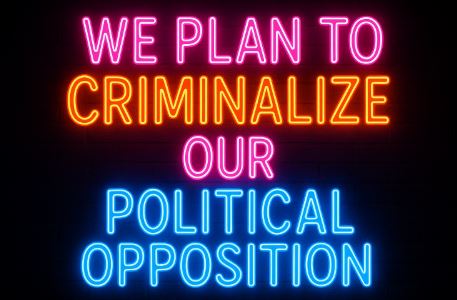
This is no longer about “supporting public safety” by giving law enforcement every possible tool. This is about whether the tools previously given to law enforcement will be illegally used to criminalize political opposition. And the administration might as well right now be holding up a gigantic neon sign, saying, “We Plan To Criminalize Political Opposition.” Those going to the No Kings protest this weekend should plan accordingly.

And for those who think that, while the Trump administration might feel this way, Boston’s Joint Terrorism Task Force and Boston PD would never, here’s the actual front cover of the Boston Police Patrolmen’s Association’s newsletter “Pax Centurion” from their now memory-holed fall 2018 issue, which contained a vile and lengthy poem identifying as “antifa” undocumented immigrants, socialists, liberals, students, and anybody who took a knee to protest police violence:

Want to do something about surveillance?

  • MASSACHUSETTS RESIDENTS: Call the Joint Committee on Public Safety and Homeland Security at the Legislature at (617) 722-2020, ask to speak to House Chair Rep. Daniel Cahill, and say that you’d like his committee to vote out favorably H. 2687, “An Act relative to protecting Massachusetts residents against federal government surveillance.”
  • BOSTON RESIDENTS: Call the Police Commissioner’s office at (617) 343-4500, tell them that you oppose the deployment of surveillance technologies against people organizing or attending protests, and ask what Boston PD’s response is to these federal instructions to use counter-terrorism powers against Boston residents for expressing First Amendment-protected speech.
  • CAMBRIDGE RESIDENTS: Call the office of City Manager Yi-An Huang on (617) 349-4300, and tell him that in light of what the Trump administration is doing, you oppose allowing Cambridge PD to fly drones over protests, deploy Flock Safety security cameras that DHS can access, and participate in the Joint Terrorism Task Force.
  • OTHER CITIES AND TOWNS: Email your questions and concerns here.
Categories
Mission News privacy state

Pass the Mass Digital Privacy Act

Your online identity without a good, comprehensive privacy law

Despite what industry would like us all to think, privacy is not dead!

Aren’t you tired of your data not being your own, of your digital life being carelessly smooshed up and segmented and sold across a thousand commercial and governmental databases? We’ve gotten used to putting up with what that means – the scams, the stress, the self-policing, the endless robocalls, the poorly targeted ads, the data-fueled AI chatbots and LLMs that mimic real thinking the way pink slime mimics a grass-fed steak. This is no way to live.

But it’s also not the only way to live. Here in the Commonwealth, we can do better, like Maryland and the EU have already done. Yesterday, Digital Fourth activists sent a coalition letter to Senate and House leadership, urging them to pass S.2516, the Massachusetts Digital Privacy Act. This is genuinely an excellent privacy bill — so good that industry has already swung into action against it, even though the bill is barely out of the Senate Committee on Advanced Technology (who did great work on this).

This bill includes:

  • Strong data minimization provisions, which limit:
    • the collection and use of personal data to what is reasonably necessary for a company to provide the data or service requested by a consumer
    • The collection and use of sensitive data to what is strictly necessary to provide the data or service requested by a consumer
  • A clear list of all of the kinds of data that must be regarded as sensitive.
  • Prohibition on the sale of sensitive data.
  • Requires affirmative consent of a consumer before each transfer of their personal data.
  • Provides every consumer with the right to see, correct verifiable inaccuracies in, and delete their personal data that has been collected by a company.
  • Gives consumers the right to opt out of targeted advertising or automated profiling.
  • Requiring that companies provide a clear and obvious privacy notice about their data collection practice and security measures and method to contact them for execution of all of a consumer’s rights.
  • Establishes a free automated mechanism whereby consumers can learn whether a data broker possesses their data and can request that their data be deleted.

Call your legislator to let them know they should support this bill!

COALITION LETTER: https://warrantless.org/wp-content/uploads/2025/06/MDPA-Leadership-Outreach-Letter-2025-06-12.pdf

DETAILED EXPLAINER: https://warrantless.org/wp-content/uploads/2025/06/The-Urgent-Need-for-Effective-Comprehensive-Data-Privacy-Protections-Created-in-MDPA-S.2516-.pdf

ENDORSERS:

We’re glad to say that we’re not alone in this fight: The letter was cosigned by AFL-CIO, the American Federation of Teachers, Fight for the Future, the National Council of Jewish Women, YW Boston and more, and now also the Consumer Federation of America.

Categories
cameras facial recognition Mission News

Don’t Ban Masks At Protests

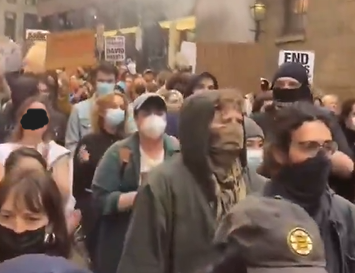
Most Boston ICE protesters know to mask up. The rest, we blur out for their safety.

It’s hearings season at the State House, so this is when we put together testimony on bills that particularly relate to privacy, surveillance and the Fourth Amendment. But first, a little history on the issue of face masks and privacy.

Before wearing a surgical mask became politicized as “a thing woke liberals do,” the Boston police, in fall 2019, tried to criminalize the wearing of masks in public without criminal intent. We objected, and testified in masks, because wearing a mask shouldn’t give discretion to police to launch in and arrest you. For some reason, though, by the spring of 2020 nobody was interested in banning mask-wearing.

In 2023-25, as the pandemic receded, and in response to the Gaza ceasefire protests, elected officials also began dusting off mask bans as a way to signal that they, too, found such protests unacceptable. Most notably, Gov. Hochul of New York, citing anti-semitism concerns tried hard to revive a ban (Our national coalition joined NYCLU in opposing it). Police would love these bans to pass, because it’s a lot easier to identify people if they’re not wearing masks, whether you use facial recognition software or not.

Most recently, the Trump administration is trying to require both universities and local governments to hand over drone and camera data of protests, presumably so that the administration can then use facial recognition software to identify unmasked people engaging in disfavored activities as well as crimes. In the Los Angeles area this week, the federal government has directly intervened to conduct aerial surveillance of protests using drones, and connectedly, President Trump posted on June 5 on Truth Social, “From now on, MASKS WILL NOT BE ALLOWED to be worn at protests. What do these people have to hide, and why???”

Inappropriate aerial surveillance of protesters may escalate still further, into violence. Regarding this coming weekend’s military parade in DC, the President has threatened any protesters with “heavy force.” Abroad, U. S. military drone technology has already been used in attacks on weddings, funerals and hospitals. Even domestically, lethal extrajudicial attacks on members of disfavored groups and people accused of violence are not unknown. The guardrails intended to protect us at home from our own government are getting weaker. The new facial recognition and AI-based targeting capabilities of military technology mean that today’s protesters face risks of identification that previous generations of protesters did not. The First Amendment, of course, ought to restrain the President from escalating further; but he already has a track record of only refraining from violating the law, where he faces a realistic chance of personal legal or financial consequences. Who among us can be fully confident that he will rein himself in?

Our own organization has always been explicitly peaceful and law-abiding, but even peaceful people have an interest in being able to protest or just to move around in public, without having their facial features fed into a federal facial recognition algorithm for them to be investigated as an opponent or dissenter and “doxxed”, “swatted”, harassed or prosecuted. Both the Supreme Court and Massachusetts’ Supreme Judicial Court have now recognized that people have a privacy interest in the pattern of their movements in public. So we have good grounds for saying that masks are an important tool for the privacy-conscious.

To sum up, people can have perfectly valid reasons for masking, even if they have no health conditions that a mask would help with. Because of the risks to people’s privacy alone, we should not in any municipality in Massachusetts, at any point, be requiring people to unmask in public. We strongly support a favorable report for S. 1427‘s ban on municipal or board of health measures that prohibit “the wearing of face coverings for protective or medical use in any indoor or outdoor space open to the public.”

Our full testimony to the Joint Committee on Municipalities and Regional Government is here:

https://warrantless.org/wp-content/uploads/2025/06/D4-Municipalities-testimony-on-masking-2025-06-12.pdf

Categories
cameras News

The Risks of Automated Traffic Enforcement

It’s hearings season at the State House, so this is when we put together testimony on bills that particularly relate to privacy, surveillance and the Fourth Amendment.

Today, we submitted comments in opposition to “An Act Relative To Traffic Regulation Using Road Safety Cameras” (S. 2344, H. 3754). In the 1980s, Massachusetts banned automated parking enforcement, out of concerns over driver privacy. Now, influential legislators like Sen. Will Brownsberger are trying to overturn that ban, with the unanimous support of the Cambridge City Council. Here’s part of what we wrote to the Judiciary Committee on this bill:

Data Sharing Concerns

Historically, lawmakers didn’t pass our traffic laws with the thought that one day, technological change would let them be universally, rigidly and digitally enforced. They didn’t know then that it’s possible now to search archived camera footage to form a pattern of drivers’ movements in public, or that license plate reading software, if applied to that camera’s footage, is now being trawled through by officers in red states, searching nationwide for women suspected of having had an abortion. We also now have a federal administration newly interested in making unrealistic deportation quotas, and therefore using camera networks to identify, track and deport immigrants. […] [N]othing you [i.e., the Legislature] do here can bind what police departments in other states lawfully ask a vendor for, or what DHS asks a vendor for. You can’t prevent camera companies from lawfully responding to lawful federal data requests. The only way, therefore, to prevent out-of-state AGs or DHS from accessing such data is to not collect it in the first place.

Racial Profiling Concerns

Some well-meaning activists and legislators hope that automated traffic enforcement will diminish racism in police stops. It’s true that racial profiling in Massachusetts traffic stops has been extensively documented. But speed cameras won’t necessarily reduce racial profiling, because it will still be police who buy, monitor and maintain the cameras, set the thresholds, choose where cameras are placed, and decide who gets arrested. In Washington, DC, when police shifted to automated enforcement, racial biases persisted. Cameras are a diversion from, not a solution to racism, and efforts to automate out the human element merely obscure it from view.

If we’re concerned about police hurting people in traffic stops, then rather than automating policing, one solution is to allow unarmed civilian parking and traffic enforcement, diverting that responsibility from police, as several jurisdictions are currently exploring.

Corruption Concerns

Cities and towns are interested in automated traffic enforcement for two reasons: To increase road safety, and to increase revenue. This bill contains a provision that reasonably limits the income that camera vendors take in (in Section 7(a)), but, by doing so, it increases the incentive for cities and towns to adopt such cameras for revenue generation purposes. In Florida, where automated cameras are permitted, the corruption this has produced has been so severe that it even led to the state having to dissolve one town’s government. So, if this bill is to pass, it should remove the financial incentives to cities and towns, by having all ticket revenues go into the state general fund.

We respectfully urge you to send this bill to study. [ ]

Sincerely,

Alex Marthews, Alexandra Thorn and Christine Felice, Digital Fourth volunteers.

For our full comments, see below:

Categories
Mission News ordinances shotspotter

Cambridge Debates “ShotSpotter” Audio Monitoring

The following is a letter from Stephanie Guirand of The Black Response, a community group of current and former public housing residents concerned with racial justice, police abolition, and surveillance technologies. TBR has developed some good data visualizations of Cambridge’s ShotSpotter deployment here.

Dear Cambridge City Councilors,

I am writing on behalf of The Black Response and the Stop ShotSpotter Coalition – Camberville to thank you for convening a thoughtful and deeply informative Public Safety Committee hearing on ShotSpotter on Monday. We are especially appreciative of Councilor Ayesha Wilson for her skillful facilitation and for managing a logistically complex session with care and focus. We also thank Councilors McGovern, Siddiqui, Sobrinho-Wheeler, Toner, and Zusy for their presence and engagement, as well as Police Commissioner Elow and her colleagues for taking this issue seriously and participating in good faith.
We can all agree that we are in a fight to preserve democracy nationally. At Monday’s hearing, we saw democracy in action. The public, councilors, CPD, researchers, legal experts, and community organizations engaged in meaningful dialogue on a highly consequential issue, ShotSpotter. While we appreciate the opportunity to be heard, several critical concerns raised during the hearing merit follow-up.

ShotSpotter is Always-On and Recording, and Other Privacy Concerns

One of the clearest takeaways from the expert testimony, especially from Professors Spencer Piston and Robert Maher, is that ShotSpotter is a network of microphones that are always on. Regardless of whether audio is stored for 24 or 72 hours, the reality is that these microphones are continuously listening and recording. Whether or not street-level conversation triggers a sensor to send local law enforcement doesn’t matter, the microphones are always listening. Professor Maher affirmed, and Professor Piston supported with legal precedent, that these microphones are capable of picking up and transmitting street-level conversations.

This raises a fundamental difference from personal recording devices (e.g., Smartphones, Alexa), which people knowingly use and control in everyday life. The vast majority of Cambridge residents are unaware of the ShotSpotter microphones. They do not know that they may be recorded while speaking outside or near these microphones. That lack of informed consent raises serious privacy and civil liberties concerns.

The Overstated Utility of ShotSpotter for Law Enforcement

During the hearing, we repeatedly heard from councilors, the police, SoundThinking representatives, and the District Attorney that ShotSpotter is “just one tool among many” used to address gun crime in the city. Police Commissioner Elow opened her remarks by assuring the public that “no one has been arrested solely on the basis of ShotSpotter” (or something to that effect). However, this reassurance raises important questions about the actual utility of the ShotSpotter microphones.

Interpretations of current research (see Carr et al) suggest the presence of ShotSpotter may actually discourage members of the public from calling 911, undermining one of the most direct and community-driven tools for emergency response and investigation.

The data presented by the Cambridge Police Department did not demonstrate a clear or urgent need for ShotSpotter’s microphone technology. Despite the privacy concerns it raises, the numbers failed to show a meaningful impact on reducing gun violence or increasing arrest or conviction rates for gun-related offenses.

Additionally, attorney Connie Tran provided important clarification during the hearing. She debunked a misleading description of a case in which she represented a client who was falsely accused, and ultimately cleared, of gun charges that had originated from a ShotSpotter alert. Tran also noted that the Massachusetts Supreme Judicial Court has raised concerns about the scientific reliability of ShotSpotter and is now requiring courts to evaluate the soundness of ShotSpotter in relevant cases.

If ShotSpotter does not meaningfully reduce gun violence, does not lead to arrests or convictions, and is increasingly under judicial scrutiny for its lack of scientific reliability, we are left wondering: What is its true utility in Cambridge?

Potential Infringement on Civil Liberties of Cambridge Residents

One of the most striking themes to emerge during the hearing, and repeated during public comment, was the tension between the public’s right to privacy and the City’s use of ShotSpotter. At its core, this is more than a debate about a surveillance tool. It is a question of what we value as a community. Should residents be asked to give up their right to privacy in exchange for a law enforcement tool that has demonstrated limited effectiveness?

As experts explained during the hearing, ShotSpotter relies on microphones that are always on and continuously listening. While SoundThinking claims that recordings are only retained for 24 hours (previously 72 hours), the fact remains that these devices are always active in public spaces. Again, most people do not realize that their conversations on the street could be recorded without their knowledge or consent.

The benefits presented by law enforcement were modest at best. In eleven years, ShotSpotter was credited with saving one life in Cambridge. It was unclear whether that incident was also reported through a 911 call. In another instance, there was a confirmed gun incident without a 911 report. It is still not clear if these are two separate cases or the same one. Even if they are different, the impact of ShotSpotter over a decade appears limited.

Despite this, law enforcement and the District Attorney argued that ShotSpotter is a valuable tool beyond its intended function, to identify audio of gun incidents and alert law enforcement to the location of the gun incident. They described instances in which alerts led to broader investigations. For example, in a case discussed at the hearing, a ShotSpotter alert ultimately resulted in a conviction for a restraining order violation, but the person was acquitted of all gun-related charges. This was attorney Connie Tran’s case. While public safety is of course important, using ShotSpotter to extend the reach of investigations raises serious concerns. This pattern suggests that the tool is being used in ways not originally intended, scientifically investigated, or publicly debated.

Professor Spencer Piston raised a similar issue when discussing a class-action lawsuit in Chicago (William v City of Chicago). In that case, plaintiffs argue that ShotSpotter has led to increased policing, stop and frisk, in Black and Brown neighborhoods. They claim that the technology results in over-surveillance and unnecessary police encounters, often unrelated to gun violence. This pattern of overreach is at the heart of their legal challenge.

If local authorities are already stretching the use of ShotSpotter, there is reason to question whether the company itself, or its funders, might also be doing so. In this case, ShotSpotter is funded not by the City of Cambridge, but by the Department of Homeland Security. That funding relationship, between SoundThinking and the Department of Homeland Security, calls into question who truly controls the ShotSpotter technology (and the data it produces) in Cambridge. If the federal government is the real client, what assurances does the City of Cambridge have about how the data is being used or shared?

Without a clear and publicly available contract, it is difficult to verify what protections exist. The City of Cambridge cannot simply rely on verbal assurances from the SoundThinking salesman, or as a Cambridge police officer referred to him, “their colleague.” As attorney Connie Tran points out, the SoundThinking representative during the trial was under oath, and it was there that more information about the function of ShotSpotter was revealed. There must be enforceable limits, transparency, and oversight. The presence of always-on microphones in public spaces, especially without widespread awareness or consent, raises fundamental questions about civil liberties. If the benefits are so limited, is the trade-off worth it?

Cambridge must ask whether this is a reasonable and responsible use of public space and public trust to continue to use ShotSpotter microphones. If not, then it is time to reconsider whether ShotSpotter belongs in our city at all.

Lack of Contract Oversight

We were deeply alarmed to learn during the hearing that the City Solicitor has not yet seen or reviewed the contract that governs the relationship between the City of Cambridge and SoundThinking. The City has a duty to ensure that its agreements, particularly those involving surveillance technologies, are transparent, legally sound, and in compliance with Cambridge’s Surveillance Technology Ordinance.

We strongly urge the Council to:

  • Immediately obtain the full contract with SoundThinking,
  • Make the document publicly accessible, and
  • Schedule a follow-up hearing focused specifically on the contract and its legal implications.

Federal Influence and Sanctuary City Values

Although SoundThinking’s sales representative, Alfred Lewers, claimed that Cambridge data is only shared with the City of Cambridge, the fact that the Department of Homeland Security funds the ShotSpotter system casts serious doubt on that assurance, especially given SoundThinking’s unrestricted ability to share data as established in their contracts (see available contract with Boston). It appears that DHS, not the City, is the true client. We understand this because the City does not appear to even have the contract between the City and SoundThinking. This suggests that SoundThinking has no obligation to uphold Cambridge’s Sanctuary City protections, and the public has no way of verifying who else may access these recordings or how the data is ultimately used.

This raises an important question: if, under the current federal administration, our Sanctuary City status limits federal funding for social programs, why is DHS funding a surveillance system in our city and why is the City of Cambridge working to set it up for them? What does that say about the federal government’s priorities—and about our own?

Lack of Transparency on Device Locations

SoundThinking’s explanation for why device locations are withheld from the public was underwhelming at best. Fortunately, our coalition obtained a leaked list of ShotSpotter microphone locations, which we have since verified by physically visiting the sites. These microphones are disproportionately located on top of public buildings, including public housing and section 8 buildings, confirming that marginalized communities are bearing the brunt of this audio surveillance (see our map).

At the hearing, SoundThinking introduced a paid “dashboard” service that visualizes ShotSpotter data. We see no justification for Cambridge to spend any taxpayer dollars on this, especially when a free and equally effective alternative already exists. In preparation for the hearing, The Black Response developed a publicly accessible dashboard using data from Cambridge’s Bridgestats reports. We offer our dashboard to the city for free (The Black Response’s ShotSpotter data dashboard). If the city does not trust our dashboard, why not contract out this work to other local community organizations or universities in the City?

Incomplete Participation and Need for Follow-Up

Due to time constraints, two of our expert panelists, Jonathan Manes from the MacArthur Justice Center and Abdul Nasser Rad, a quantitative researcher from Campaign Zero, were not able to share their insights during the hearing. In addition, at least a dozen residents who signed up for public comment were not called upon.

We believe a follow-up session is necessary to allow for these important voices to be heard and for unanswered questions to be addressed. We would be more than willing to help coordinate that effort in partnership with the City.

A Call for a Temporary Freeze

We also want to echo the concern raised by Councilor Zusy: perhaps it is time to consider a (temporary) freeze on the use of ShotSpotter in Cambridge. This would be a prudent and responsible step while the City investigates the legal, ethical, and operational implications of ShotSpotter microphones. In an era where federal law enforcement agencies have demonstrated increasing disregard for legal norms and human rights, we cannot afford to take these risks lightly, especially in communities that are already vulnerable.

Thank you again for your leadership and for demonstrating what democratic governance should look like: accessible, informed, transparent, and responsive. We look forward to continuing this vital conversation and working with the City to ensure public safety strategies are both effective and equitable.

In community,

Stephanie Guirand
The Black Response
On behalf of the Stop ShotSpotter Coalition – Camberville