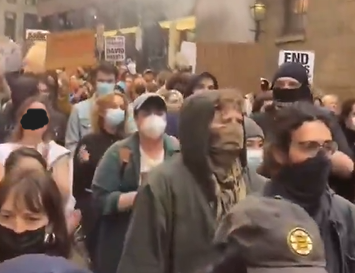
It’s hearings season at the State House, so this is when we put together testimony on bills that particularly relate to privacy, surveillance and the Fourth Amendment. But first, a little history on the issue of face masks and privacy.
Before wearing a surgical mask became politicized as “a thing woke liberals do,” the Boston police, in fall 2019, tried to criminalize the wearing of masks in public without criminal intent. We objected, and testified in masks, because wearing a mask shouldn’t give discretion to police to launch in and arrest you. For some reason, though, by the spring of 2020 nobody was interested in banning mask-wearing.
In 2023-25, as the pandemic receded, and in response to the Gaza ceasefire protests, elected officials also began dusting off mask bans as a way to signal that they, too, found such protests unacceptable. Most notably, Gov. Hochul of New York, citing anti-semitism concerns tried hard to revive a ban (Our national coalition joined NYCLU in opposing it). Police would love these bans to pass, because it’s a lot easier to identify people if they’re not wearing masks, whether you use facial recognition software or not.
Most recently, the Trump administration is trying to require both universities and local governments to hand over drone and camera data of protests, presumably so that the administration can then use facial recognition software to identify unmasked people engaging in disfavored activities as well as crimes. In the Los Angeles area this week, the federal government has directly intervened to conduct aerial surveillance of protests using drones, and connectedly, President Trump posted on June 5 on Truth Social, “From now on, MASKS WILL NOT BE ALLOWED to be worn at protests. What do these people have to hide, and why???”
Inappropriate aerial surveillance of protesters may escalate still further, into violence. Regarding this coming weekend’s military parade in DC, the President has threatened any protesters with “heavy force.” Abroad, U. S. military drone technology has already been used in attacks on weddings, funerals and hospitals. Even domestically, lethal extrajudicial attacks on members of disfavored groups and people accused of violence are not unknown. The guardrails intended to protect us at home from our own government are getting weaker. The new facial recognition and AI-based targeting capabilities of military technology mean that today’s protesters face risks of identification that previous generations of protesters did not. The First Amendment, of course, ought to restrain the President from escalating further; but he already has a track record of only refraining from violating the law, where he faces a realistic chance of personal legal or financial consequences. Who among us can be fully confident that he will rein himself in?
Our own organization has always been explicitly peaceful and law-abiding, but even peaceful people have an interest in being able to protest or just to move around in public, without having their facial features fed into a federal facial recognition algorithm for them to be investigated as an opponent or dissenter and “doxxed”, “swatted”, harassed or prosecuted. Both the Supreme Court and Massachusetts’ Supreme Judicial Court have now recognized that people have a privacy interest in the pattern of their movements in public. So we have good grounds for saying that masks are an important tool for the privacy-conscious.
To sum up, people can have perfectly valid reasons for masking, even if they have no health conditions that a mask would help with. Because of the risks to people’s privacy alone, we should not in any municipality in Massachusetts, at any point, be requiring people to unmask in public. We strongly support a favorable report for S. 1427‘s ban on municipal or board of health measures that prohibit “the wearing of face coverings for protective or medical use in any indoor or outdoor space open to the public.”
Our full testimony to the Joint Committee on Municipalities and Regional Government is here:

