On August 27, after a lot of work from Digital Fourth members, ACLU’s Kade Crockford, the Muslim Justice League’s Fatema Ahmad, and computer scientist Nasser Eledroos, Boston City Council formally voted to reject Boston PD’s second attempt in a dozen years to set up a permanent social media surveillance framework for the residents of Boston and surrounding communities. The technologies at issue were SourceFeed, SearchFeed and Chorus Intelligence Suite. Councilors Breadon, Louijeune, Mejia, Pepén, Weber and Worrell voted to reject the technology. Councilors Durkan, FitzGerald, Flynn, Murphy and Santana voted to accept it.
We’re setting out here the background on this issue, and what our volunteers have been doing on it. We’ve been around long enough in town to know that this isn’t BPD’s first effort to deploy this technology – and that the first effort failed spectacularly. In 2014 and 2015, BRIC, Boston PD’s DHS-funded intelligence arm, used Geofeedia social media surveillance with the aim of identifying potential Muslim terrorists. For years, BPD, through its intelligence arm BRIC, used keywords like “#MuslimLivesMatter” and “Ferguson” to collect the posts of local activists, leading to searches of completely innocent individuals, including Councilor Tito Jackson. They only abandoned it when the City Council found out. In fact, BPD has a long track record of suspicionless surveillance of activists like Veterans for Peace, Stop the Wars Coalition, Occupy Wall Street, Code Pink, Black and Muslim activists and now also, as we expected, pro-Palestinian protest groups, including those at local universities.
BPD claims to want to “identify pre-violent extremists”, but the police have no business surveilling such people’s communications. If they have probable cause that a particular individual is planning a crime, they can get a judge to approve a warrant for the person’s communications; they can even do it simply by asking the social media company, or by subpoenaing them. These kinds of social media surveillance software vendors are different. They surveil hundreds of networks at a time and millions of people’s communications, using AI to flag whatever they define as anomalous. When BRIC gathers records on individuals for whom there is no reasonable suspicion of their involvement in a crime, that violates the Fourth Amendment’s prohibition of “unreasonable searches and seizures”, as well as the federal privacy regulation, 28 CFR Part 23.20, that is supposed to prevent BRIC from doing this kind of thing.
On August 11, our volunteer co-chair Julie participated as an invited expert on a panel at a Committee hearing, where she described various surveillance technologies of concern that are used by the Boston Police Department (BPD) and BRIC without any warrant based on particularized suspicion. She discussed how an executive order is demanding that the federal government eliminate the data silos mandated by the National Data Privacy Act of 1974, to merge state databases into a master database being created by Palantir, a company notorious for its dystopian surveillance and highlighted how DHS has forced universities to share data on its students. Julie drove home the threat of searches and seizures based on expression of opinions that contradict current policies of the United States in social media or in the press, giving examples of students apprehended by ICE, including Rümeysa Oztürk of Tufts University.
Also testifying at this hearing was our member Fiona from Smith College. She described the danger posed by the pilot contract that BPD has with the ALPR company, Flock. Fiona discussed how the national database of license plates captured countrywide was used by a Texas sheriff to track a woman seeking an out-of-state abortion and the fact that the Flock database has been accessed by the federal government. As a member of Smith Students for Reproductive Justice, Fiona said that she saw privacy protection as paramount in ensuring reproductive autonomy. She emphasized that access by other states and the federal government to databases generated by surveillance technology used by the BPD also threatens the freedom of political activists, protesters and immigrants.
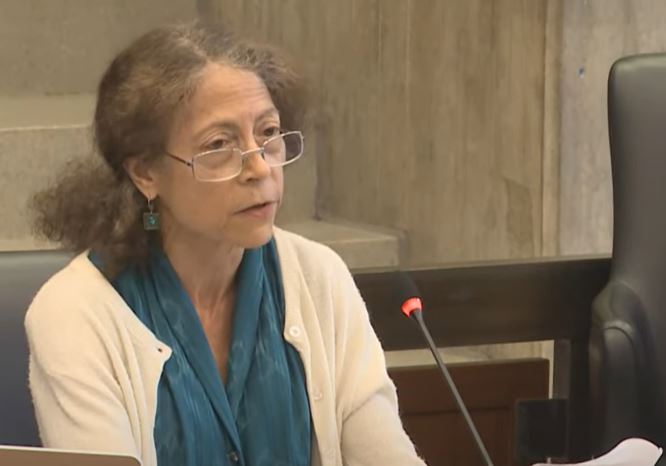
On August 12, Julie was also a panel expert at a Committee hearing dedicated to discussing the three social media surveillance tools, SourceFeed, SearchFeed and Chorus Intelligence Suite. Back in October 2024, BPD decided to use an “exigent circumstances” exception in the Surveillance Oversight Ordinance, to adopt social media surveillance without either notifying the Boston City Council or submitting an impact report within the 30-day time frame required by the Surveillance Ordinance. SourceFeed and SiteFeed are especially intrusive because they involve chat surveillance on a number of platforms. If our DHS-funded regional systems flag people without reasonable suspicion as “pre-violent extremists”, she argued, the federal government’s elimination of data silos could easily give them those locally collected leads. Julie emphasized that the DOD’s use of social media surveillance failed to notice Jack Teixeira as he was leaking classified information on Discord and that in 2022, the BPD did not even show up when notified about a demonstration by the Patriot Front, a known violent group in Boston, and a Black man filming the event was attacked. The plain fact is that, as we’ve been observing for a dozen years, trying to detect terrorist attacks in advance on social media doesn’t work. The signal-to-noise ratio is impossible to get around, no matter what AI-driven tools you deploy. The best such systems can offer is easier access after an attack to the social media accounts of an already-known attacker – but that means that by definition, the collection wouldn’t be under “exigent” circumstances intended to prevent immediate loss of life and limb.
One Digital Fourth member, who is a graduate student at Boston University, gave powerful testimony at a second hearing on Social Media Surveillance on August 19, saying that in the past the BPD has surveilled political groups and that she feared that social media surveillance would target our most vulnerable residents including immigrants and activists and homeless people whose posts would be screened to look for mental illness. Our member recalled the conversations that she has had with fellow Boston University students. Domestic students are fearful that exposure of their political affiliations could lead to them being denied opportunities. Foreign students are afraid that surveillance of their social media could lead to the revocation of their visas. Even staying wholly off social media doesn’t protect you. She said that this fear leads to censorship and that Boston’s tradition of free speech must be protected, especially as the federal government targets people for their opinions. At the end of the hearing, Julie told the committee that they had to reject the use of these technologies by BPD. She reminded the Committee that BPD had responded to a social media post made by the Muslim Justice League to its members encouraging their attendance at a City Council meeting by sending a massive police presence to the meeting, where they blocked entrances and behaved as though there was a threat when there was no evidence of one. Since the Committee has no way to enact guardrails to protect the public from abuses, this surveillance needs to be ended.
When the City Council discussed the matter on August 27, one of their main objections was procedural. BPD had so little respect for the Surveillance Oversight Ordinance that they didn’t follow it. They justified the “exigent” adoption of social media surveillance tools because of the pending federal elections, but the Ordinance requires that after thirty days, they either cease to use the tool, bring it to City Council, or apply to the Mayor for a temporary extension that also would be notified to City Council. Instead, it was July 2025 before they notified the City Council of their ongoing social media surveillance program. If BPD can’t respect the process of approval of the technology, how can Boston area residents trust that they can run the actual surveillance in a responsible and rights-respecting way?
When the Ordinance was negotiated, it contained flaws that stack the deck in favor of police continuing their use of surveillance technologies. It should be the case that, the City Council having now voted the technology down (again), BPD would not be allowed to use it. Instead, their use of it has been delayed, and more work is needed to stop it. The Ordinance says:
“If the City Council does not approve the use of the proposed new surveillance capabilities, the request shall be sent to the Surveillance Oversight Advisory Board who will make recommendations to the Mayor. Subsequent to receiving the recommendations from the Surveillance Oversight Advisory Board, the Mayor may at their discretion resubmit a modified request to the City Council for approval.”
This is the first time this procedure will be used.
The Surveillance Oversight Advisory Board is a five-member body consisting of a City Councilor chosen by the City Council President (currently Ruthzee Louijeune, who voted against this technology); a representative of the MA ACLU (currently Chris Conley); a representative of the Boston Police Commissioner (currently Teresa Anderson); and two representatives chosen by the Mayor, including at least one academic expert (currently Ân H. Lê and Hilary Robinson).
In the event the Mayor chooses to resubmit a modified request to the City Council, the same process would apply again, where the Council would have 60 days to conduct a review and take a vote on whether to approve the request. So, our next task as advocates is to work to ensure that the Advisory Board’s recommendation on this technology is negative.
We have managed fine since 2016 without Boston PD contracting with a third party vendor to surveil our social media. We are blessed with historically low crime rates. The only threat Boston’s elected officials should be worrying about is what our local police and the federal government will do with this data if BPD collects it.