Categories
Mission News

Trump Admin Directs Boston’s JTTF To Investigate “Antifa” Protests

On September 25, 2025, the President issued an order, NSPM-7, directing the Joint Terrorism Task Forces to coordinate a strategy to disrupt “antifa” organizations and nonprofits that advocate for “anti-Americanism, anti-capitalism, and anti-Christianity; support for the overthrow of the United States Government; extremism on migration, race, and gender; and hostility towards those who hold traditional American views on family, religion, and morality.”  ACLU just released a useful analysis of it, here.

Just in case any readers mistakenly thought that this new strategy was aimed only at spying on those planning or committing acts of violence, the President supplemented his order with a September 26 article, Democrats’ Unhinged Crusade Against ICE Fuels Bloodshed, containing a list of Democratic elected officials who had suggested publicly that his administration’s acts were authoritarian, fascist, Nazi, or Gestapo-like, and describing such suggestions as a “battle cry for violence.” That same day, DHS published a memo, DHS Is Fighting Back Against Antifa Violence, that included as an example of such violence, Democratic members of Congress attempting to exercise their legal right to conduct oversight visits of ICE facilities. On October 1, DHS and FBI circulated a joint intelligence bulletin to all law enforcement agencies in the country, Domestic Violent Extremists Pose Increased Threat of Violence to ICE Facilities and Personnel, arguing that previous attacks “took advantage of First Amendment-protected activity,” and therefore making a case for pro-active monitoring of protests against ICE. In advance of Saturday’s expected nationwide “No Kings” rally against the administration, House Speaker Mike Johnson has described it as a “hate-America” rally that would draw “the pro-Hamas wing” and “the antifa people.”

We should not deceive ourselves here. In the eyes of this administration, all Democrats, and all Republicans who dare to cross or even criticize the President, are now “antifa” — no matter how lawful, peaceful or reasonable their opposition is. This is a coordinated administration effort to depict all opposition to the administration as an appropriate target for DHS and FBI surveillance, spanning the whole range from mere verbal criticism through to actual, though thankfully rare, acts of violence. It won’t matter to Patel’s FBI or Noem’s DHS how much you support the police; if you cross this administration, it won’t matter even if you are the police.

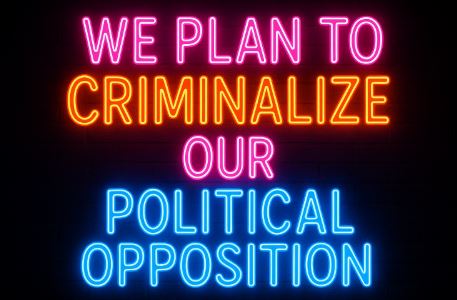
This is no longer about “supporting public safety” by giving law enforcement every possible tool. This is about whether the tools previously given to law enforcement will be illegally used to criminalize political opposition. And the administration might as well right now be holding up a gigantic neon sign, saying, “We Plan To Criminalize Political Opposition.” Those going to the No Kings protest this weekend should plan accordingly.

And for those who think that, while the Trump administration might feel this way, Boston’s Joint Terrorism Task Force and Boston PD would never, here’s the actual front cover of the Boston Police Patrolmen’s Association’s newsletter “Pax Centurion” from their now memory-holed fall 2018 issue, which contained a vile and lengthy poem identifying as “antifa” undocumented immigrants, socialists, liberals, students, and anybody who took a knee to protest police violence:

Want to do something about surveillance?

  • MASSACHUSETTS RESIDENTS: Call the Joint Committee on Public Safety and Homeland Security at the Legislature at (617) 722-2020, ask to speak to House Chair Rep. Daniel Cahill, and say that you’d like his committee to vote out favorably H. 2687, “An Act relative to protecting Massachusetts residents against federal government surveillance.”
  • BOSTON RESIDENTS: Call the Police Commissioner’s office at (617) 343-4500, tell them that you oppose the deployment of surveillance technologies against people organizing or attending protests, and ask what Boston PD’s response is to these federal instructions to use counter-terrorism powers against Boston residents for expressing First Amendment-protected speech.
  • CAMBRIDGE RESIDENTS: Call the office of City Manager Yi-An Huang on (617) 349-4300, and tell him that in light of what the Trump administration is doing, you oppose allowing Cambridge PD to fly drones over protests, deploy Flock Safety security cameras that DHS can access, and participate in the Joint Terrorism Task Force.
  • OTHER CITIES AND TOWNS: Email your questions and concerns here.
Categories
Uncategorized

Understanding Fusion Centers

Our local fusion center, BRIC, has been at the core of police efforts to surveil and suppress social movements for over a decade. And, since 2012, we’ve been calling them out on their abusive and un-Constitutional practices.

This October 30, please join us for a livestreamed discussion on fusion centers, with Boston City Councilor Ricardo Arroyo, law student Dani Hargus, and journalist Emma Best, moderated by our own Alex Marthews!

Categories
Mission News

Belgian Police Overwhelmed By…Mass Surveillance?

Lest_darkness_fall_holt

Buzzfeed’s Mitch Prothero reported on the day of the Brussels attacks that “Belgian Authorities [Are] Overwhelmed By Terror Investigations“. He quotes a “Belgian counterterrorism official”, talking prior to the attacks, as having told him that:

[D]ue to the small size of the Belgian government and the huge numbers of open investigations — into Belgian citizens suspected of either joining ISIS, being part of radical groups in Belgium, and the ongoing investigations into last November’s attacks in Paris, which appeared to be at least partially planned in Brussels and saw the participation of several Belgian citizens and residents — virtually every police detective and military intelligence officer in the country was focused on international jihadi investigations. “We just don’t have the people to watch anything else and, frankly, we don’t have the infrastructure to properly investigate or monitor hundreds of individuals suspected of terror links, as well as pursue the hundreds of open files and investigations we have,” the official, who spoke on condition of anonymity because he was not authorized to speak to the media, said. “It’s literally an impossible situation and, honestly, it’s very grave.”

This icorroborates a major part of this blog – and our group’s – analysis of the surveillance state: That it generates so many false leads that it drowns law enforcement in data they can’t reasonably analyze or follow up on.

As a comparison, consider this comment from Michael Downing, deputy LAPD police chief and head of their counterterrorism unit, in 2012:


“[suspicious activity reporting has] flooded fusion centers, law enforcement, and other security entities with white noise; [the profusion of SAR reports] complicates the intelligence process and distorts resource allocation and deployment decisions.”

Categories
Mission News

Levitating the Pentagon Is Now A Terrorist Act

rainbow-family

Back in 1967, the much-missed Abbie Hoffman and several hundred of his friends hatched a plan to exorcise and levitate the Pentagon, so that they could end the war in Vietnam. They meticulously went through all the steps for requesting a permit (including negotiating the proposed levitation down to three feet, from the initially suggested 300 feet). Most amazingly of all, to our tired War-on-Terror eyes, they were allowed to go through with it, albeit with several thousand US troops and a couple hundred US Marshals standing ready in case of chaos.

Authoritarians of both major parties will be happy to hear that today’s law enforcement won’t stand for such peaceful acts of political theater. At a time when the newspapers are dutifully parroting the paramount need for a Democratic President to bomb ISIS so hard that it will make the rubble bounce, our domestic law enforcement agencies and private security companies are getting floods of easy money to deal with the devastating terroristic threats posed by people who drop glitter or take photos of factory farms or who hold hippy parties in the woods.

Pity, in this last context, the Rainbow Family of Living Light, who make the mistake of “stressing non-violence, peace and love.” We Are Change reports that Missoula’s police chief has applied for a grant from DHS (who else?) to purchase a mobile command unit to spy on the Rainbow Family as an “extremist” organization. One of its gatherings was described as “rowdy” and as “creat[ing] a mess that [needed] to be cleaned up”. If that makes you an extremist, then based on the appearance of our toy room I appear to have two domestic extremist seven-year-olds; maybe I should be applying for a quarter-million dollar grant from DHS myself?

My goodness gracious. Well, the last thing we Americans want is any rowdiness. Leave that to the Canadians, or possibly the British. We, unlike them, are sober and obedient people who dutifully obey orders from the powers that be. It’s the only safe thing to do in this post-9/11 world.

Categories
Mission News

Our New Bill H. 2170 Mandates Police Bodycams, Protects Data

"Our police department in Lynn, MA likes both kinds of music - country AND western..."
“Our police department in Lynn, MA likes both kinds of music – country AND western…”

When Michael Brown was shot in Ferguson, MO, there was no video of it. When Denis Reynoso was shot in Lynn, MA, there was no video of it. But what if there had been? And what if police bodycams could significantly reduce incidents of use of force by police?

Responding to this need, Digital Fourth took model legislation developed by the Harvard Black Law Students Association that mandates bodycams for police departments, modified it for Massachusetts, and got a bill filed on Beacon Hill. This session was the first time our gallant volunteers have tried anything like this, and we got a strong response. Sen. Jamie Eldridge filed the bill in the Senate; Rep. Denise Provost filed it in the House; and it has already attracted as cosponsors Rep. Benjamin Swan (D-Springfield), Rep. Mary Keefe (D-Worcester) and Rep. Byron Rushing (D-Boston).

The bill is a result of months of consultation with interested police departments and grapples with some difficult issues – how would bodycam data be used? When would officers be required to record? What about the consent of the people being filmed? It sets up a blue-ribbon committee to review traffic stops, pedestrian stops, and bodycam footage, requires police officers to carry bodycams in almost all circumstances, and sets strong controls on the use and dissemination of the footage.

As this appears to be the only bodycams bill that got filed in the 2015-16 session, we believe that our bill represents the best chance of fostering a discussion about reducing on-the-ground unreasonable searches and seizures – the bread and butter of the Fourth Amendment – and that it could substantially improve relations between the police and communities of color in particular. Community-police relations directly affects those working on policy initiatives: One of the people advising on our bill, Segun Idowu, chairman of the Boston Police Cameras Action Team, was arrested at a Black Lives Matter protest and is currently facing trial.

“Our research, inspired by current events, confirms that community/police relations may be improved with the use of this technology, as bodycams will provide a truth that has no color,” said McKenzie Morris, President of the Harvard Black Law Students Association. “This legislation, albeit a first step, is a necessary endeavor for the pursuit of transparency and accountability in policing.”

Categories
Mission News

Every Car, Everywhere: The DEA Tracks Where & When You Drive

alpr_cartoon

For who-knows-how-many years, the Drug Enforcement Administration has been using Automatic License Plate Recognition software to create a national database of the driving habits of ordinary citizens not suspected of a crime, according to documents obtained by the American Civil Liberties Union through the Freedom of Information Act. The documents describe the state of the surveillance effort as of 2009, leaving us wondering just how vast it could be today.

This vehicle tracking program originated near border crossings in the southwestern United States but has grown into a nation-wide project. It is a joint effort between the DEA and local, state, and federal law enforcement agencies throughout the United States. The surveillance program has been alluded to in Congressional testimony every once in a while through the years, but has yet to be fully understood. The documents released by the ACLU, despite being heavily redacted, shine some much-needed light on the interests and priorities of the DEA and federal law enforcement agencies in general. As of 2009, at least 100 license plate readers had been deployed in states like California, Arizona, New Mexico, Texas, Florida, Georgia, Nevada and New Jersey.

And we should be concerned. According to the ACLU:

These records . . . offer documentation that this program is a major DEA initiative that has the potential to track our movements around the country. With its jurisdiction and its finances, the federal government is uniquely positioned to create a centralized repository of all drivers’ movements across the country — and the DEA seems to be moving toward doing just that. If license plate readers continue to proliferate without restriction and the DEA holds license plate reader data for extended periods of time, the agency will soon possess a detailed and invasive depiction of our lives.

Categories
Mission News

Our New Bill, H2169, Reining In Militarization in Massachusetts

DemocracyLooksLike

Last month, we broke the news that even small towns in Massachusetts, like Rehoboth and Norfolk, were getting mine-resistant armored vehicles for free from the federal government, and had no good answer for why they needed them.

Last Friday was the deadline for filing bills for the Massachusetts legislature’s 2015-16 session, and we took the opportunity to draft a solution to the state’s police militarization problem.

Sponsored by Rep. Denise Provost (D-Somerville), our bill doesn’t ban police departments altogether from getting military-style equipment. What it does is forbid them from getting them for free, either from the federal government or as a gift from any third party. If they want to get military equipment (including stingrays or drones), the mayor and city council (in a city) or the selectmembers (in a town) have to vote publicly to approve that purchase, in effect forcing the purchase to come out of municipal funds.

Right now, the process is not democratic. The federal surplus programs are a remote corner of the federal budget, and their costs are a rounding error in DC. But to the taxpayers of a town like Rehoboth, it makes a big difference whether it’s them or the feds paying for a $700,000 MRAP.

Categories
Mission News

Should We Police Threats On Social Media?

keyboard-commando

The United States has a well-developed jurisprudence for dealing with people who make threats. The default presumption, thanks to the First Amendment, is that any speech, even speech that is frightening, prejudiced or factually wrong, is legal. Even a generic desire for the President to die has First Amendment protection. The key precedents here are Watts v. United States and Brandenburg v. Ohio, both from 1969. In Watts, an 18-year-old remarked during a rally against the draft that:

“They always holler at us to get an education. And now I have already received my draft classification as 1-A and I have got to report for my physical this Monday coming. I am not going. If they ever make me carry a rifle the first man I want to get in my sights is L. B. J.”

The ruling suggested that this was protected as merely ‘a kind of very crude offensive method of stating a political opposition to the President’, of a kind still very familiar to us today. Those prosecuted for threatening the President over the last few years have typically had additional evidence of actual conspiracy to commit murder.

In Brandenburg, a KKK leader’s advocacy of ethnic violence was ruled to be protected by the First Amendment, because it was not “directed to inciting” or “likely to incite, imminent lawless action.” There must be some specificity as to the time that the lawless action is to occur; it cannot simply be a generalized articulation of the need for violence at some future time. It must be, in other words, a so-called “true threat.”

These rulings have stood essentially unmodified for nearly half a century. They are also a lot more protective of threatening speech than most people, including surveillance state employees, casually assume. One result of that assumption is that surveillance agencies pro-actively monitor social media, and open investigations on the basis of First Amendment-protected threats they encounter, when the constitutionality of doing so is at best highly suspect.

Categories
Mission News

It Takes A Massive Surveillance Apparatus To Hold Us Back: Fusion Centers, Ferguson and the Deep State

Dime-Fasces

Here’s a question: How much of a national security threat are people protesting the non-indictment of Ferguson police officer Darren Wilson for killing Michael Brown?

If you answered, There’s no national security threat; they’re exercising their First Amendment rights, which should be celebrated, then you’re obviously a pre-9/11-American, which is enough to get you disinvited from the major TV propaganda shows.

Local news media reported on the Black Lives Matter protest in Boston, and noted, without really thinking about it, that “the state police Commonwealth Fusion Center monitored social media, which provided “critical intelligence about protesters’ plans to try to disrupt traffic on state highways.” It didn’t really register because journalists are mostly not watching fusion centers like we are, and aren’t seeing them come up again and again and again and again, lurking at the edges of stories about free speech and national security, and policing the boundaries of what is acceptable to say.

Think, then, of fusion centers as state-based NSAs overseen loosely by the Department of Homeland Security. Set up after 9/11 to provide “joined-up intelligence” and thwart terrorist attacks, they quickly found that there just wasn’t enough terrorism of the kind not ginned up by government informants themselves to sustain 88 separate local antiterrorism centers in addition to the NSA, FBI and CIA. So they expanded their definition of terrorism to cover many other things, which in Massachusetts have included harassing peaceful activists and elected officials while missing actual terrorist plots, and now, for lack of anything better to do with their tax dollars, vetting licenseholders for marijuana dispensaries and fostering anonymous threat reporting in public schools.

We have advocated against fusion centers for a long time. Last week, we received the results of a FOIA request to Massachusetts’ Commonwealth Fusion Center that throws more light on the kind of information they hold, and the kind of society that is being constructed without our consent.

Categories
Mission News

State Report Tells Schoolkids: Inform, Conform, and Trust the Police

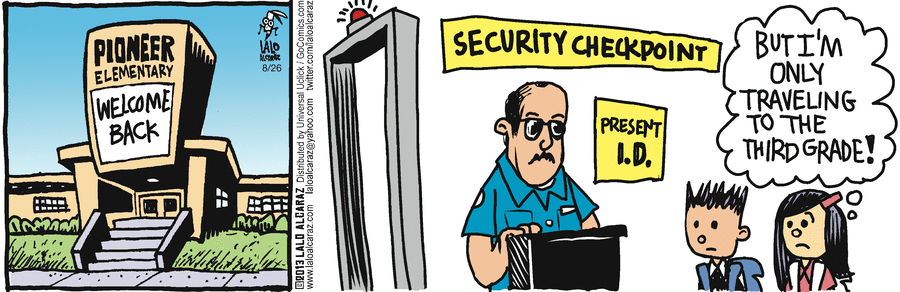
"La Cucaracha", August 26, 2013, by Lalo Alcaraz
“La Cucaracha”, August 26, 2013, by Lalo Alcaraz

Following on from the Sandy Hook school shooting, the “Massachusetts Task Force on School Safety and Security” released a report in July. As you’d expect from a report written with plenty of police input and none from the civil liberties community, it recommends changes that are highly intrusive, probably ineffective, definitely expensive, and likely to benefit police more than they benefit students.

Of course, that’s not how it’s being reported. Local papers, including my own, are portentously explaining how this is all “for the kids” and will “keep them safe” (I’d link to the Belmont Citizen-Herald’s exhaustive coverage, but it’s not up yet).

The most important thing to understand regarding school shootings is that school districts can’t prevent them. I wish they could, but they can’t. School shootings happen far too much in the US, largely because we spend too little on mental health services and allow, as a matter of constitutional principle, broad access to guns. School shootings also tend to happen more in rural and suburban districts where the schools are pretty much the only place that will grab the attention of the whole community.

Nothing school districts can do will change these things. However, in fear that they ought to be doing something, it’s very possible for school districts to misdirect funds better spent on education, and impose inappropriate systems of surveillance and control.

Let’s look anew, with a critical eye, at what’s being suggested.