Recently, Cambridge residents have been receiving communications in their mailboxes that new “Flock Safety” cameras are being installed in their neighborhoods.
Flock Safety (“Protect Your Community With 24/7 Coverage That Never Sleeps!”) is a surveillance company which produces and installs, among other products, cameras with automatic license plate reader (ALPR) capabilities. Flock is marketed as an all-encompassing “privacy solution […] boosting efficiency and reducing crime” for municipalities.
There are, however, serious privacy concerns with Flock’s systems. Despite months of denying contracts with federal agencies, Flock recently revealed that it has a contract with Customs and Border Patrol (CBP) and shares ALPR data without the consent of local officials. This week, it was also revealed that they had been sharing data with ICE, Homeland Security Investigations, the Secret Service and, for good measure, NCIS. Due to the company sharing data in violation of Illinois law, the state of Illinois recently terminated their contracts with Flock. After Evanston, IL, ordered Flock to shut down its use of ALPR cameras in the city, Flock reinstalled the cameras without permission, prompting Evanston to send a cease-and-desist letter. This week, Eugene, OR, also paused its Flock deployment as a result of privacy concerns.
As other states and municipalities reckon with Flock’s dishonest data sharing policies, Cambridge should take a long look at their own contract. This is the state of play in Greater Boston for now, as far as we know. The City of Boston launched a pilot contract with Flock in 2024, but has not yet, to our knowledge, proceeded to a full rollout. Flock cameras are appearing in Brookline and on the Watertown-Waltham line. Cambridge City Council, at the urging of Cambridge PD and embattled Councilor Paul Toner, approved Flock Safety for use in February 2025, and Flock opened an office in Boston in August 2025. Now, resistance is mounting in the Greater Boston Area due to concerns about data sharing, and Cambridge residents are being confronted with the implications of Flock in their own neighborhoods.
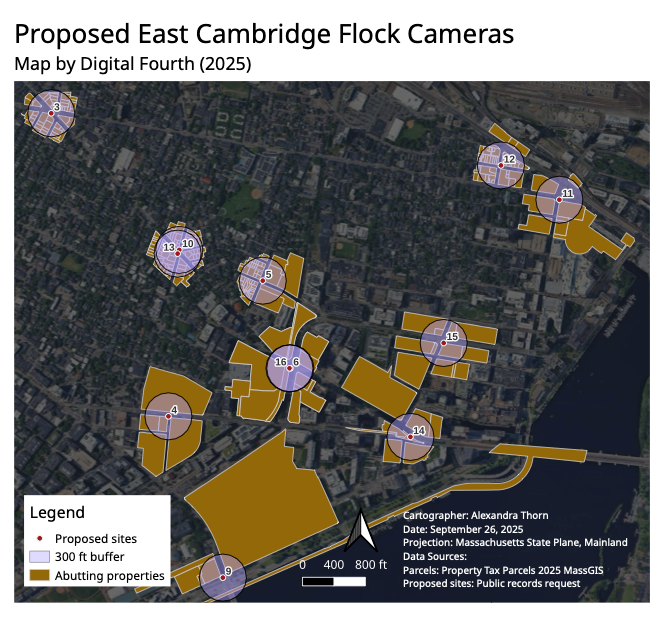
So far, 16 Flock ALPR camera locations have been proposed in Cambridge (the blue pins):

The densest deployment is planned for East Cambridge, near the public housing at Newtowne Court, Washington Elms and Roosevelt Towers, as well as Kendall Square and MIT. The other proposed locations are on major thoroughfares into and out of Cambridge, including nearly all routes of travel between Cambridge and Boston. This raises the concern that it will become very difficult for local residents to move about without having their license plate information, and thereby in many cases their patterns of life, captured.
Depending on the city’s contract with Flock relating to data retention, these residents’ patterns of movement may be visible to both the Cambridge Police Department and other agencies using Flock’s database. This is particularly concerning because Flock has developed an AI tool which reports suspicious vehicle movement patterns to local law enforcement. This is to say, artificial intelligence may have a hand in not only assisting police with searching networks for particular crimes or “hits,” but in deciding what is suspicious in the first place and flagging potentially innocent residents based on algorithmically determined criteria. Citizens should not be subject to the whims of an algorithm determined by a private company whose policies are not transparent or subject to the same rigorous checks that a government administration would be. Flock has given Cambridge no reason to trust in the idea that their algorithms are effective and unbiased, and has in fact provided more reason to suspect the contrary.
There’s a further issue. The City of Cambridge Surveillance Use Policy directs the City to pay attention to whether any communities are being “disproportionately impacted” by the deployment of any surveillance technology, especially “low-income communities, communities of color, or any community that is marginalized in the City.” Based on the proposed camera locations, it’s obvious that the movement patterns of residents of Strawberry Hill and West Cambridge traveling, for instance, to Harvard Square, would not be as regularly captured as would the movements of East Cambridge residents. The City has not considered whether there are disproportionate impacts of this kind; the Council, in approving it, relied simply on a declaration by Cambridge PD that there weren’t any.
A key privacy practice is data minimization: Limiting data collection to the minimum required, and not retaining data for longer than it is required. Flock’s website discloses that the local law enforcement agencies that contract with them may store data themselves, but Flock itself stores all license plate data for 30 days. As a result, in accordance with their data sharing record, Flock data may be visible for a significant window to out-of-state law enforcement, Immigration and Customs Enforcement (ICE), CBP, the Department of Homeland Security, or other federal agencies, either through the pilot data-sharing scheme Flock now claims to have suspended, or through requests by federal agencies to local and state law enforcement who themselves have Flock contracts.
Federal agencies may also have the opportunity to access Flock ALPR data through the Boston Regional Intelligence Center and through informal favors granted by local members of the Joint Terrorism Task force, which has recently been directed by Trump in a presidential memorandum to conduct investigations of groups which espouse “anti-fascist,” “anti-capitalist,” “anti-American” or “anti-Christian” viewpoints. The actions of the current federal administration make it even more urgent to protect the sensitive data of vulnerable Cambridge residents, including immigrants, politically active people, and those who express views that might be classified under these dangerously loose categories. Anything that requires the use of a car in certain areas of Cambridge has the possibility of being tracked. Whether residents choose to exercise their free speech by attending a protest, accessing reproductive care, or simply moving about, Flock’s license plate readers may be storing that data, exposing it to federal search, and potentially using it to draw conclusions about the vehicle driver’s future potential to commit crimes. For example, many vehicle going into and out of Cambridge Health Alliance’s Windsor Street Care Center, which offers reproductive healthcare services, would be in Flock’s databases.
Data stored is always data that may be used. Any data stored with Flock is not safe. Even if the City of Cambridge specifies that they do not want the ALPR data that they store to be accessed by federal law enforcement, there is no guarantee that Flock will successfully prohibit access by federal law enforcement to their own systems directly in the absence of the consent of the city of Cambridge, especially considering their recent record of lying to cities about their data sharing practices. What’s more, federal agencies can always subpoena Flock.
We are currently advocating for Cambridge to terminate its arrangement with Flock, along with many other Cambridge residents, local advocacy groups, and MIT professors. As is all too common when it comes to local surveillance technology deployments, notifications on the proposed Flock camera deployments have been relatively under the radar, but progress has been made in the direction of an examination of Flock’s data sharing policies. Recently, all Cambridge city council members voted in favor of taking a second look at the deal with Flock that they approved in February, but it was specified that this review was not expected to result in abandoning the contract altogether.
During this meeting, Councilor Jivan Sobrinho-Wheeler called attention to the funding source for the Flock cameras being deployed in Cambridge. They would be paid for largely by the federal Urban Area Security Initiative (UASI) grant, meaning that Cambridge would technically only be leasing them. This system of funding would place very little control over Flock’s data storage systems in the hands of the Cambridge city council, and potentially open the door to more federal abuses of the type already being perpetrated by Flock in other states. The unexpected, and probably short-term termination of UASI funds by the Trump administration is not expected to change the City’s decision.
Approval of the specific locations for the cameras was included in an agenda for a recent Pole and Conduit committee meeting, but was later removed. The next committee meeting is scheduled for Thursday, October 23, 2025, but it is unclear whether or not Flock will be discussed.
As the members of the Cambridge City Council and the committee make time for community feedback and consider recent developments with Flock, Cambridge residents have a vital opportunity to make their opinions heard. Cambridge residents should take advantage of their right to free speech by reaching out to their city council members on this topic, all of whom are up for re-election. As informed and engaged members of the community, Cambridge residents should not be willing to accept the creeping spread of civil rights violations associated with the surveillance state.
Note: This article was written with assistance from Digital Fourth volunteers Alex M., Alex T. and Julie B.