Categories
cameras Mission News Police body-worn cameras

Lack of Police Oversight Board Delays Body-Worn Camera Adoption in Somerville

[Narrative reposted by permission of Derrick Rice]

On Friday April 24th, a working group of Somerville residents concerned about body-worn cameras [“BWCs”] delivered this letter to City Council, co-signed by 22 community leaders and organizations. The letter outlines the gaps between widely recognized BWC policy requirements and the City of Somerville’s proposed BWC Surveillance Technology Impact Report (“STIR”), which functions as the legally binding use policy). It also emphasizes the importance of developing a BWC use policy with public engagement and defining the policy prior to collective bargaining.

On Tuesday April 28th, we were sponsored by Councilor Scott to speak at City Council’s Legislative Matters Committee meeting. Derrick Rice presented, summarizing some of the policy concerns and emphasizing the procedural concerns. The Legislative Matters Committee then deliberated the BWC STIR. You can watch the video here (presentation @ 49m38s, deliberation @ 1h05m to 1h37m). 

Derrick: “From what we in the public are able to see, there is a real cause for concern in this moment. … We have six years of task forces studies in this council’s past deliberations have converged on a clear answer to the question of how body-worn cameras should be governed if adopted, yet we don’t see elements of that adequately represented in the STIR presented by the city. The city’s own studies and past commitments have led us to expect community transparency and input on this policy, yet we’re being caught off guard by the mayor’s request for funding and STIR approval prior to any public engagement. I am one of many people appealing to you to use your authority over the STIR to help ensure we meet these held standards of transparent policy and public engagement.”

Throughout deliberation, all councilors communicated some degree of apprehension with the BWC STIR. Ultimately, they agreed to hold the item in committee, effectively declining to seriously consider approval at this time. (Want to know what they said? See the addendum below!)

What’s Next

The City Council’s Legislative Matters Committee has opposed the BWC STIR for now, but Mayor Wilson’s administration could push for its approval at any time. We will be watching carefully to see if and how the City responds to our letter or changes its process with regard to collective bargaining negotiations and BWC policy.

In the interim, community members have circulated a variety of content regarding the consideration of Body Worn Cameras:

Somerville residents can sign up for future updates by filling out this form.

With neighborly love,

Derrick Rice (he/him)

e: local.derrick@rice.io

Want to be more involved? Have something to add? Spot an error? Please get in touch!


Addendum: What They Said

Here’s what the councilors on Legislative Matters had to say on April 28th: 

Councilor Mbah: “I’m a proponent of body-worn cameras, but now the more I hear about this conversation I just also want to make sure that those loopholes that continue to surface have to be closed. We have to do it right. So, you’ve really articulated a lot of stuff that is also — I mean, it almost feels like common sense. If anybody wants public safety, they should be able to accept those things. They should be able to accept that this is all about accountability”

Councilor Strezo: “I would like to have the administration respond about the concept — because there is a good point that is brought up — about the police oversight board. … The administration had to have seen this coming with the body-worn cameras talk. All the research that I’ve seen has mentioned that this is an important element to implementation of the body-worn cameras. We need that oversight board.”

Councilor Ewen-Campen: “This is different from every other impact report we’ve done because it’s the subject of collective bargaining. …  this council has an executive session — had conversations about this topic — but the public hasn’t seen any of that, right? …  I’m concerned about the kind of putting the cart before the horse; that it’s not come as a surprise to anyone that the use policy is really, really important to me, to my colleagues on the council, to the public, and to not be able to have a detailed conversation about it before we’re asked to approve it in public is really, really hard”, adding “given the budget conversations we’re having this year, I’m extremely apprehensive about that.”

Councilor Davis: “Aside from all of the sort of the tactical issues that are raised with trying to review a document that we can’t change that relates to some discussion that may be happening that we can’t really materially impact. — I guess I will repeat [Councilor Ewen-Campen] a little bit. — This is a backwards way of doing it.”

Councilor Scott: “As I look at the impact report, I am certainly in agreement that there are a few glaring omissions here. …  one thing I’m absolutely convinced of is that there is no pathway for this to be a beneficial technology implementation without meeting at least these baseline requirements that have been presented, both in the Good Counselors 2022 memo and the legion of sources that was cited here, which I do want to call out again, included the cop staffing study that the city paid for in 2022 that was done by an outside consultant that included a chief of police”, later adding “I firmly believe that we must have a civilian oversight body in order for this to be of any positive effect.”

Councilor Scott went on to clarify with Legislative Liaison Raddassi (representing the administration), that the city’s ongoing negotiations with the police unions will constrain what can or cannot be in the BWC policy. These are discussions that we — the public — have no transparency into, despite the clear impact it has on all of us.

Legislative Liaison Raddassi: “The collective bargaining agreement will set the limits of what can be included in a surveillance use policy. …Those conversations have been happening in executive session with this council around some of the policy considerations that councillors have raised. And so again, this STIR is based on the current body-worn camera policy because it’s basically the only thing we can debate about in public at the moment.”

Councilor Scott: “I think I heard, I just want to make sure I repeat accurately what you said, that the outcome of collective bargaining will serve as a top-end constraint over what could be pursued in terms of access and policies in that use policy.”

Legislative Liaison Raddassi: “Correct.”

Councilor Scott: “Okay. Well, from my standpoint, that’s just entirely backwards of where we should be doing this as a city. The city council has a very specific role in this process. … I am inclined not to support this in its current stance. I would encourage the city to go back and rethink their approach to this.”

Categories
cameras immigration News privacy

Cambridge Suspends Flock, But May Revive It Dec. 9

On Monday, October 20th, the Cambridge City Council voted to temporarily halt the city’s use of automatic license plate reader technology, including Flock Safety, because of concerns about privacy and data sharing with the federal government. 

Many community members offered oral public testimony, including members of Digital Fourth, the ACLU, collaborators, and other concerned citizens. Much of this testimony focused on issues with Flock Safety specifically, especially their issues with Flock’s recent history of sharing information with federal agencies. 

Members of the city council, including those who had voted in favor of moving forward with Flock Safety in February, were surprised and concerned by the issues with Flock Safety that were raised during public comment. Specifically, they were concerned by the idea that the information collected by Flock Safety cameras owned by Cambridge might be shared with Customs and Border Protection and Immigration and Customs Enforcement. Council Member Marc McGovern, who had initially voted in favor of Flock Safety in February, stated his concern about the testimony shared about the breaches of contract committed by Flock Safety against communities like Evanston, IL. McGovern said that “there are all sorts of loopholes in the control that we became more aware of over time.” 

After over an hour of public comment, the council voted unanimously to refer the issue to the Public Safety committee, and in the meantime, to suspend or revoke the use of Flock cameras. Many councilors expressed the desire to allow time for more public comment. 

The Cambridge Police Department has stated that none of the Flock Safety cameras are operational. Volunteers with Digital Fourth independently verified that the cameras have been removed. 

The governor’s thoughts on the development were shared in a recent CBS News article. She stated that “cameras are ubiquitous” and came out unambiguously in support of “responsible surveillance technology …when it comes to the investigation and deterrence of crime.” It remains to be seen what the Cambridge City Council and the Public Safety Committee will decide constitutes “responsible use.” 

Several members mentioned the possibility of working with a different automatic license plate reader company. However, recent reports have detailed issues of data sharing by other automatic license plate reader companies, as well. According to a recent report by 404 Media, an app recently demoed by Immigration and Customs Enforcement (ICE) allows officers to scan a license plate with their phones and cross-check it with millions of other records, like marriage records, license data, vehicle ownership, voter registrations, and ALPR data. This app partners with another ALPR company, Motorola Solutions. Though Flock has a particularly spotty record, when a municipal police department partners with an ALPR company, it is always difficult to confirm that the data collected by the cameras will not be used for purposes that the police department would not approve of. Even if an ALPR company seems to be using the data that they collect ethically at one point, this does not preclude them from changing their policies in the future. 

On December 9th, the city will discuss the Flock Safety at a Public Safety Committee meeting from 12pm-2pm. Invited panelists will include a Cambridge-based Digital Fourth representative, representatives from the ACLU, the Cambridge Police Department, and Flock Safety. 

As the Cambridge City Council prepares to turn over after the recent election, it is a vital time for privacy-concerned residents of Cambridge to make their voices heard. 

Categories
cameras Mission News

Let’s Stop Cambridge From Getting Flocked Up

Recently, Cambridge residents have been receiving communications in their mailboxes that new “Flock Safety” cameras are being installed in their neighborhoods. 

Flock Safety (“Protect Your Community With 24/7 Coverage That Never Sleeps!”) is a surveillance company which produces and installs, among other products, cameras with automatic license plate reader (ALPR) capabilities. Flock is marketed as an all-encompassing “privacy solution […] boosting efficiency and reducing crime” for municipalities.

There are, however, serious privacy concerns with Flock’s systems. Despite months of denying contracts with federal agencies, Flock recently revealed that it has a contract with Customs and Border Patrol (CBP) and shares ALPR data without the consent of local officials. This week, it was also revealed that they had been sharing data with ICE, Homeland Security Investigations, the Secret Service and, for good measure, NCIS. Due to the company sharing data in violation of Illinois law, the state of Illinois recently terminated their contracts with Flock. After Evanston, IL, ordered Flock to shut down its use of ALPR cameras in the city, Flock reinstalled the cameras without permission, prompting Evanston to send a cease-and-desist letter. This week, Eugene, OR, also paused its Flock deployment as a result of privacy concerns.

As other states and municipalities reckon with Flock’s dishonest data sharing policies, Cambridge should take a long look at their own contract. This is the state of play in Greater Boston for now, as far as we know. The City of Boston launched a pilot contract with Flock in 2024, but has not yet, to our knowledge, proceeded to a full rollout. Flock cameras are appearing in Brookline and on the Watertown-Waltham line. Cambridge City Council, at the urging of Cambridge PD and embattled Councilor Paul Toner, approved Flock Safety for use in February 2025, and Flock opened an office in Boston in August 2025. Now, resistance is mounting in the Greater Boston Area due to concerns about data sharing, and Cambridge residents are being confronted with the implications of Flock in their own neighborhoods. 

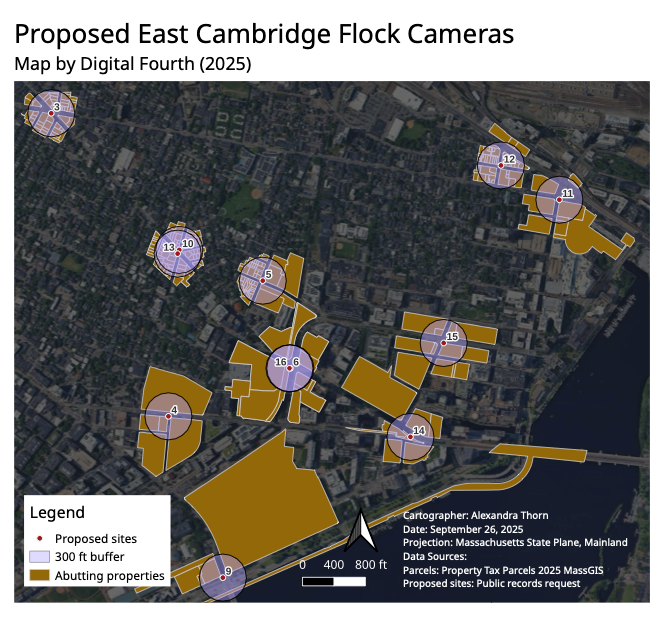
So far, 16 Flock ALPR camera locations have been proposed in Cambridge (the blue pins):

The densest deployment is planned for East Cambridge, near the public housing at Newtowne Court, Washington Elms and Roosevelt Towers, as well as Kendall Square and MIT. The other proposed locations are on major thoroughfares into and out of Cambridge, including nearly all routes of travel between Cambridge and Boston. This raises the concern that it will become very difficult for local residents to move about without having their license plate information, and thereby in many cases their patterns of life, captured. 

Depending on the city’s contract with Flock relating to data retention, these residents’ patterns of movement may be visible to both the Cambridge Police Department and other agencies using Flock’s database. This is particularly concerning because Flock has developed an AI tool which reports suspicious vehicle movement patterns to local law enforcement. This is to say, artificial intelligence may have a hand in not only assisting police with searching networks for particular crimes or “hits,” but in deciding what is suspicious in the first place and flagging potentially innocent residents based on algorithmically determined criteria. Citizens should not be subject to the whims of an algorithm determined by a private company whose policies are not transparent or subject to the same rigorous checks that a government administration would be. Flock has given Cambridge no reason to trust in the idea that their algorithms are effective and unbiased, and has in fact provided more reason to suspect the contrary. 

There’s a further issue. The City of Cambridge Surveillance Use Policy directs the City to pay attention to whether any communities are being “disproportionately impacted” by the deployment of any surveillance technology, especially “low-income communities, communities of color, or any community that is marginalized in the City.” Based on the proposed camera locations, it’s obvious that the movement patterns of residents of Strawberry Hill and West Cambridge traveling, for instance, to Harvard Square, would not be as regularly captured as would the movements of East Cambridge residents. The City has not considered whether there are disproportionate impacts of this kind; the Council, in approving it, relied simply on a declaration by Cambridge PD that there weren’t any.

A key privacy practice is data minimization: Limiting data collection to the minimum required, and not retaining data for longer than it is required. Flock’s website discloses that the local law enforcement agencies that contract with them may store data themselves, but Flock itself stores all license plate data for 30 days. As a result, in accordance with their data sharing record, Flock data may be visible for a significant window to out-of-state law enforcement, Immigration and Customs Enforcement (ICE), CBP, the Department of Homeland Security, or other federal agencies, either through the pilot data-sharing scheme Flock now claims to have suspended, or through requests by federal agencies to local and state law enforcement who themselves have Flock contracts. 

Federal agencies may also have the opportunity to access Flock ALPR data through the Boston Regional Intelligence Center and through informal favors granted by local members of the Joint Terrorism Task force, which has recently been directed by Trump in a presidential memorandum to conduct investigations of groups which espouse “anti-fascist,” “anti-capitalist,” “anti-American” or “anti-Christian” viewpoints. The actions of the current federal administration make it even more urgent to protect the sensitive data of vulnerable Cambridge residents, including immigrants, politically active people, and those who express views that might be classified under these dangerously loose categories. Anything that requires the use of a car in certain areas of Cambridge has the possibility of being tracked. Whether residents choose to exercise their free speech by attending a protest, accessing reproductive care, or simply moving about, Flock’s license plate readers may be storing that data, exposing it to federal search, and potentially using it to draw conclusions about the vehicle driver’s future potential to commit crimes. For example, many vehicle going into and out of Cambridge Health Alliance’s Windsor Street Care Center, which offers reproductive healthcare services, would be in Flock’s databases.

Data stored is always data that may be used. Any data stored with Flock is not safe. Even if the City of Cambridge specifies that they do not want the ALPR data that they store to be accessed by federal law enforcement, there is no guarantee that Flock will successfully prohibit access by federal law enforcement to their own systems directly in the absence of the consent of the city of Cambridge, especially considering their recent record of lying to cities about their data sharing practices. What’s more, federal agencies can always subpoena Flock. 

We are currently advocating for Cambridge to terminate its arrangement with Flock, along with many other Cambridge residents, local advocacy groups, and MIT professors. As is all too common when it comes to local surveillance technology deployments, notifications on the proposed Flock camera deployments have been relatively under the radar, but progress has been made in the direction of an examination of Flock’s data sharing policies. Recently, all Cambridge city council members voted in favor of taking a second look at the deal with Flock that they approved in February, but it was specified that this review was not expected to result in abandoning the contract altogether.

During this meeting, Councilor Jivan Sobrinho-Wheeler called attention to the funding source for the Flock cameras being deployed in Cambridge. They would be paid for largely by the federal Urban Area Security Initiative (UASI) grant, meaning that Cambridge would technically only be leasing them. This system of funding would place very little control over Flock’s data storage systems in the hands of the Cambridge city council, and potentially open the door to more federal abuses of the type already being perpetrated by Flock in other states. The unexpected, and probably short-term termination of UASI funds by the Trump administration is not expected to change the City’s decision.

Approval of the specific locations for the cameras was included in an agenda for a recent Pole and Conduit committee meeting, but was later removed. The next committee meeting is scheduled for Thursday, October 23, 2025, but it is unclear whether or not Flock will be discussed. 

As the members of the Cambridge City Council and the committee make time for community feedback and consider recent developments with Flock, Cambridge residents have a vital opportunity to make their opinions heard. Cambridge residents should take advantage of their right to free speech by reaching out to their city council members on this topic, all of whom are up for re-election. As informed and engaged members of the community, Cambridge residents should not be willing to accept the creeping spread of civil rights violations associated with the surveillance state.

Note: This article was written with assistance from Digital Fourth volunteers Alex M., Alex T. and Julie B.

Categories
cameras facial recognition Mission News

Don’t Ban Masks At Protests

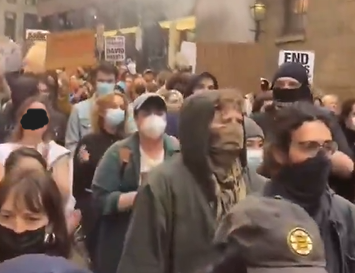
Most Boston ICE protesters know to mask up. The rest, we blur out for their safety.

It’s hearings season at the State House, so this is when we put together testimony on bills that particularly relate to privacy, surveillance and the Fourth Amendment. But first, a little history on the issue of face masks and privacy.

Before wearing a surgical mask became politicized as “a thing woke liberals do,” the Boston police, in fall 2019, tried to criminalize the wearing of masks in public without criminal intent. We objected, and testified in masks, because wearing a mask shouldn’t give discretion to police to launch in and arrest you. For some reason, though, by the spring of 2020 nobody was interested in banning mask-wearing.

In 2023-25, as the pandemic receded, and in response to the Gaza ceasefire protests, elected officials also began dusting off mask bans as a way to signal that they, too, found such protests unacceptable. Most notably, Gov. Hochul of New York, citing anti-semitism concerns tried hard to revive a ban (Our national coalition joined NYCLU in opposing it). Police would love these bans to pass, because it’s a lot easier to identify people if they’re not wearing masks, whether you use facial recognition software or not.

Most recently, the Trump administration is trying to require both universities and local governments to hand over drone and camera data of protests, presumably so that the administration can then use facial recognition software to identify unmasked people engaging in disfavored activities as well as crimes. In the Los Angeles area this week, the federal government has directly intervened to conduct aerial surveillance of protests using drones, and connectedly, President Trump posted on June 5 on Truth Social, “From now on, MASKS WILL NOT BE ALLOWED to be worn at protests. What do these people have to hide, and why???”

Inappropriate aerial surveillance of protesters may escalate still further, into violence. Regarding this coming weekend’s military parade in DC, the President has threatened any protesters with “heavy force.” Abroad, U. S. military drone technology has already been used in attacks on weddings, funerals and hospitals. Even domestically, lethal extrajudicial attacks on members of disfavored groups and people accused of violence are not unknown. The guardrails intended to protect us at home from our own government are getting weaker. The new facial recognition and AI-based targeting capabilities of military technology mean that today’s protesters face risks of identification that previous generations of protesters did not. The First Amendment, of course, ought to restrain the President from escalating further; but he already has a track record of only refraining from violating the law, where he faces a realistic chance of personal legal or financial consequences. Who among us can be fully confident that he will rein himself in?

Our own organization has always been explicitly peaceful and law-abiding, but even peaceful people have an interest in being able to protest or just to move around in public, without having their facial features fed into a federal facial recognition algorithm for them to be investigated as an opponent or dissenter and “doxxed”, “swatted”, harassed or prosecuted. Both the Supreme Court and Massachusetts’ Supreme Judicial Court have now recognized that people have a privacy interest in the pattern of their movements in public. So we have good grounds for saying that masks are an important tool for the privacy-conscious.

To sum up, people can have perfectly valid reasons for masking, even if they have no health conditions that a mask would help with. Because of the risks to people’s privacy alone, we should not in any municipality in Massachusetts, at any point, be requiring people to unmask in public. We strongly support a favorable report for S. 1427‘s ban on municipal or board of health measures that prohibit “the wearing of face coverings for protective or medical use in any indoor or outdoor space open to the public.”

Our full testimony to the Joint Committee on Municipalities and Regional Government is here:

https://warrantless.org/wp-content/uploads/2025/06/D4-Municipalities-testimony-on-masking-2025-06-12.pdf

Categories
cameras News

The Risks of Automated Traffic Enforcement

It’s hearings season at the State House, so this is when we put together testimony on bills that particularly relate to privacy, surveillance and the Fourth Amendment.

Today, we submitted comments in opposition to “An Act Relative To Traffic Regulation Using Road Safety Cameras” (S. 2344, H. 3754). In the 1980s, Massachusetts banned automated parking enforcement, out of concerns over driver privacy. Now, influential legislators like Sen. Will Brownsberger are trying to overturn that ban, with the unanimous support of the Cambridge City Council. Here’s part of what we wrote to the Judiciary Committee on this bill:

Data Sharing Concerns

Historically, lawmakers didn’t pass our traffic laws with the thought that one day, technological change would let them be universally, rigidly and digitally enforced. They didn’t know then that it’s possible now to search archived camera footage to form a pattern of drivers’ movements in public, or that license plate reading software, if applied to that camera’s footage, is now being trawled through by officers in red states, searching nationwide for women suspected of having had an abortion. We also now have a federal administration newly interested in making unrealistic deportation quotas, and therefore using camera networks to identify, track and deport immigrants. […] [N]othing you [i.e., the Legislature] do here can bind what police departments in other states lawfully ask a vendor for, or what DHS asks a vendor for. You can’t prevent camera companies from lawfully responding to lawful federal data requests. The only way, therefore, to prevent out-of-state AGs or DHS from accessing such data is to not collect it in the first place.

Racial Profiling Concerns

Some well-meaning activists and legislators hope that automated traffic enforcement will diminish racism in police stops. It’s true that racial profiling in Massachusetts traffic stops has been extensively documented. But speed cameras won’t necessarily reduce racial profiling, because it will still be police who buy, monitor and maintain the cameras, set the thresholds, choose where cameras are placed, and decide who gets arrested. In Washington, DC, when police shifted to automated enforcement, racial biases persisted. Cameras are a diversion from, not a solution to racism, and efforts to automate out the human element merely obscure it from view.

If we’re concerned about police hurting people in traffic stops, then rather than automating policing, one solution is to allow unarmed civilian parking and traffic enforcement, diverting that responsibility from police, as several jurisdictions are currently exploring.

Corruption Concerns

Cities and towns are interested in automated traffic enforcement for two reasons: To increase road safety, and to increase revenue. This bill contains a provision that reasonably limits the income that camera vendors take in (in Section 7(a)), but, by doing so, it increases the incentive for cities and towns to adopt such cameras for revenue generation purposes. In Florida, where automated cameras are permitted, the corruption this has produced has been so severe that it even led to the state having to dissolve one town’s government. So, if this bill is to pass, it should remove the financial incentives to cities and towns, by having all ticket revenues go into the state general fund.

We respectfully urge you to send this bill to study. [ ]

Sincerely,

Alex Marthews, Alexandra Thorn and Christine Felice, Digital Fourth volunteers.

For our full comments, see below: