[This alert is from The Black Response; Digital Fourth is a member of “Stop ShotSpotter Camberville,” a coalition of community groups opposed to this surveillance technology.]
“On Monday, May 11, 2026, at 5:30 p.m., the Cambridge City Council is scheduled to vote on a policy order to end the City’s use of ShotSpotter microphones and remove the devices from Cambridge neighborhoods.
ShotSpotter is a network of microphones installed across the Port and Riverside (Coast) neighborhoods (see ShotSpotter dashboard). The system is marketed as a technology that detects loud sounds and alerts police to possible gunfire.
However, during the April 29 Public Safety Committee hearing (video not yet available), it became clear to council members and attendees that ShotSpotter is continuously listening. The Cambridge Police Department explained that when ShotSpotter detects a gunshot, the company provides them with an audio clip containing one second before and one second after the sound. This raised significant concerns because the existence of audio from before the alleged gunshot indicates that the system is actively listening at all times. [Not only that, but ShotSpotter records continuously over a 48-hour period; Cambridge PD acknowledged that that was so, and that recordings from within that timeframe were “useful for evidence.” – Digital Fourth]
Boston University Professor Spencer Piston emphasized the distinction between continuous recording and the alert that the police eventually receive, noting that while ShotSpotter may not permanently store all audio, the technology still relies on constant monitoring in order to generate alerts. This raises serious concerns.
Additional concerns were raised about the structure and oversight of the program in Cambridge. The current ShotSpotter system is funded through a Department of Homeland Security (DHS) grant, the same federal department that oversees ICE. Harvard Law School Professor Mason Kortz testified that the City of Cambridge is not itself a party to the current ShotSpotter contract operating in the city. As a result, city officials have reportedly faced difficulties obtaining and reviewing the contract. Since we are not party to the contract, residents lack clear protections regarding how data may be accessed, shared, or used.
The ACLU of Massachusetts, represented by lawyer Gideon Epstein, explained why ShotSpotter appears inconsistent with the standards established under Cambridge’s surveillance technology ordinance, a framework the ACLU helped develop.
Taken together, these concerns paint a troubling picture. Cambridge’s use of ShotSpotter may create risks that sensitive surveillance data could be accessed by federal agencies, including ICE, potentially undermining Cambridge’s commitments as a sanctuary city and Welcoming Community.
Four of the five members of the Cambridge Public Safety Committee, Councillors Al Zubi, McGovern, Nolan, and Sobrinho-Wheeler, have sponsored and submitted a policy order for the Monday, May 11, 2026 City Council meeting to remove ShotSpotter from Cambridge. The ShotSpotter policy order is the second item on the agenda: POR 2026-98.
We encourage community members to sign up for public comment and send letters in support of the policy order and to attend the meeting if possible. Please join us in supporting this important step toward ending Cambridge’s use of ShotSpotter.
Recently, Cambridge residents have been receiving communications in their mailboxes that new “Flock Safety” cameras are being installed in their neighborhoods.
Flock Safety (“Protect Your Community With 24/7 Coverage That Never Sleeps!”) is a surveillance company which produces and installs, among other products, cameras with automatic license plate reader (ALPR) capabilities. Flock is marketed as an all-encompassing “privacy solution […] boosting efficiency and reducing crime” for municipalities.
There are, however, serious privacy concerns with Flock’s systems. Despite months of denying contracts with federal agencies, Flock recently revealed that it has a contract with Customs and Border Patrol (CBP) and shares ALPR data without the consent of local officials. This week, it was also revealed that they had been sharing data with ICE, Homeland Security Investigations, the Secret Service and, for good measure, NCIS. Due to the company sharing data in violation of Illinois law, the state of Illinois recently terminated their contracts with Flock. After Evanston, IL, ordered Flock to shut down its use of ALPR cameras in the city, Flock reinstalled the cameras without permission, prompting Evanston to send a cease-and-desist letter. This week, Eugene, OR, also paused its Flock deployment as a result of privacy concerns.
As other states and municipalities reckon with Flock’s dishonest data sharing policies, Cambridge should take a long look at their own contract. This is the state of play in Greater Boston for now, as far as we know. The City of Boston launched a pilot contract with Flock in 2024, but has not yet, to our knowledge, proceeded to a full rollout. Flock cameras are appearing in Brookline and on the Watertown-Waltham line. Cambridge City Council, at the urging of Cambridge PD and embattled Councilor Paul Toner, approved Flock Safety for use in February 2025, and Flock opened an office in Boston in August 2025. Now, resistance is mounting in the Greater Boston Area due to concerns about data sharing, and Cambridge residents are being confronted with the implications of Flock in their own neighborhoods.
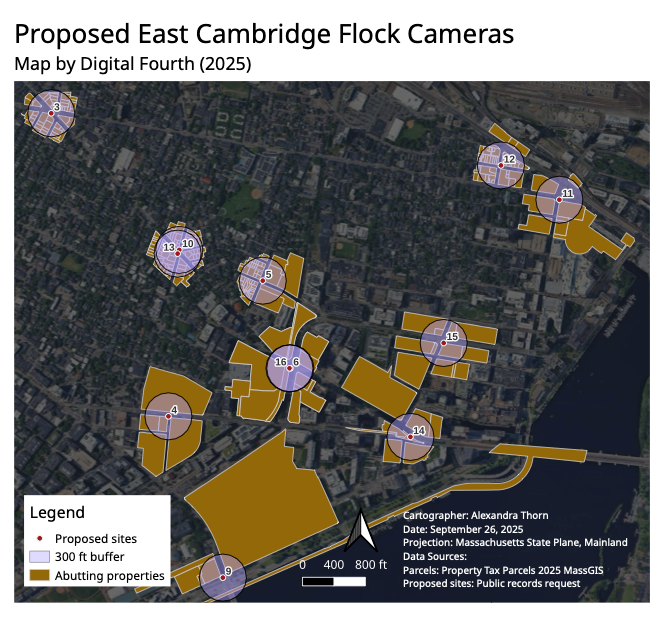
So far, 16 Flock ALPR camera locations have been proposed in Cambridge (the blue pins):
The densest deployment is planned for East Cambridge, near the public housing at Newtowne Court, Washington Elms and Roosevelt Towers, as well as Kendall Square and MIT. The other proposed locations are on major thoroughfares into and out of Cambridge, including nearly all routes of travel between Cambridge and Boston. This raises the concern that it will become very difficult for local residents to move about without having their license plate information, and thereby in many cases their patterns of life, captured.
Depending on the city’s contract with Flock relating to data retention, these residents’ patterns of movement may be visible to both the Cambridge Police Department and other agencies using Flock’s database. This is particularly concerning because Flock has developed an AI tool which reports suspicious vehicle movement patterns to local law enforcement. This is to say, artificial intelligence may have a hand in not only assisting police with searching networks for particular crimes or “hits,” but in deciding what is suspicious in the first place and flagging potentially innocent residents based on algorithmically determined criteria. Citizens should not be subject to the whims of an algorithm determined by a private company whose policies are not transparent or subject to the same rigorous checks that a government administration would be. Flock has given Cambridge no reason to trust in the idea that their algorithms are effective and unbiased, and has in fact provided more reason to suspect the contrary.
There’s a further issue. The City of Cambridge Surveillance Use Policy directs the City to pay attention to whether any communities are being “disproportionately impacted” by the deployment of any surveillance technology, especially “low-income communities, communities of color, or any community that is marginalized in the City.” Based on the proposed camera locations, it’s obvious that the movement patterns of residents of Strawberry Hill and West Cambridge traveling, for instance, to Harvard Square, would not be as regularly captured as would the movements of East Cambridge residents. The City has not considered whether there are disproportionate impacts of this kind; the Council, in approving it, relied simply on a declaration by Cambridge PD that there weren’t any.
A key privacy practice is data minimization: Limiting data collection to the minimum required, and not retaining data for longer than it is required. Flock’s website discloses that the local law enforcement agencies that contract with them may store data themselves, but Flock itself stores all license plate data for 30 days. As a result, in accordance with their data sharing record, Flock data may be visible for a significant window to out-of-state law enforcement, Immigration and Customs Enforcement (ICE), CBP, the Department of Homeland Security, or other federal agencies, either through the pilot data-sharing scheme Flock now claims to have suspended, or through requests by federal agencies to local and state law enforcement who themselves have Flock contracts.
Federal agencies may also have the opportunity to access Flock ALPR data through the Boston Regional Intelligence Center and through informal favors granted by local members of the Joint Terrorism Task force, which has recently been directed by Trump in a presidential memorandum to conduct investigations of groups which espouse “anti-fascist,” “anti-capitalist,” “anti-American” or “anti-Christian” viewpoints. The actions of the current federal administration make it even more urgent to protect the sensitive data of vulnerable Cambridge residents, including immigrants, politically active people, and those who express views that might be classified under these dangerously loose categories. Anything that requires the use of a car in certain areas of Cambridge has the possibility of being tracked. Whether residents choose to exercise their free speech by attending a protest, accessing reproductive care, or simply moving about, Flock’s license plate readers may be storing that data, exposing it to federal search, and potentially using it to draw conclusions about the vehicle driver’s future potential to commit crimes. For example, many vehicle going into and out of Cambridge Health Alliance’s Windsor Street Care Center, which offers reproductive healthcare services, would be in Flock’s databases.
Data stored is always data that may be used. Any data stored with Flock is not safe. Even if the City of Cambridge specifies that they do not want the ALPR data that they store to be accessed by federal law enforcement, there is no guarantee that Flock will successfully prohibit access by federal law enforcement to their own systems directly in the absence of the consent of the city of Cambridge, especially considering their recent record of lying to cities about their data sharing practices. What’s more, federal agencies can always subpoena Flock.
We are currently advocating for Cambridge to terminate its arrangement with Flock, along with many other Cambridge residents, local advocacy groups, and MIT professors. As is all too common when it comes to local surveillance technology deployments, notifications on the proposed Flock camera deployments have been relatively under the radar, but progress has been made in the direction of an examination of Flock’s data sharing policies. Recently, all Cambridge city council members voted in favor of taking a second look at the deal with Flock that they approved in February, but it was specified that this review was not expected to result in abandoning the contract altogether.
During this meeting, Councilor Jivan Sobrinho-Wheeler called attention to the funding source for the Flock cameras being deployed in Cambridge. They would be paid for largely by the federal Urban Area Security Initiative (UASI) grant, meaning that Cambridge would technically only be leasing them. This system of funding would place very little control over Flock’s data storage systems in the hands of the Cambridge city council, and potentially open the door to more federal abuses of the type already being perpetrated by Flock in other states. The unexpected, and probably short-term termination of UASI funds by the Trump administration is not expected to change the City’s decision.
Approval of the specific locations for the cameras was included in an agenda for a recent Pole and Conduit committee meeting, but was later removed. The next committee meeting is scheduled for Thursday, October 23, 2025, but it is unclear whether or not Flock will be discussed.
As the members of the Cambridge City Council and the committee make time for community feedback and consider recent developments with Flock, Cambridge residents have a vital opportunity to make their opinions heard. Cambridge residents should take advantage of their right to free speech by reaching out to their city council members on this topic, all of whom are up for re-election. As informed and engaged members of the community, Cambridge residents should not be willing to accept the creeping spread of civil rights violations associated with the surveillance state.
Note: This article was written with assistance from Digital Fourth volunteers Alex M., Alex T.and Julie B.
Many kids in the Cambridge Public Schools (and elsewhere in the Commonwealth) still don’t know that if you’re using a school-issued Chromebook, the school is monitoring whatever you browse, down to deleted draft emails, whether you’re at school or not.
This is through a browser add-on called “Securly.” CPS has an agreement with Securly that all school-issued Chromebooks will have this add-on.
What’s more, wittingly or not, CPS is lying to the City Council about whether student data gets shared. Let’s show you how.
In the Annual Surveillance Report submitted to the City, Cambridge Public Schools cites to the language of its Data Privacy Agreement with Securly, insisting, “This data is not shared with third parties” (Annual Surveillance Report, p.67). However, the DPA actually allows the sharing of data with third parties – specifically, but not limited to, the cops. Law enforcement is allowed to contact Securly to get data on students, and Securly is allowed to disclose that information without waiting for a warrant or evidence of involvement in illegal activities, and without telling either CPS or the student:
II. 4. Law Enforcement Requests. Should law enforcement or other government entities (“Requesting Party(ies)”) contact Provider with a request for Student Data held by the Provider pursuant to the Services, the Provider shall notify the LEA in advance of a compelled disclosure to the Requesting Party, unless lawfully directed by the Requesting Party not to inform the LEA of the request.
Since Securly can tell the cops without telling CPS, there’s no way CPS can truthfully guarantee to the City Council that your “data is not shared with third parties.” It might not be. But they can’t know for sure.
Beyond that, Article IV of the DPA goes into great detail about the circumstances under which Securly may share both personally identifiable student information and de-identified student information, for a variety of purposes. Again, it might be that, despite the DPA allowing them to, Securly is not in fact sharing CPS student information onwards; but we suspect that they are doing whatever the DPA currently allows them to do.
CPS also insists that Securly is being used only as a “Web Filter”, to block various kinds of disagreeable content. The material they have provided to the City Council focuses on students accessing gun-related content and suicide-related content.
But Securly’s Web Filter product not only blocks; it also shows to teachers and to admins what URLs are being blocked, offering what Securly describes as “Complete online visibility … monitor[ing] for signs of bullying, self-harm, gun terms, and violence”, with “AI-based context analysis … for signs of bullying, self-harm, gun terms, and violence across social networking and web searches. If a student is suffering or looking at concerning content, you’ll know.”
It is legal for students to search for content that includes violence, graphic imagery, and guns, and it’s hard to envision how they could research, say, Russia’s invasion of Ukraine without encountering such content.
It’s not clear that school monitoring software in general works. VICE reports, “The few published studies looking into the impacts of these tools indicate that they may have the opposite effect, breaking down trust relationships within schools and discouraging adolescents from reaching out for help—particularly those in minority and LGBTQ communities, who are far more likely to seek help online.” It is evident in places where school monitoring software is in use that students and parents are often contacted, inflicting harm, without administrators or teachers first examining the context of the flagged material. At a minimum, the City Council should find out what terms and sites are being flagged in Securly’s system, in order to evaluated whether there is manifest prejudice going into the selection of those terms and sites and whether each instance is being reviewed by the student’s teacher.
What Securly’s system appears to do is to monitor everything, and then rely on school officials’ discretion to determine whether what gets flagged is really cause for worry. Monitoring and disciplining students for accessing such content places the school district on dangerous legal ground. In last September’s ruling in Mahanoy School District v. B. L., the Supreme Court explained that students’ off-campus speech may be regulated only in cases of “[1] serious or severe bullying or harassment targeting particular individuals; [2] threats aimed at teachers or other students; [3] the failure to follow rules concerning lessons, the writing of papers, the use of computers, or participation in other online school activities; and [4] breaches of school security devices, including material maintained within school computers.” Securly’s systems envision monitoring students’ off-campus speech in a far larger set of circumstances than provided for in Mahanoy.
My master’s thesis was on blocking and filtering technologies, and their potential for discriminating against the provision of LGBT-oriented information. I was also bullied in school, for years. I understand why schools want to track students’ access to gun- and suicide-related imagery. But public schools have to adhere to the Constitution in the surveillance they conduct of students. At most, considering the rights protected by the Fourth and First Amendments, schools are only be justified in starting to track out-of-school browsing behavior of a particular student on a school-issued device if they have probable cause to believe that the student was engaged in or is the target of one of the four kinds of conduct envisioned under Mahanoy. This technology goes far beyond what the law and the Constitution permits. We believe that the City Council should not approve the use of this technology.
This is part of a series on the surveillance technologies the City of Cambridge is reviewing. The City Council has referred consideration of these technologies through to the Public Safety Committee, which will hold a hearing and then report back to the City Council with recommendations. Email us if you’d like to testify at the Public Safety Committee. Now is the time to weigh in on whether you want to see this technology deployed in your community!
The city of Cambridge, MA is considering whether to switch on its network of surveillance cameras. Councillor Craig Kelley, who chairs the Public Safety Subcommittee [UPDATE: and whom, I should make clear, is skeptical about the merits of surveillance camera systems, scheduled seven public hearings on the newly proposed Security Camera Policy, but like most subcommittee hearings, they were relatively poorly attended]. The City Council voted unanimously on July 2 to ask the Mayor and the City Manager to arrange a better-publicized meeting to discuss the Policy.
ORDERED:
That Her Honor the Mayor and the City Manager be and hereby is requested to arrange a community meeting with other stakeholders to discuss the proposed Security Camera Policy submitted by the Police Department for implementation.