Categories
Mission News Uncategorized

The NSA Is Not Above The Law

tr-above-the-law

[Crossposted at Restore The Fourth]

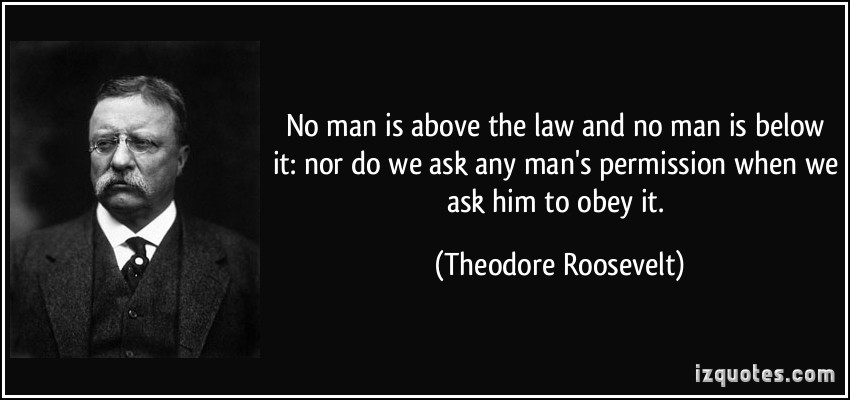
Last Thursday’s 2nd Circuit Court of Appeals ruling in ACLU v. Clapper threw a bomb into the middle of the debate over renewing the legal authority governing the NSA’s mass metadata surveillance programs. In a unanimous ruling, the Justices held that such programs, untethered to the limiting factor of what is relevant to a specific investigation, were never authorized under Section 215 of the PATRIOT Act.

Bob Litt, the general counsel of the Office of the Director of National Intelligence, scrambled to respond, arguing at a panel on transparency in DC on May 8 that the ruling is not binding on the FISC, that it is not currently in effect, and that it will be overturned soon anyway. Senate Intelligence Committee Chairman Richard Burr (R-NC), who vehemently supports mass NSA surveillance, is contending that “I think the statutory language today allows the NSA to do exactly what they’re doing […] I have a very tough time thinking the Supreme Court would look at this law […] and come to the conclusion that we didn’t empower the NSA to do bulk collection.” In the same article, Stewart Baker, the former general counsel for the NSA, is reported as deriding the ruling as a “97-page law review article” whose “significance is close to zero.”

Collectively, these assertions are the public face of what’s nothing less than a desperate effort by the NSA to declare itself literally above the law. But let’s take them one at a time, shall we?

Categories
News

NSA Whistleblower John Tye Explains Executive Order 12333

captain-america-freedom-fear

It’s been widely reported that the NSA, under the constitutionally suspect authority of Section 215 of the PATRIOT Act, collects all Americans’ phone metadata. Congress has not yet passed any reforms to this law, but there have been many proposals for changes and the national debate is still raging. Yet Americans’ data is also being collected under a different program that’s entirely hidden from public oversight, and that was authorized under the Reagan-era Executive Order 12333.

That’s the topic of a TEDx-Charlottesville talk by whistleblower John Napier Tye, entitled “Why I spoke out against the NSA.” Tye objected to NSA surveillance while working in the US State Department. He explains that EO 12333 governs data collected overseas, as opposed to domestic surveillance which is authorized by statute. However, because Americans’ emails and other communications are stored in servers all over the globe, the distinction between domestic and international surveillance is much less salient than when the order was originally given by President Reagan in 1981.

[youtube http://www.youtube.com/watch?v=ATUoU9B187w]

Categories
Mission News

Every Car, Everywhere: The DEA Tracks Where & When You Drive

alpr_cartoon

For who-knows-how-many years, the Drug Enforcement Administration has been using Automatic License Plate Recognition software to create a national database of the driving habits of ordinary citizens not suspected of a crime, according to documents obtained by the American Civil Liberties Union through the Freedom of Information Act. The documents describe the state of the surveillance effort as of 2009, leaving us wondering just how vast it could be today.

This vehicle tracking program originated near border crossings in the southwestern United States but has grown into a nation-wide project. It is a joint effort between the DEA and local, state, and federal law enforcement agencies throughout the United States. The surveillance program has been alluded to in Congressional testimony every once in a while through the years, but has yet to be fully understood. The documents released by the ACLU, despite being heavily redacted, shine some much-needed light on the interests and priorities of the DEA and federal law enforcement agencies in general. As of 2009, at least 100 license plate readers had been deployed in states like California, Arizona, New Mexico, Texas, Florida, Georgia, Nevada and New Jersey.

And we should be concerned. According to the ACLU:

These records . . . offer documentation that this program is a major DEA initiative that has the potential to track our movements around the country. With its jurisdiction and its finances, the federal government is uniquely positioned to create a centralized repository of all drivers’ movements across the country — and the DEA seems to be moving toward doing just that. If license plate readers continue to proliferate without restriction and the DEA holds license plate reader data for extended periods of time, the agency will soon possess a detailed and invasive depiction of our lives.

Categories
News

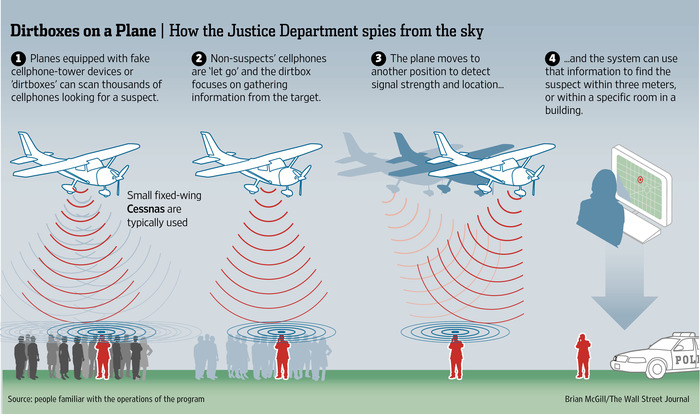
“Dirtbox” planes scoop your cellphone data from the sky without a warrant

dirtboxes_wsj

It may be true that “Nobody is listening to your telephone calls,” as President Obama declared in the wake of revelations of the National Security Agency’s mass surveillance programs, but the fact remains that the devices we use are constantly leaking private information – our location, who we talk to, the duration of our calls, Wi-Fi networks we have connected to in the past, unique identification numbers of our mobile devices, and so on. Criminal hackers, corporate actors and governments around the world are ecstatic about the weak standards, backdoors, and exploits that they can use to vacuum up data about you, while your Fourth Amendment right to be free from warrantless searches and seizures is shoved as far as possible into an unregarded corner.

Last week, the Wall Street Journal revealed the existence of yet another dragnet surveillance program – this time, it’s run by the U.S. Marshals:

Categories
Mission News

Midterms & Mass Surveillance, Part I: End “Section 215” Mass Metadata Surveillance

The midterms saw defeat of several surveillance reformers in the Senate, notably Mark Begich and Mark Udall, and the arrival of ardent authoritarian Tom Cotton. But even had reformers won, electing surveillance reformers does not of itself make surveillance reform more likely. There are certain policy outcomes that are not permitted, and real surveillance reform is not permitted.

Here at Digital Fourth, we offer a more radical and more realistic perspective. What is not permitted has in the past included ending Jim Crow, ending legal discrimination against gay and lesbian people, and electing professed atheists to public office. The parameters of the not permitted can shift more abruptly than it’s possible to imagine ahead of time. Ending the mass surveillance state may be not permitted, but it can absolutely be done.

In a global sense, as even the Boston Globe has noticed, the actual opinions of the people have had no measurable effect on US national security and foreign policy. The party in charge may change, but the deep state remains in power, and the fundamental assumptions of American imperial management remain essentially the same.

Despite this, the change in control of the Senate has meaningful strategic implications for how surveillance activists should be pursuing the battle against mass surveillance over the next two years, both federally and at the state level. So, follow us below the fold for the first in our five-part analysis of next steps for the movement.

PART II: CIA and Elite Torturers Win, The Rule of Law Loses
PART III: Congress & Obama At Daggers Drawn – Except Where It Really Counts
PART IV: Surveillance Doesn’t Pay: The New Massachusetts Political Landscape
PART V: And I Have Seen Blue Skies
Like our work? Donate today!

Categories
Mission

Interview with 4th Amendment Scholar Orin Kerr

orinkerr

Today, we’re interviewing one of the nation’s foremost Fourth Amendment scholars, Professor Orin Kerr of George Washington University. Professor Kerr has written extensively on the law of national surveillance, and how the Fourth Amendment’s warrant requirements apply under current law and practice to national security investigations. Since the surveillance revelations of last year, his research has become a touchstone for people on both sides of the surveillance debate.

Professor Kerr: what got you interested in Fourth Amendment law in the first place?

Categories
Mission News

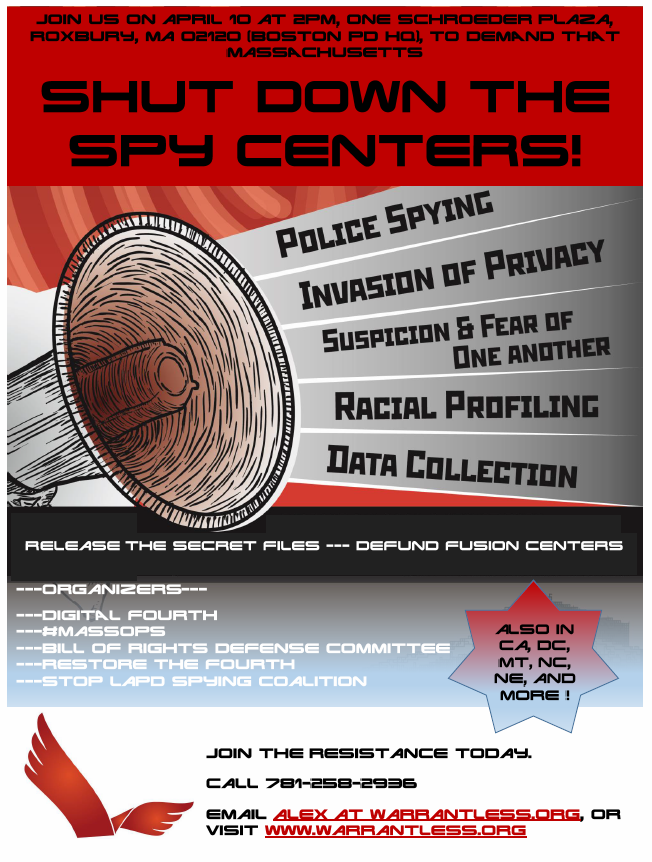
Shut Down The Spy Centers, April 10, 2pm

[CORRECTED TIME: 2PM EST]

The New York Times revealed last week that the National Counterterrorism Center now has access to all data, not minimized for privacy in any way, that was authorized for collection via the Foreign Intelligence Surveillance Act, or FISA. That includes the phone metadata dragnet on all US calls, and much else besides.

Sounds legit? It really isn’t. This is why. NCTC provides an enormous amount of data to the now-80+ “fusion centers” around the country. These spy centers act as clearinghouses where federal and local law enforcement data meet; Massachusetts’ ones are run out of the Massachusetts State Police and the Boston PD. So what does this revelation – again, coming to us courtesy of Edward Snowden & Co. – mean? It means that local police forces across America, without a warrant or subpoena of any kind, are able to access what the NSA has on you – and, as we already know, they’re collecting everything they can on everyone. In consequence, the Fourth Amendment now only exists for you if law enforcement (a) isn’t that interested in you or (b) has everything it wants on you already. That’s not much of a “right” at all. It’s more of a trivially revocable privilege. Imagine: any time you get stopped by the police, for any reason, they can now provably access the last five years of, say, your movements by car and your phone communications.

So, Digital Fourth, the Stop LAPD Spying Coalition, Restore The Fourth, and the Bill of Rights Defense Committee, have teamed up to launch a series of nationwide “Shut Down The Spy Centers” protests. Be there or be scared!

And if you find this idea as shocking as we do, and would like to help us, we’re accepting donations here and volunteers here.

flyer

Categories
Mission News

Digital Fourth Secures 100% Support for NSA Reform By MA’s US Reps and Senators

The main substantive reform of the NSA proposed in Congress, the “USA FREEDOM Act”, would ban bulk surveillance, require a Special Advocate to plead the case against surveillance at the Foreign Intelligence Surveillance Court, and force the publication of secret laws governing how surveillance is conducted.

At Digital Fourth, we have campaigned ever since the law was introduced to get 100% of Massachusetts’ federal legislators – Representatives and Senators – to cosponsor this legislation. Last week, with the cosponsorship of Rep. Richard Neal in Western Massachusetts, we achieved our goal, becoming the only state (other than Alaska and Montana) where that is true.

Right now, the USA FREEDOM Act has 141 cosponsors in the House out of 218 needed, and 21 cosponsors in the Senate. Its cosponsors are almost equally divided between Democrats and Republicans, sending a message that no matter who occupies the White House, people of all political beliefs have a stake in preventing mass surveillance.

Categories
Mission

Friends Don’t Let Friends Support the NSA

Building on work by Christopher Soghoian, local data visualization expert MC McGrath has come up with a fascinating exploration of the network of firms and agencies supporting the major electronic surveillance programs run by NSA and GCHQ, using data scraped from the individual LinkedIn profiles of people advertising their expertise in those particular programs.

To explore just one tiny corner of this visualization, the NSA has a program called “DISHFIRE” which collects SMS messages. The SMS messages of suspected terrorists? Bless your heart, no! Everybody’s SMS messages. The visualization makes clear that every branch of the military draws on people with DISHFIRE expertise, and that certain private companies appear to do so too – DC area-based companies with anodyne names like L-3 Communications (“Our products and services play a critical role in the protection and defense of freedoms worldwide”) Six3 Systems (“High quality Signals Intelligence (SIGINT) and Counterterrorism solutions”), and PiccoTek (“Uniquely talented people with the right “can do” attitude”).

I’m glad they’re so positive about their work. How devastating it would be if the employees of these firms raking in vast quantities of tax dollars in exchange for smoothing the broad downward path toward turnkey tyranny, felt, in unguarded moments, a crawling sense of unease. Trawling through their profiles, it’s easy to find a certain defensiveness in tone – they’re saving “countless lives everyday“? Really?

Most of the people who list this program in their LinkedIn profiles are or have been in Afghanistan, a country we never should have invaded, and which we’re still in thirteen long years later in America’s longest ever war. If it were me, maybe I’d have to believe that I was “saving countless lives” in order to make it seem worth while.

And so they beaver away, in Virginia and Afghanistan and many other places, devising more and more refined technological solutions to the problem of detecting anti-American sentiments people are texting to one another; and it seems impossible to have us stand back and look at whether it is truly productive to expend so much energy squashing – sometimes in a very literal way – every hint of dissent.

drones-seamless

…But in matters of vital importance – meaning, in effect, war and police espionage – the empirical approach is still encouraged, or at least tolerated. The two aims of the Party are to conquer the whole surface of the earth and to extinguish once and for all the possibility of independent thought. There are therefore two great problems which the Party is concerned to solve. One is how to discover, against his will, what another human being is thinking, and the other is how to kill several hundred million people in a few seconds without giving warning beforehand. In so far as scientific research still continues, this is its subject matter. The scientist of today is either a mixture of psychologist and inquisitor, studying with real ordinary minuteness the meaning of facial expressions, gestures, and tones of voice, and testing the truth-producing effects of drugs, shock therapy, hypnosis, and physical torture; or he is chemist, physicist, or biologist concerned only with such branches of his special subject as are relevant to the taking of life. Orwell, 1984.

Listen. The NSA’s purpose is very simple. It’s not to thwart terrorist attacks. It’s to buttress empire, over there, and, through use of the exact same tools developed to “thwart terrorism”, over here and in our towns and schools as well. The money flows towards them, and towards their work of destruction; and is sucked away from our vulnerable, our poor, our schools and our towns. Our own ability to voice sentiments opposing the decisions of the American government, or to enjoy due process protections before being deprived of life or liberty, look increasingly like localized exceptions to a different and worse rule we have been imposing on the rest of the world, and now also on various categories of people deemed unacceptable here at home.

So I’ll say this now: Friends don’t let friends support the NSA, its associated agencies or its nexus of security firms that feed off of and sustain it. If you know people who work for them, help them find a better line of work. They have better things to do with their lives, and it is not yet too late. We are already working with former intelligence people who have grown disenchanted with what their country asked them to do, and there are a thousand Snowdens waiting in the wings.

Help them. Join us. Support our movement. Spend your time really “protecting and defending” the freedom of your neighbors and fellow people, instead of the revenues of a machine that profits directly every single time the Constitution is violated by an unwarranted intrusion on our lives.

May we all, one day, be left in peace – peace here, abroad, and with each other.
Categories
Mission News

The Wall Begins To Crack: Fourth Amendment Challenge to Bulk Metadata Spying Program “Likely to Succeed on the Merits”

Ever since the 2005 revelations of Mark Klein (yes, that long ago) that the NSA was intercepting phone traffic on a mass basis, successive presidential administrations have employed every possible species of legal trickery to prevent a constitutional challenge to the program on the merits.

The key question is, Why? Surely, if either Bush or Obama believed their rhetoric that what they’re doing is Constitutional, they would welcome the courts’ review, which would surely result in a thumping endorsement of bulk metadata spying, probably based on the 1979 Supreme Court case Smith v. Maryland, which ruled the collection of much more limited metadata to be constitutional.

The actions of both administrations suggest otherwise. Their problem was always that the plain text of the Fourth Amendment didn’t seem to support their position. Shall we take a look at it again? I never get tired of it.

The right of the people to be secure in their persons, houses, papers, and effects, against unreasonable searches and seizures, shall not be violated, and no Warrant shall issue, except upon probable cause, but upon probable cause, supported by Oath or affirmation, and particularly describing the place to be searched, and the persons or things to be seized.

In order to be “reasonable”, a “search” must have a warrant, which is supported by “probable cause”, and which “particularly describes” the “place” to be searched.

So let’s say, then, just hypothetically, that you set up a massive phone data interception program without bothering with a warrant at all, and got Congress to retroactively immunize anyone participating in it from prosecution (hey there, W!), or that your response to the existence of this program when you got into office was to get a secret court to issue a secret ruling approving a warrant allowing the “seizure” of all phone metadata for all calls in the United States (howdy, BarackO!). How would a reasonable court interpret the requirements for probable cause, or for particularly describing the “persons or things” to be seized, for a program like that?