Categories
Mission News

No Way To Complain = No Complaints = No Problem!

Boston’s fusion center, the Boston Regional Intelligence Center, no longer hosts their privacy policy on their website – I was told that it was “under review” and that the new policy will be posted when it’s ready – so it’s lucky for all of us that the ACLU of Massachusetts has a copy of the policy. And it’s a doozy.

If you’re worried about the fusion center’s privacy practices, and that it may have gathered information on you that it shouldn’t, then you’re essentially out of luck. Sure, you can write to them (the address is Boston Regional Intelligence Center, Boston Police Department, Privacy Committee, One Schroeder Plaza, Boston, MA 02120, (617) 343-4328), but the Privacy Policy specifies that the only complaints they will accept or review are those where:

… an individual has a complaint with regard to the accuracy or completeness of terrorism-related protected information that:
(a) Is exempt from disclosure,
(b) Has been or may be shared through the ISE [Information Sharing Environment], or
(c) (1) Is held by the BRIC and
(2) Allegedly has resulted in demonstrable harm to the complainant

So, in essence, before a complaint can even be reviewed about a given piece of information, the complainant has to know what information the fusion center holds on them, and has to be able to make an allegation of “demonstrable harm” – harm, that is, in the eyes of the BRIC. And there’s no procedure for complaining about the collection of monstrous quantities of data in the first place – only for circumstances where they have collected, and acted upon, something provably false about you personally.

That’s some catch, that catch-22.

Wonder how many people have successfully complained?

And by definition, if nobody’s complaining, they must be respecting our privacy, right?

In fact, they’re respecting our privacy so much, that they are aggregating data from the following sources (this is just the ones they’re acknowledging, summarized from the list in the appendix of their privacy policy):

“Telephone analysis software”, state crime information systems, national crime information systems, the state drivers’ license database, the Lexis-Nexis “Accurint” database, Thomson-Reuters’ “CLEAR” database [now integrated with Palantir!], “intelligence data” [up to and possibly including unminimized data collected via FISA], the Regional Information Sharing Systems (RISS) System, the Law Enforcement Online system, the Homeland Security Information Network (HSIN) System, jail management databases, the Financial Crimes Enforcement Network (FinCEN) System, state sex offender registries, “crime-specific listservs”, RSS readers, the High Intensity Drug Trafficking Areas (HIDTA) Program database, EPIC hospital records, the National Drug Intelligence Center (NDIC) database, state corrections/probation databases systems, and juvenile justice databases.

Based on information provided by BRIC employees on their LinkedIn profiles (thanks, guys!), we can also determine that the BRIC has access to gang databases, information from the Department of Youth Services, and “medical intelligence”, defined by the Department of Defense as “That category of intelligence resulting from collection, evaluation, analysis, and interpretation of foreign medical, bio-scientific, and environmental information that is of interest to strategic planning and to military medical planning and operations for the conservation of the fighting strength of friendly forces and the formation of assessments of foreign medical capabilities in both military and civilian sectors.”

So if you’ve never made an electronic financial transaction, never used the phone, never had a drivers’ license, never communicated with somebody abroad, never been in trouble with the law, never used drugs, and never been to a hospital abroad for treatment, then congratulations: you’re probably not in the fusion center’s database, and you still have a Fourth Amendment. And for the rest of us, they have records on you, that they aren’t going to allow you to review, and there’s nothing you can do about it. Why should you be concerned?

In related news, the BRIC is changing its slogan to “Share and Enjoy.”
Categories
Mission News

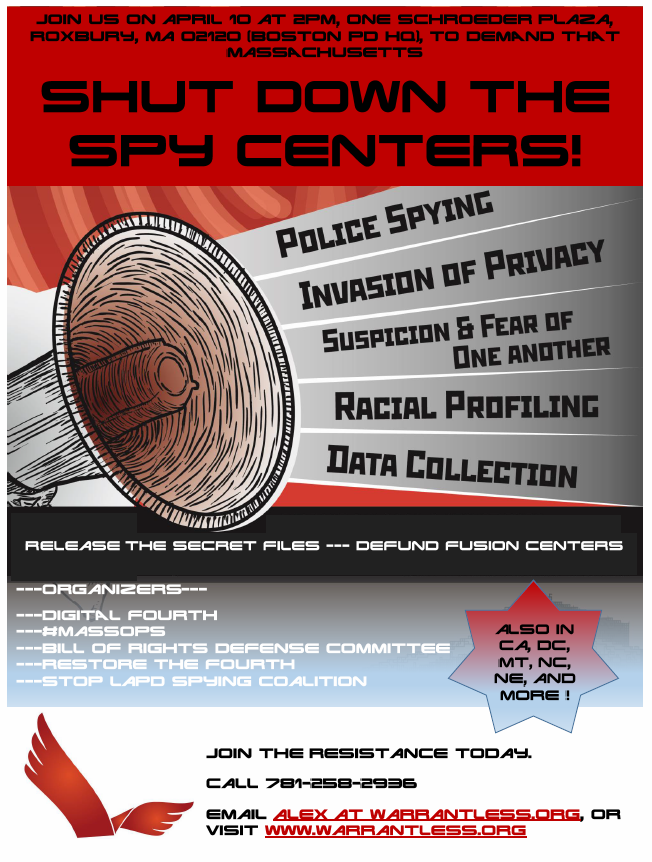
Shut Down The Spy Centers, April 10, 2pm

[CORRECTED TIME: 2PM EST]

The New York Times revealed last week that the National Counterterrorism Center now has access to all data, not minimized for privacy in any way, that was authorized for collection via the Foreign Intelligence Surveillance Act, or FISA. That includes the phone metadata dragnet on all US calls, and much else besides.

Sounds legit? It really isn’t. This is why. NCTC provides an enormous amount of data to the now-80+ “fusion centers” around the country. These spy centers act as clearinghouses where federal and local law enforcement data meet; Massachusetts’ ones are run out of the Massachusetts State Police and the Boston PD. So what does this revelation – again, coming to us courtesy of Edward Snowden & Co. – mean? It means that local police forces across America, without a warrant or subpoena of any kind, are able to access what the NSA has on you – and, as we already know, they’re collecting everything they can on everyone. In consequence, the Fourth Amendment now only exists for you if law enforcement (a) isn’t that interested in you or (b) has everything it wants on you already. That’s not much of a “right” at all. It’s more of a trivially revocable privilege. Imagine: any time you get stopped by the police, for any reason, they can now provably access the last five years of, say, your movements by car and your phone communications.

So, Digital Fourth, the Stop LAPD Spying Coalition, Restore The Fourth, and the Bill of Rights Defense Committee, have teamed up to launch a series of nationwide “Shut Down The Spy Centers” protests. Be there or be scared!

And if you find this idea as shocking as we do, and would like to help us, we’re accepting donations here and volunteers here.

flyer

Categories
Mission News

Turns out, MBTA has plenty of dollars – for surveillance.

Kade Crockford reports that DHS has awarded the MBTA $7 million to refit its buses with fancy new surveillance cameras. Why? Oh, no reason in particular. But the MBTA is at pains to point out that they spent none of their own money on the project. What’s wrong with free money?

Let me tell you what’s wrong with free money. Whether it’s coming from MBTA, DHS, the NSA or the Corporation for Public Broadcasting, it all comes from you and me in the end, and I care just the same about whether it’s being spent wisely.

I understand the politics. MBTA, being a local agency, tends to come under fire if it, say, has a massive budget crisis and hikes fares by 23% to help make up the shortfall. DHS, on the other hand, won’t be protested, and this one grant is a drop in the bucket. Nobody’s going to lose their job at DHS if the money does no good.

Crockford rightly comments:

Categories
News

Boston PD Suspends ALPR Program After Massive Privacy Violation

Just before Christmas, Muckrock and the ACLU of Massachusetts brought out excellent articles based on a full year of Muckrock’s investigative reporting into Boston PD’s use of automated license plate recognition technology.

ALPR systems automatically photograph and store in a police database the license plates of any car an ALPR-equipped police vehicle passes. The car may be parked or driving. It could be on the Pike, in a driveway, or anywhere a camera can reach. The question was, what does the Boston PD do with the mountain of data once it has it?

Categories
Mission News

Sauce for the Gander: Boston Police Officers Apparently Don’t Like Being “Followed All Over The Place”

sauce_for_gander

From the ACLU of Massachusetts:

Boston Police Department bosses want to install GPS monitoring devices in every patrol car, to enable dispatch to more efficiently process 911 calls. But police officers and their union are outraged, saying that the ubiquitous tracking is too invasive of their personal privacy. Tracking the location of officers as they go about their days would reveal incredibly detailed information about their lives, the officers say.

It must be just awful to go about your daily life looking over your shoulder, conscious that your every movement and activity is being recorded and could be used against you. Oh, wait. That’s what the entire American public is already dealing with, in this age of mass electronic surveillance. But the way the police union is hissing’n’flapping about it, it’s almost as if there was something wrong with that. Don’t they know that you have nothing to fear, if you have nothing to hide?

The ACLU’s tack is that if the police don’t like the feeling of being followed, they shouldn’t be pushing for technologies like mass tracking of license plates or cellphone locations. That’s fair enough, but there’s a larger point here also.

Police officers are public employees, and they would be monitored during, and only during, the performance of their duties as public officials employees. We require elected officials to disclose their votes publicly, and require secrecy for private individuals at the ballot box, even though that’s inconsistent, because public disclosure of how public business is conducted is vital to maintain democratic accountability. In the same way, close monitoring of law enforcement is vital, to ensure that police don’t abuse the vast and special powers society gives them. When you put cameras on cops, complaints about police misbehavior and brutality drop like a stone. We have the right – affirmed by the federal courts in the First Circuit and across America – to record the police in the commission of their duties. The Fourth Amendment constrains the actions of the government, not the actions of members of the general public.

The Boston police may not like it – last week’s PINAC case shows that they’re willing even to threaten people with felonies to avoid public embarrassment over misconduct – but they are not entitled to a high level of privacy protection in their capacity as police officers. That distinction matters. Doxxing police officers’ personal names and phone numbers and addresses is not cool. But recording them, having them record themselves, and encouraging people to call their office numbers and hold them accountable to the public, is vitally important in order to preserve freedom for the rest of us.

Categories
Mission News

StopWatchingUs DC rally rocks out: 3,000+ people call for NSA reforms

This Saturday, DC saw something it had never seen before.

A city that treats the superficial hatreds of party politics as its lifeblood, saw thousands of people from across the political spectrum gather to denounce NSA mass spying. We heard, and roared approval for, the words of feminist Naomi Wolf, Dennis Kucinich (Democrat), Justin Amash (Republican), and Gary Johnson (Libertarian). Kymone Freeman spoke movingly about the impact of surveillance on minority communities and the civil rights movement. Whistleblowers Thomas Drake and Russell Tice were there, and Edward Snowden sent a message to be read by leading whistleblower-protecting attorney Jesselynn Radack. Tea Party people up from Richmond, VA, proudly put on Code Pink stickers labeled “Make Out Not War”. The press reported wonderingly that it was not put together “by any of the “usual” well-connected DC organizers.” I should know: I’m proud to say that, in a small way, I was one of them, and this was the first time most of us had done anything like this.

That wasn’t all. Here in Boston, activist Joan Livingston put together a solidarity rally at Park Street Station:

and ACLU organizer Raquel Ronzone arranged for the rally to livestream at the Digital Media Conference in Cambridge.

If you want updates on the StopWatchingUs campaign going forward, text “PRIVACY” to 877877. Stay tuned for the next stage of the campaign, which will be to pass the “USA FREEDOM Act.” Personally, just to hammer home the point, I’d have preferred the “USA FREEDOM Fourth Amendment Restoration – Objective: Undermining Tyranny Act of 2013”, because I too can do acronyms, but such frivolity is apparently frowned upon in the legislature that gave us the Uniting (and) Strengthening America (by) Providing Appropriate Tools Required (to) Intercept (and) Obstruct Terrorism Act of 2001 in the first place.

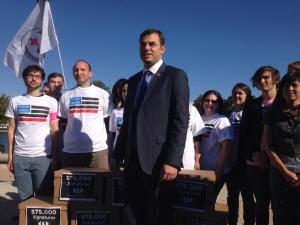
UPDATE: Oh yeah, I nearly forgot. I’m the tall guy to the left of Rep. Amash!

BXhn9hYCYAEoV-b

Categories
Mission News

Oh, That’s Just Great: NSA Breaks the Internet, Reduces Job Creation By 24,000/Year

One huge question for legislators and the public to understand is: how does pervasive US government surveillance damage the tech industry itself? The Boston area’s economy depends hugely on the health of the tech industry. The United States as a whole benefits enormously from the dominance of US tech firms like Apple, Microsoft, Dropbox, Adobe, Amazon and too many others to name.

Now that we have had a few months since the beginning of the Snowden revelations in June, analysts are beginning to come out with some answers. It seems that the economic impact could be enormous.

Categories
Mission

Globe reports on Saturday’s NSA/fusion center picnic

Michael Morisy at the Globe reports:

With speeches, flyers, and some family friendly songs, a few dozen protesters joined outside the Boston Regional Intelligence Center (BRIC) yesterday to push back against what they said were increasingly invasive government intrusions into individuals’ privacy.

The event was dubbed an Orwell Day protest, after George Orwell’s 1984 (the date was 8/4), a novel about a totalitarian regime that maintains control largely through an aggressive surveillance program.

“I believe in the constitution, I believe in the Fourth Amendment,” said Alex Marthews, founder of Digital Fourth, a non-profit which advocates for strong Fourth Amendment protections and a strong emphasis on privacy. He blasted BRIC as an ineffective institution that wasted time and money investigating peace activists and graffiti artists rather than more serious threats.

“An agency that does no good and wastes your money should be closed,” he said.

Maximum attendance was around 75, which was much larger than the first event – looks like the movement is growing. Here’s full footage of the first hour, featuring great speeches from Steve Revilak of the Mass Pirates and Joan Livingston of Veterans for Peace. Many thanks to the activists from #MassOps and Restore the Fourth Boston who put the event together!

Categories
Mission News

July 4, 10am: Restore The Fourth MA!

restorethe4th

Over 150 people are already coming to the rally to Restore the Fourth tomorrow in Boston. Thousands more will be rallying across the country. But this is Massachusetts. We invented the Fourth Amendment, and people will be watching Boston more than any other city tomorrow. Come with us and let the government know that we don’t need their fearmongering, and will not allow them to take our liberties.

Schedule
09:00 – 10:00: Gathering outside the Old State House in preparation for the day.
10:00 – 11:00: Listening reverently to the Declaration of Independence. Be respectful: save the protesting for after.
11:00 – 12:00: Talking with the crowds that gathered for the reading, followed by a peaceful “Cease and Desist” action at mobile stores to protest at their cooperation with the NSA. Then to Boston Common.
12:00 – 13:00: We’ll be demonstrating on the Common, as well as gathering signatures against the upcoming MA wiretapping bill. This bill aims to expand the Commonwealth’s use of electronic surveillance against its residents.
13:00 – 14:00: Make our way to Dewey Square.
14:30 – 17:00: March throughout Boston including Faneuil Hall and the Esplanade.

What to bring
Water (in clear plastic containers)
Fliers if you can print them (don’t print too many, they’ll likely get thrown away)
SIGNS. Lots of signs. Here are some ideas we came up with for some slogans.
Restore the Fourth!
No Warrant, No Search
Repeal the Patriot Act / NDAA
Don’t Spy on Me
Abolish DHS
No “Random” Searches
Save Edward Snowden
No Secret Courts

Categories
Mission News

A Helpful PSA from the Boston Regional Intelligence Center

nwa_prodigy

Here at the Boston Regional Intelligence Center, we have watched in sorrow as misinformation about our work to defend America and keep Americans safe here in America has appeared in certain scurrilous publications. We felt it was important to get the truth out about what we do and why we do it.

Some crypto-Marxist at the Jamaica Plain Gazette decided to ask this week why we were busy tracking the activities of local peace activists and the Occupy movement, instead of, say, paying attention to intelligence reports we had received from Russia about some guy called Tsarnasomethin Whatshisface.

God, you people! It’s like you think that just because we’ve taken billions of your dollars and told you we’ll use it to prevent terror attacks, you expect us to actually prevent them!

Allow us to break it down for you point-missing morons.