Categories
News

GUEST POST: Time to reveal the Israeli role in the US surveillance machine

[Guest post from Nancy Murray, an advocate for Palestinian rights for over 25 years. Crossposted at Mondoweiss. Nancy has researched and written about surveillance extensively for the ACLU of Massachusetts and its privacysos.org website. While this is not a blog that covers the Israeli-Palestinian conflict, it is shocking that the NSA, as a matter of policy, shares unconstitutionally collected and unminimized intelligence on US persons with agents of any foreign government.]

If the Israeli government has indeed ordered its spies “to dig up intelligence” showing links between the supporters of BDS and “terrorists and enemy states” as reported in the February 11, 2014 London Times, it may find that it already has as much information as it needs in its data banks.
As described in the UK Guardian by Glenn Greenwald, Laura Poitras and Ewen MacAskill, a 2008 document obtained by whistleblower Edward Snowden states that “one of the NSA’s biggest threats is actually from friendly intelligence services, like Israel. There are parameters on what NSA shares with them, but the exchange is so robust, we sometimes share more than we intended.”

Categories
Mission News

Cities around the country say: fusion centers are wasteful, fraudulent, and ineffective

[Guest post from Adwoa Masozi of the Bill of Rights Defense Committee.]

Screen Shot 2014-04-10 at 10.48.20 PMThursday, April 10, 2014 was a National Day of Action against Fusion Centers. Diverse, multiracial grassroots coalitions from around the country held rallies, press conferences, and creative actions to challenges civil liberties by fusion centers, which coordinate the surveillance activities of local police alongside federal agencies like the NSA and FBI. Fusion centers have operated at unknown cost, failed to meaningfully serve a public benefit, and drawn critics including Senators across the partisan spectrum, the ACLU, environmentalists, Muslim Americans, peace activists, and Ron Paul supporters.

Participating cities in yesterday’s action included: Boston, Charlotte, Dallas, Los Angeles, Oakland, San Francisco, and Washington DC. Below the jump are quotes from organizers, as well as photos and videos from several of the sites.

Categories
Uncategorized

Digital Fourth protests at the Boston fusion center

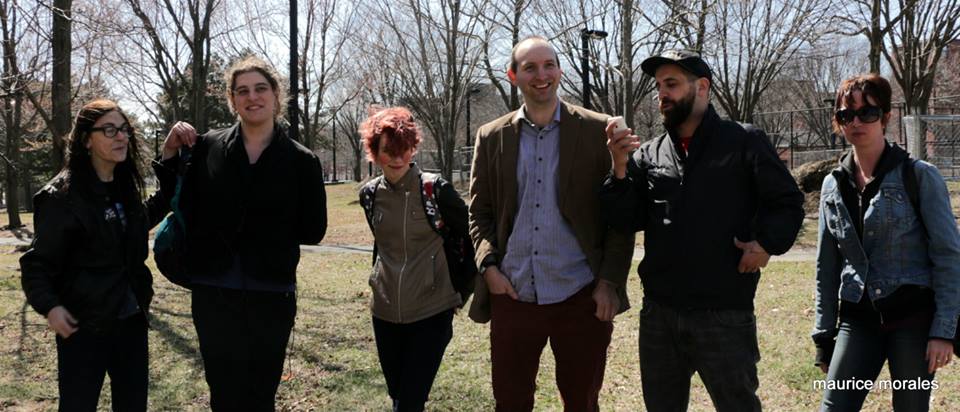
Noble defenders of the Constitution in Boston included Joan Livingston, Kinetic Theorist, journalist Chris Faraone, and some British guy
Noble defenders of the Constitution in Boston included Joan Livingston, Kinetic Theorist, Chris Faraone, and some British guy.

On a windy Thursday afternoon, we gathered to protest the privacy abuses of the Boston Regional Intelligence Center. It’s one of 85 fusion centers across the country, and we were joined nationally by groups in LA, Oakland, Dallas, Charlotte and DC. Cambridge City Councillor Nadeem Mazen gave a fiery speech describing the waste of resources the fusion center represents; journalist Chris Faraone described an operation of the fusion center where they digitally classified graffiti tags and enabled the arrest of graffiti artists (way to go, strike a blow for freedom!).

We presented a FOIA request to the Boston Fusion Center, but neither the Privacy Officer nor any BRIC representative would descend to communicate with us mortals. It appears that they were far too busy with vitally important meetings all day trying to prevent the next terrorist attack on the Boston Marathon, to meet with members of the public concerned about privacy.

Categories
Mission News

No Way To Complain = No Complaints = No Problem!

Boston’s fusion center, the Boston Regional Intelligence Center, no longer hosts their privacy policy on their website – I was told that it was “under review” and that the new policy will be posted when it’s ready – so it’s lucky for all of us that the ACLU of Massachusetts has a copy of the policy. And it’s a doozy.

If you’re worried about the fusion center’s privacy practices, and that it may have gathered information on you that it shouldn’t, then you’re essentially out of luck. Sure, you can write to them (the address is Boston Regional Intelligence Center, Boston Police Department, Privacy Committee, One Schroeder Plaza, Boston, MA 02120, (617) 343-4328), but the Privacy Policy specifies that the only complaints they will accept or review are those where:

… an individual has a complaint with regard to the accuracy or completeness of terrorism-related protected information that:
(a) Is exempt from disclosure,
(b) Has been or may be shared through the ISE [Information Sharing Environment], or
(c) (1) Is held by the BRIC and
(2) Allegedly has resulted in demonstrable harm to the complainant

So, in essence, before a complaint can even be reviewed about a given piece of information, the complainant has to know what information the fusion center holds on them, and has to be able to make an allegation of “demonstrable harm” – harm, that is, in the eyes of the BRIC. And there’s no procedure for complaining about the collection of monstrous quantities of data in the first place – only for circumstances where they have collected, and acted upon, something provably false about you personally.

That’s some catch, that catch-22.

Wonder how many people have successfully complained?

And by definition, if nobody’s complaining, they must be respecting our privacy, right?

In fact, they’re respecting our privacy so much, that they are aggregating data from the following sources (this is just the ones they’re acknowledging, summarized from the list in the appendix of their privacy policy):

“Telephone analysis software”, state crime information systems, national crime information systems, the state drivers’ license database, the Lexis-Nexis “Accurint” database, Thomson-Reuters’ “CLEAR” database [now integrated with Palantir!], “intelligence data” [up to and possibly including unminimized data collected via FISA], the Regional Information Sharing Systems (RISS) System, the Law Enforcement Online system, the Homeland Security Information Network (HSIN) System, jail management databases, the Financial Crimes Enforcement Network (FinCEN) System, state sex offender registries, “crime-specific listservs”, RSS readers, the High Intensity Drug Trafficking Areas (HIDTA) Program database, EPIC hospital records, the National Drug Intelligence Center (NDIC) database, state corrections/probation databases systems, and juvenile justice databases.

Based on information provided by BRIC employees on their LinkedIn profiles (thanks, guys!), we can also determine that the BRIC has access to gang databases, information from the Department of Youth Services, and “medical intelligence”, defined by the Department of Defense as “That category of intelligence resulting from collection, evaluation, analysis, and interpretation of foreign medical, bio-scientific, and environmental information that is of interest to strategic planning and to military medical planning and operations for the conservation of the fighting strength of friendly forces and the formation of assessments of foreign medical capabilities in both military and civilian sectors.”

So if you’ve never made an electronic financial transaction, never used the phone, never had a drivers’ license, never communicated with somebody abroad, never been in trouble with the law, never used drugs, and never been to a hospital abroad for treatment, then congratulations: you’re probably not in the fusion center’s database, and you still have a Fourth Amendment. And for the rest of us, they have records on you, that they aren’t going to allow you to review, and there’s nothing you can do about it. Why should you be concerned?

In related news, the BRIC is changing its slogan to “Share and Enjoy.”

Categories
Uncategorized

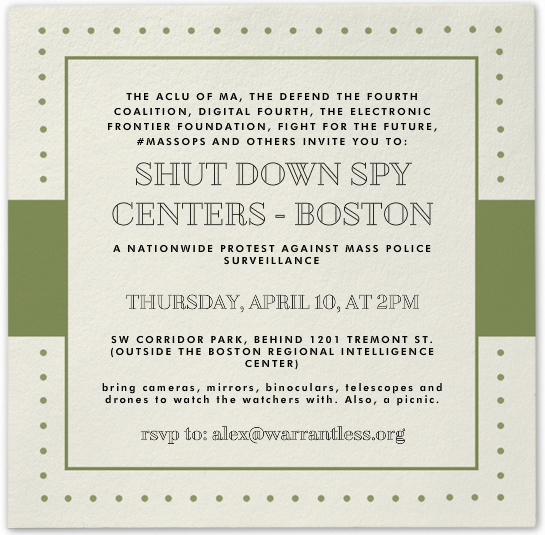
You’re Invited!

invite

Categories
Mission

Commonwealth Fusion Center Violates Constitution, New Report Says

minorityreport

Massachusetts has two “fusion centers”, mostly state-funded, which aggregate enormous amounts of data on innocent Massachusetts residents, with the notion of preventing terrorist attacks. When you call the “See Something, Say Something” line, the information goes into “Suspicious Activity Reports.” The ACLU of Massachusetts documented that the Boston fusion center (“BRIC”) had actually spent its time harassing peaceful activists rather than thwarting terrorism, which is one of the reasons why there will be nationwide protests against fusion centers on April 10, including in Boston.

In response to the ACLU revelations, Rep. Jason Lewis (now the newly elected Sen. Jason Lewis) filed a fusion center reform bill on Beacon Hill. Disconcerted at the prospect of more sunshine on their work, the Commonwealth Fusion Center, the fusion center in Maynard, offered him and other legislators a courtesy tour of their facility, to try to explain what good work they were doing. As an example of that work, they cited their First Amendment-violating harassment of an Arlington man who was not actually planning any violent crime, but who had tweeted about it being a good idea to shoot statists. They also provided to Rep. Lewis copies of various policies that they follow, including their Privacy Policy (updated 06.13.2013) and their policy on First Amendment investigations. Rep. Lewis then asked Digital Fourth to evaluate the policies they had provided, to assess whether they were constitutional. We enthusiastically agreed, and the resulting report is here.

Here are our main recommendations:

Categories
News

How Did Snowden Change Search Behavior? New Research Shows, More Than You Might Think

A new empirical research paper I have coauthored with Catherine Tucker of MIT-Sloan examines the question of how Edward Snowden’s surveillance revelations have shifted the way people search for information on the Internet. We look at Google searches in the US and its top ten trading partners during 2013. We identify a roughly 5% drop in search volume on privacy-sensitive terms. In the US, UK and Canada, the countries in our data who were most involved with the surveillance controversy, search volume fell for search terms likely to get you in trouble with the government (“pipe bomb”, “anthrax” etc.), and for searches that were personally sensitive (“viagra”, “gender reassignment”, etc.). In France and Saudi Arabia, search volume fell only for the government-sensitive search terms. This paper, though at an early stage, provides the first systematic empirical evidence of a chilling effect on people’s search behaviors that is attributable to increased awareness of government surveillance. I will be presenting this paper at the Privacy Law Scholars’ Conference in DC in June, 2014. I would welcome comments at alex@warrantless.org.

Categories
Mission News

Shut Down The Spy Centers, April 10, 2pm

[CORRECTED TIME: 2PM EST]

The New York Times revealed last week that the National Counterterrorism Center now has access to all data, not minimized for privacy in any way, that was authorized for collection via the Foreign Intelligence Surveillance Act, or FISA. That includes the phone metadata dragnet on all US calls, and much else besides.

Sounds legit? It really isn’t. This is why. NCTC provides an enormous amount of data to the now-80+ “fusion centers” around the country. These spy centers act as clearinghouses where federal and local law enforcement data meet; Massachusetts’ ones are run out of the Massachusetts State Police and the Boston PD. So what does this revelation – again, coming to us courtesy of Edward Snowden & Co. – mean? It means that local police forces across America, without a warrant or subpoena of any kind, are able to access what the NSA has on you – and, as we already know, they’re collecting everything they can on everyone. In consequence, the Fourth Amendment now only exists for you if law enforcement (a) isn’t that interested in you or (b) has everything it wants on you already. That’s not much of a “right” at all. It’s more of a trivially revocable privilege. Imagine: any time you get stopped by the police, for any reason, they can now provably access the last five years of, say, your movements by car and your phone communications.

So, Digital Fourth, the Stop LAPD Spying Coalition, Restore The Fourth, and the Bill of Rights Defense Committee, have teamed up to launch a series of nationwide “Shut Down The Spy Centers” protests. Be there or be scared!

And if you find this idea as shocking as we do, and would like to help us, we’re accepting donations here and volunteers here.

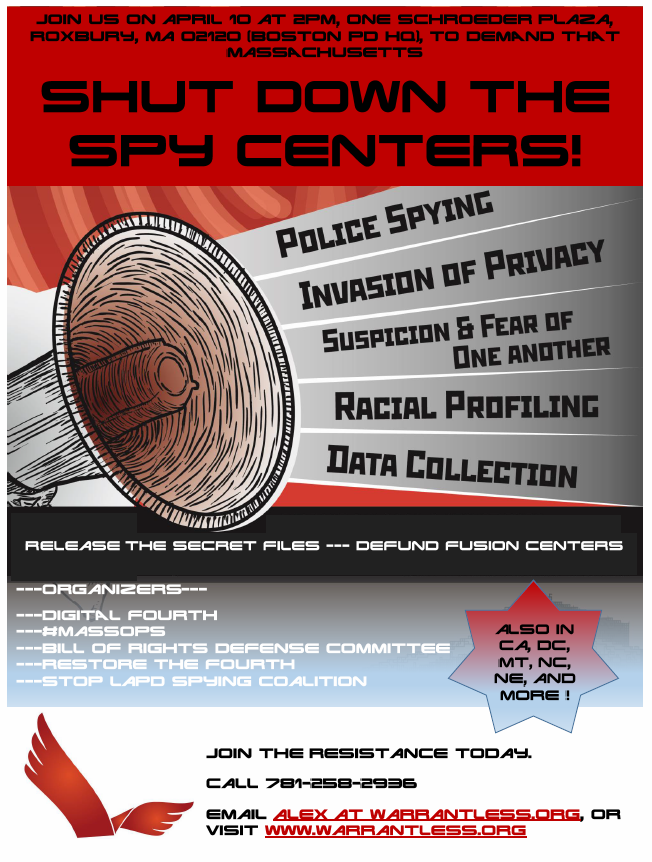
flyer

Categories
News Uncategorized

FBI: Look Mom, We “Found” Another Terrorist!

Nicholas_Teausant_Facebook

The news this morning is full of the arrest of yet another American on charges of “attempting to provide material support to a foreign terrorist organization.” Nobody’s suggesting that 20-year-old National Guardsman Nicholas Teausant of Acampo, CA is a terrorist, or that he provided any help whatsoever to terrorists, or that he was in contact, ever, with any actual terrorists. But, the media breathlessly report, he’s still facing charges that can put him in jail through to the 2030s.

Why?

Categories
Mission News

Digital Fourth Secures 100% Support for NSA Reform By MA’s US Reps and Senators

The main substantive reform of the NSA proposed in Congress, the “USA FREEDOM Act”, would ban bulk surveillance, require a Special Advocate to plead the case against surveillance at the Foreign Intelligence Surveillance Court, and force the publication of secret laws governing how surveillance is conducted.

At Digital Fourth, we have campaigned ever since the law was introduced to get 100% of Massachusetts’ federal legislators – Representatives and Senators – to cosponsor this legislation. Last week, with the cosponsorship of Rep. Richard Neal in Western Massachusetts, we achieved our goal, becoming the only state (other than Alaska and Montana) where that is true.

Right now, the USA FREEDOM Act has 141 cosponsors in the House out of 218 needed, and 21 cosponsors in the Senate. Its cosponsors are almost equally divided between Democrats and Republicans, sending a message that no matter who occupies the White House, people of all political beliefs have a stake in preventing mass surveillance.