Categories
Mission

Spying is Censorship

[We welcome our newest contributor, Gregg Housh, an activist focused on internet freedoms, censorship, over-prosecution and Anonymous. This article is cross-posted at 0v.org. – Alex.]

spyingiscensorship

It was February 6th, 2011 that I had to give some bad news to my wife. Her pseudonym (one she calls “as subtle as John Zeus”) was on the list of supposed “lieutenants of Anonymous” that Aaron Barr of HB Gary Federal had compiled. Barr’s intention was to identify the people involved in various projects on the AnonOps IRC network by connecting them to real social network profiles, and then to somehow parlay this data into brownie points with the FBI. And there she was, in the cross hairs.

Categories
Mission

Accountability and Intelligence: The Surveillance State’s Foreseeable Fall

I promised a longer and brighter view of where a world of mass surveillance is headed.

Surveillance means power, but it also means accountability. The deep state is trying to impose perfect accountability on others, and to preserve perfect unaccountability for itself. That can’t last. Employees of the deep state cannot be expected to have its back, when the deep state doesn’t have their back. The war on whistleblowers, and now the frantic ban by James Clapper on any deep state employees talking to the media without prior permission from their superiors, smack of panic, of a white-knuckle approach to the politics of information. The deep state knows that they can win individual battles, such as by imprisoning John Kiriakou or Chelsea Manning; with respect to their employees, their position appears to be that the beatings will continue until morale improves. They want to intimidate unauthorized leakers, and need a constant stream of Espionage Act prosecutions to do it with. However, they cannot, in the end, win this war.

Categories
Mission

Our Snowden research featured on Lawfare

In Lawfare today, Benjamin Wittes covers our new empirical research on the effect of the Snowden revelations on search engine behavior.

Categories
Mission News

High Over Compton: “Wide Area Surveillance” Surveils Entire Town

The Atlantic picks up on a story from the Center for Investigative Reporting that in 2012, the LA County Sheriff’s Department secretly tested a civilian surveillance aircraft by flying it over a town in their jurisdiction and taking high-resolution footage of everything visibly happening there, over a period of up to six hours (highlights are ours):

If it’s adopted, Americans can be policed like Iraqis and Afghanis under occupation – and at bargain prices:

McNutt, who holds a doctorate in rapid product development, helped build wide-area surveillance to hunt down bombing suspects in Iraq and Afghanistan. He decided that clusters of high-powered surveillance cameras attached to the belly of small civilian aircraft could be a game-changer in U.S. law enforcement.

“Our whole system costs less than the price of a single police helicopter and costs less for an hour to operate than a police helicopter,” McNutt said. “But at the same time, it watches 10,000 times the area that a police helicopter could watch.”

A sergeant in the L.A. County Sheriff’s office compared the technology to Big Brother, which didn’t stop him from deploying it over a string of necklace snatchings.

The town they chose? Compton. Yes, that Compton, but it’s not the same Compton as yesteryear. Its boosters are now touting it as the hip, countercultural Brooklyn of the LA area. It has an inspirational new Millennial mayor, Aja Brown, who has garnered comparisons to Cory Booker. Its crime rate is down sixty percent, and it’s now majority-Latino. But it still has a median household income of $42,335, and still, even after all its struggles, somehow found itself the first city selected for mass surveillance, over, say, majority-white, tony Santa Clarita (median household income $91,450). Well, blow me down with a post-racial colorblind goddamn feather.

In related news, the NSA, under its MYSTIC and RETRO programs, was revealed last month to have been collecting the contents of the phone communications of an entire country (unnamed, but probably Iraq).

Believe it or not, this is the program's actual logo.
Believe it or not, this is the program’s actual logo.

These two stories are essentially the same. Developments in technology allow law enforcement surveillance to sweep past legal constraints intended for an era where collecting, storing and analyzing so much data was inconceivable. In luckless Compton, the Supreme Court’s 1989 decision in Florida v. Riley renders “wide area surveillance” presumptively constitutional. In luckless Iraq, the expansive powers of Executive Order 12333 and the FISA Amendments Act impose effectively no constraints on the NSA in intercepting the communications of foreign nations.

May I draw your attention to three salient points?

Categories
Mission News

Cities around the country say: fusion centers are wasteful, fraudulent, and ineffective

[Guest post from Adwoa Masozi of the Bill of Rights Defense Committee.]

Screen Shot 2014-04-10 at 10.48.20 PMThursday, April 10, 2014 was a National Day of Action against Fusion Centers. Diverse, multiracial grassroots coalitions from around the country held rallies, press conferences, and creative actions to challenges civil liberties by fusion centers, which coordinate the surveillance activities of local police alongside federal agencies like the NSA and FBI. Fusion centers have operated at unknown cost, failed to meaningfully serve a public benefit, and drawn critics including Senators across the partisan spectrum, the ACLU, environmentalists, Muslim Americans, peace activists, and Ron Paul supporters.

Participating cities in yesterday’s action included: Boston, Charlotte, Dallas, Los Angeles, Oakland, San Francisco, and Washington DC. Below the jump are quotes from organizers, as well as photos and videos from several of the sites.

Categories
Mission News

No Way To Complain = No Complaints = No Problem!

Boston’s fusion center, the Boston Regional Intelligence Center, no longer hosts their privacy policy on their website – I was told that it was “under review” and that the new policy will be posted when it’s ready – so it’s lucky for all of us that the ACLU of Massachusetts has a copy of the policy. And it’s a doozy.

If you’re worried about the fusion center’s privacy practices, and that it may have gathered information on you that it shouldn’t, then you’re essentially out of luck. Sure, you can write to them (the address is Boston Regional Intelligence Center, Boston Police Department, Privacy Committee, One Schroeder Plaza, Boston, MA 02120, (617) 343-4328), but the Privacy Policy specifies that the only complaints they will accept or review are those where:

… an individual has a complaint with regard to the accuracy or completeness of terrorism-related protected information that:
(a) Is exempt from disclosure,
(b) Has been or may be shared through the ISE [Information Sharing Environment], or
(c) (1) Is held by the BRIC and
(2) Allegedly has resulted in demonstrable harm to the complainant

So, in essence, before a complaint can even be reviewed about a given piece of information, the complainant has to know what information the fusion center holds on them, and has to be able to make an allegation of “demonstrable harm” – harm, that is, in the eyes of the BRIC. And there’s no procedure for complaining about the collection of monstrous quantities of data in the first place – only for circumstances where they have collected, and acted upon, something provably false about you personally.

That’s some catch, that catch-22.

Wonder how many people have successfully complained?

And by definition, if nobody’s complaining, they must be respecting our privacy, right?

In fact, they’re respecting our privacy so much, that they are aggregating data from the following sources (this is just the ones they’re acknowledging, summarized from the list in the appendix of their privacy policy):

“Telephone analysis software”, state crime information systems, national crime information systems, the state drivers’ license database, the Lexis-Nexis “Accurint” database, Thomson-Reuters’ “CLEAR” database [now integrated with Palantir!], “intelligence data” [up to and possibly including unminimized data collected via FISA], the Regional Information Sharing Systems (RISS) System, the Law Enforcement Online system, the Homeland Security Information Network (HSIN) System, jail management databases, the Financial Crimes Enforcement Network (FinCEN) System, state sex offender registries, “crime-specific listservs”, RSS readers, the High Intensity Drug Trafficking Areas (HIDTA) Program database, EPIC hospital records, the National Drug Intelligence Center (NDIC) database, state corrections/probation databases systems, and juvenile justice databases.

Based on information provided by BRIC employees on their LinkedIn profiles (thanks, guys!), we can also determine that the BRIC has access to gang databases, information from the Department of Youth Services, and “medical intelligence”, defined by the Department of Defense as “That category of intelligence resulting from collection, evaluation, analysis, and interpretation of foreign medical, bio-scientific, and environmental information that is of interest to strategic planning and to military medical planning and operations for the conservation of the fighting strength of friendly forces and the formation of assessments of foreign medical capabilities in both military and civilian sectors.”

So if you’ve never made an electronic financial transaction, never used the phone, never had a drivers’ license, never communicated with somebody abroad, never been in trouble with the law, never used drugs, and never been to a hospital abroad for treatment, then congratulations: you’re probably not in the fusion center’s database, and you still have a Fourth Amendment. And for the rest of us, they have records on you, that they aren’t going to allow you to review, and there’s nothing you can do about it. Why should you be concerned?

In related news, the BRIC is changing its slogan to “Share and Enjoy.”

Categories
Mission

Commonwealth Fusion Center Violates Constitution, New Report Says

minorityreport

Massachusetts has two “fusion centers”, mostly state-funded, which aggregate enormous amounts of data on innocent Massachusetts residents, with the notion of preventing terrorist attacks. When you call the “See Something, Say Something” line, the information goes into “Suspicious Activity Reports.” The ACLU of Massachusetts documented that the Boston fusion center (“BRIC”) had actually spent its time harassing peaceful activists rather than thwarting terrorism, which is one of the reasons why there will be nationwide protests against fusion centers on April 10, including in Boston.

In response to the ACLU revelations, Rep. Jason Lewis (now the newly elected Sen. Jason Lewis) filed a fusion center reform bill on Beacon Hill. Disconcerted at the prospect of more sunshine on their work, the Commonwealth Fusion Center, the fusion center in Maynard, offered him and other legislators a courtesy tour of their facility, to try to explain what good work they were doing. As an example of that work, they cited their First Amendment-violating harassment of an Arlington man who was not actually planning any violent crime, but who had tweeted about it being a good idea to shoot statists. They also provided to Rep. Lewis copies of various policies that they follow, including their Privacy Policy (updated 06.13.2013) and their policy on First Amendment investigations. Rep. Lewis then asked Digital Fourth to evaluate the policies they had provided, to assess whether they were constitutional. We enthusiastically agreed, and the resulting report is here.

Here are our main recommendations:

Categories
Mission News

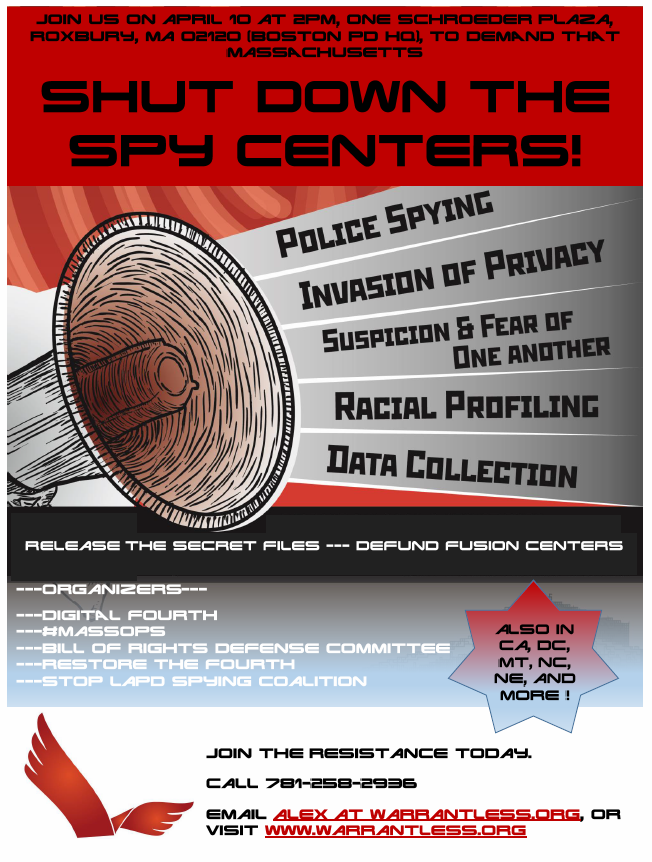
Shut Down The Spy Centers, April 10, 2pm

[CORRECTED TIME: 2PM EST]

The New York Times revealed last week that the National Counterterrorism Center now has access to all data, not minimized for privacy in any way, that was authorized for collection via the Foreign Intelligence Surveillance Act, or FISA. That includes the phone metadata dragnet on all US calls, and much else besides.

Sounds legit? It really isn’t. This is why. NCTC provides an enormous amount of data to the now-80+ “fusion centers” around the country. These spy centers act as clearinghouses where federal and local law enforcement data meet; Massachusetts’ ones are run out of the Massachusetts State Police and the Boston PD. So what does this revelation – again, coming to us courtesy of Edward Snowden & Co. – mean? It means that local police forces across America, without a warrant or subpoena of any kind, are able to access what the NSA has on you – and, as we already know, they’re collecting everything they can on everyone. In consequence, the Fourth Amendment now only exists for you if law enforcement (a) isn’t that interested in you or (b) has everything it wants on you already. That’s not much of a “right” at all. It’s more of a trivially revocable privilege. Imagine: any time you get stopped by the police, for any reason, they can now provably access the last five years of, say, your movements by car and your phone communications.

So, Digital Fourth, the Stop LAPD Spying Coalition, Restore The Fourth, and the Bill of Rights Defense Committee, have teamed up to launch a series of nationwide “Shut Down The Spy Centers” protests. Be there or be scared!

And if you find this idea as shocking as we do, and would like to help us, we’re accepting donations here and volunteers here.

flyer

Categories
Mission News

Digital Fourth Secures 100% Support for NSA Reform By MA’s US Reps and Senators

The main substantive reform of the NSA proposed in Congress, the “USA FREEDOM Act”, would ban bulk surveillance, require a Special Advocate to plead the case against surveillance at the Foreign Intelligence Surveillance Court, and force the publication of secret laws governing how surveillance is conducted.

At Digital Fourth, we have campaigned ever since the law was introduced to get 100% of Massachusetts’ federal legislators – Representatives and Senators – to cosponsor this legislation. Last week, with the cosponsorship of Rep. Richard Neal in Western Massachusetts, we achieved our goal, becoming the only state (other than Alaska and Montana) where that is true.

Right now, the USA FREEDOM Act has 141 cosponsors in the House out of 218 needed, and 21 cosponsors in the Senate. Its cosponsors are almost equally divided between Democrats and Republicans, sending a message that no matter who occupies the White House, people of all political beliefs have a stake in preventing mass surveillance.

Categories
Mission

Friends Don’t Let Friends Support the NSA

Building on work by Christopher Soghoian, local data visualization expert MC McGrath has come up with a fascinating exploration of the network of firms and agencies supporting the major electronic surveillance programs run by NSA and GCHQ, using data scraped from the individual LinkedIn profiles of people advertising their expertise in those particular programs.

To explore just one tiny corner of this visualization, the NSA has a program called “DISHFIRE” which collects SMS messages. The SMS messages of suspected terrorists? Bless your heart, no! Everybody’s SMS messages. The visualization makes clear that every branch of the military draws on people with DISHFIRE expertise, and that certain private companies appear to do so too – DC area-based companies with anodyne names like L-3 Communications (“Our products and services play a critical role in the protection and defense of freedoms worldwide”) Six3 Systems (“High quality Signals Intelligence (SIGINT) and Counterterrorism solutions”), and PiccoTek (“Uniquely talented people with the right “can do” attitude”).

I’m glad they’re so positive about their work. How devastating it would be if the employees of these firms raking in vast quantities of tax dollars in exchange for smoothing the broad downward path toward turnkey tyranny, felt, in unguarded moments, a crawling sense of unease. Trawling through their profiles, it’s easy to find a certain defensiveness in tone – they’re saving “countless lives everyday“? Really?

Most of the people who list this program in their LinkedIn profiles are or have been in Afghanistan, a country we never should have invaded, and which we’re still in thirteen long years later in America’s longest ever war. If it were me, maybe I’d have to believe that I was “saving countless lives” in order to make it seem worth while.

And so they beaver away, in Virginia and Afghanistan and many other places, devising more and more refined technological solutions to the problem of detecting anti-American sentiments people are texting to one another; and it seems impossible to have us stand back and look at whether it is truly productive to expend so much energy squashing – sometimes in a very literal way – every hint of dissent.

drones-seamless

…But in matters of vital importance – meaning, in effect, war and police espionage – the empirical approach is still encouraged, or at least tolerated. The two aims of the Party are to conquer the whole surface of the earth and to extinguish once and for all the possibility of independent thought. There are therefore two great problems which the Party is concerned to solve. One is how to discover, against his will, what another human being is thinking, and the other is how to kill several hundred million people in a few seconds without giving warning beforehand. In so far as scientific research still continues, this is its subject matter. The scientist of today is either a mixture of psychologist and inquisitor, studying with real ordinary minuteness the meaning of facial expressions, gestures, and tones of voice, and testing the truth-producing effects of drugs, shock therapy, hypnosis, and physical torture; or he is chemist, physicist, or biologist concerned only with such branches of his special subject as are relevant to the taking of life. Orwell, 1984.

Listen. The NSA’s purpose is very simple. It’s not to thwart terrorist attacks. It’s to buttress empire, over there, and, through use of the exact same tools developed to “thwart terrorism”, over here and in our towns and schools as well. The money flows towards them, and towards their work of destruction; and is sucked away from our vulnerable, our poor, our schools and our towns. Our own ability to voice sentiments opposing the decisions of the American government, or to enjoy due process protections before being deprived of life or liberty, look increasingly like localized exceptions to a different and worse rule we have been imposing on the rest of the world, and now also on various categories of people deemed unacceptable here at home.

So I’ll say this now: Friends don’t let friends support the NSA, its associated agencies or its nexus of security firms that feed off of and sustain it. If you know people who work for them, help them find a better line of work. They have better things to do with their lives, and it is not yet too late. We are already working with former intelligence people who have grown disenchanted with what their country asked them to do, and there are a thousand Snowdens waiting in the wings.

Help them. Join us. Support our movement. Spend your time really “protecting and defending” the freedom of your neighbors and fellow people, instead of the revenues of a machine that profits directly every single time the Constitution is violated by an unwarranted intrusion on our lives.

May we all, one day, be left in peace – peace here, abroad, and with each other.