Categories
Mission News

Thou Shalt Not Connect The Dots: FBI Flat-Out Refusing All FOIA Requests From MIT PhD Candidate, Because He Might Learn Too Much

eco-enigma

Item #2 on the NSA’s Official Talking Points to Justify Mass Surveillance (see p. 3) is “The NSA And Its Partners Must Make Sure We Connect The Dots So That The Nation Is Never Attacked Again Like On 9/11.” The government is fighting furiously against any attempt to restrict, say, its collection of metadata on all US telephone calls, because they argue that only collecting everything enables them to detect patterns and conduct analyses that would otherwise be impossible.

But what happens if instead of the government, the public starts using the same tools on the government? What happens when the burning eye of the surveillance state is turned back on itself?

Mother Jones reports that that’s what MIT PhD candidate Ryan Shapiro is doing. He has long been active in the field of animal rights, and became interested in the FBI’s characterization of “the eco-terrorism animal rights movement” as “the number one domestic terrorism threat” that we face. He has figured out a way of getting responses to FOIA that is so effective that the FBI is going to court to stop him.

Categories
Mission News

Sauce for the Gander: Boston Police Officers Apparently Don’t Like Being “Followed All Over The Place”

sauce_for_gander

From the ACLU of Massachusetts:

Boston Police Department bosses want to install GPS monitoring devices in every patrol car, to enable dispatch to more efficiently process 911 calls. But police officers and their union are outraged, saying that the ubiquitous tracking is too invasive of their personal privacy. Tracking the location of officers as they go about their days would reveal incredibly detailed information about their lives, the officers say.

It must be just awful to go about your daily life looking over your shoulder, conscious that your every movement and activity is being recorded and could be used against you. Oh, wait. That’s what the entire American public is already dealing with, in this age of mass electronic surveillance. But the way the police union is hissing’n’flapping about it, it’s almost as if there was something wrong with that. Don’t they know that you have nothing to fear, if you have nothing to hide?

The ACLU’s tack is that if the police don’t like the feeling of being followed, they shouldn’t be pushing for technologies like mass tracking of license plates or cellphone locations. That’s fair enough, but there’s a larger point here also.

Police officers are public employees, and they would be monitored during, and only during, the performance of their duties as public officials employees. We require elected officials to disclose their votes publicly, and require secrecy for private individuals at the ballot box, even though that’s inconsistent, because public disclosure of how public business is conducted is vital to maintain democratic accountability. In the same way, close monitoring of law enforcement is vital, to ensure that police don’t abuse the vast and special powers society gives them. When you put cameras on cops, complaints about police misbehavior and brutality drop like a stone. We have the right – affirmed by the federal courts in the First Circuit and across America – to record the police in the commission of their duties. The Fourth Amendment constrains the actions of the government, not the actions of members of the general public.

The Boston police may not like it – last week’s PINAC case shows that they’re willing even to threaten people with felonies to avoid public embarrassment over misconduct – but they are not entitled to a high level of privacy protection in their capacity as police officers. That distinction matters. Doxxing police officers’ personal names and phone numbers and addresses is not cool. But recording them, having them record themselves, and encouraging people to call their office numbers and hold them accountable to the public, is vitally important in order to preserve freedom for the rest of us.

Categories
News

Justice for Army Spc. Denis Reynoso

We like to think that we’re safe in our homes, and that if we need the police, we can call on them to help protect us. That’s what we tell our children – I have two – and I’d like to think it was more consistently the truth than it is.

Today’s story comes from Lynn, MA, which in September saw an Army reservist shot to death in his home by police in front of his five-year-old son.


Army Spc. Denis Reynoso

Police were called after Spc. Reynoso yelled at a man, who then drove away. Two police officers arrived at the Reynoso home on Newcastle Street in the King’s Lynne housing complex, and they appear to have entered the home without either a warrant or the permission of the residents, which would clearly violate the Fourth Amendment. The police version of events is that during the ensuing argument, Spc. Reynoso lunged for one of the police officers’ weapon, and fearing for their lives, the police fatally shot him. The family point out that there is no way to confirm that Spc. Reynoso did lunge for an officer’s gun, and no public information as to why he might do so; that he was unarmed, that they shot him anyway, and that they then searched the house for any drugs or contraband that would provide justification for their actions, without a warrant and without finding anything.

The excuse used by the police – that he “lunged” for the gun – is inherently unprovable. It’s such a hoary old chestnut when it comes to defending the indefensible that it has been immortalized in song. Perhaps that’s why they thought of it.

Categories
Mission News

What Does The “USA Freedom Act” Really Say?

Photo credit: The Daily Dot

Sen. Patrick Leahy (D-VT) and Rep. Jim Sensenbrenner (R-WI), one of the original authors of the USA PATRIOT Act, jointly introduced an NSA reform bill on October 29. Rep. Sensenbrenner has clearly not lost any of his love of elaborate nationalistic acronyms in the intervening years, and named his bill the ‘Uniting and Strengthening America by Fulfilling Rights and Ending Eavesdropping, Dragnet-collection, and On-line Monitoring Act”, or “USA FREEDOM ACT”. For once, the content of a bill proposed in Congress may actually bear some relation to its title, in that it appears to be a sincere effort to rein in several of the worst abuses at the NSA.

However, what has not been clear in the reporting on the Act is the specifics of what the Act actually does. A quick look at the original text shows why. As one activist lamented, “Unfortunately, the text is exceptionally hard to read … It would be much easier to read if the full text was collated with the current statutes.” Indeed it would. Luckily, Digital Fourth is on hand to provide a more detailed guide to its (very densely written) contents than is presently available.

For those who want a high-level summary of the bill, the ACLU has provided one here. What follows is a low-level, section-by-section summary of how the bill changes current law. We welcome updates and corrections as we go forward.

Categories
Mission News

StopWatchingUs DC rally rocks out: 3,000+ people call for NSA reforms

This Saturday, DC saw something it had never seen before.

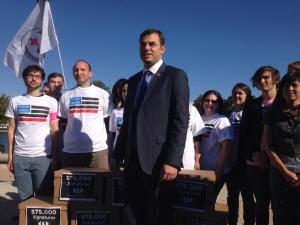
A city that treats the superficial hatreds of party politics as its lifeblood, saw thousands of people from across the political spectrum gather to denounce NSA mass spying. We heard, and roared approval for, the words of feminist Naomi Wolf, Dennis Kucinich (Democrat), Justin Amash (Republican), and Gary Johnson (Libertarian). Kymone Freeman spoke movingly about the impact of surveillance on minority communities and the civil rights movement. Whistleblowers Thomas Drake and Russell Tice were there, and Edward Snowden sent a message to be read by leading whistleblower-protecting attorney Jesselynn Radack. Tea Party people up from Richmond, VA, proudly put on Code Pink stickers labeled “Make Out Not War”. The press reported wonderingly that it was not put together “by any of the “usual” well-connected DC organizers.” I should know: I’m proud to say that, in a small way, I was one of them, and this was the first time most of us had done anything like this.

That wasn’t all. Here in Boston, activist Joan Livingston put together a solidarity rally at Park Street Station:

and ACLU organizer Raquel Ronzone arranged for the rally to livestream at the Digital Media Conference in Cambridge.

If you want updates on the StopWatchingUs campaign going forward, text “PRIVACY” to 877877. Stay tuned for the next stage of the campaign, which will be to pass the “USA FREEDOM Act.” Personally, just to hammer home the point, I’d have preferred the “USA FREEDOM Fourth Amendment Restoration – Objective: Undermining Tyranny Act of 2013”, because I too can do acronyms, but such frivolity is apparently frowned upon in the legislature that gave us the Uniting (and) Strengthening America (by) Providing Appropriate Tools Required (to) Intercept (and) Obstruct Terrorism Act of 2001 in the first place.

UPDATE: Oh yeah, I nearly forgot. I’m the tall guy to the left of Rep. Amash!

BXhn9hYCYAEoV-b

Categories
Mission News

MA-5: Addivinola and Clark tussle over surveillance, differ only on wiretapping bill *UPDATED*

clark_winsaddivinola

UPDATE: To reflect substantive changes in information received from the Addivinola campaign, the title of this article and portions of the analysis have been changed to more accurately reflect Councillor Addivinola’s positions.

The primaries are over, and two very different candidates are facing off in the December 10 general election: State Senator Katherine Clark (D) and Frank Addivinola (R). Both candidates have responded to the Digital Fourth questionnaire on surveillance issues, so we can compare their positions directly and in their own words.

We gave the same questionnaire to all seven Democratic primary candidates, but the strongest opponents of government surveillance (Long, Sciortino and Spilka) did not make it through the primary. Here are the results for the remaining two candidates.

Categories
Uncategorized

New England mobilizes against the surveillance state: Updates from ME, NH and RI

In the states and the cities of New England, unparalleled, cross-partisan, cross-racial coalitions are forming, bringing together libertarians, Tea Party people, technologists, peace and environmental activists, Occupy folks, veterans’ groups, people of color, religious groups and progressive Democrats. The nation may never have seen people of such disparate views united under one banner.

Three examples from just this last month:

Categories
Uncategorized

Thousands to Rally in DC Against Mass Surveillance on Patriot Act Anniversary 10/26

We’re now at over 4,000 signups for the Stopwatching.us anti-NSA rally down in DC this Saturday!

We’re looking for people who are driving down to DC from New England and have space in their car for fellow protesters: please email me if that’s you!

flyer-social

We’ll deliver a petition with over half a million signatures to Congress, We’ll demand real NSA reforms and an end to mass surveillance programs that do an end-run around the Fourth Amendment. It’s time for the lies to end.

To sign the petition: https://optin.stopwatching.us/
To join the rally: https://rally.stopwatching.us

Details below the fold:

Categories
Mission News

Clark Primary Victory May Be Good For Digital Privacy

In a seven-way primary with an all-star cast, Sen. Katherine Clark won the nomination for Democratic candidate for the U. S. House in my own district of MA-5, one of the most Democratic districts in the nation (D+22).

clark_wins

She now faces Boston resident Frank Addivinola in the general, but it would essentially take a meteor strike for her to not head to Congress.

Here at Digital Fourth, we’ve been tough on Sen. Clark for her cosponsorship of Martha Coakley’s proposal to expand electronic wiretapping. Our #MassWiretap campaign gathered over 4,000 signatures against that bill, and it became an issue in the campaign, producing third-party negative ads against her from the Progressive Change Campaign Committee.

Curiously, though, there’s an argument that Sen. Clark’s victory in the primary may be positive for digital privacy. Let me explain.

Categories
Mission News

The MA-5 Democratic Candidates on Surveillance: Who Does Best? *UPDATED*

Here in the heavily Democratic Fifth District of Massachusetts, we know that the winner of October 15th’s Democratic primary will reliably win the general and go to Congress. The seat was last open almost 40 years ago. Bearing that in mind, we at Digital Fourth thought it pretty important to assess the Democratic candidates’ positions on the hot issue of surveillance, while the district’s registered Democrats still have a chance to affect the outcome.

We sent a standard questionnaire to all seven candidates running in the primary. We asked about whether the candidate supported requiring warrants for searches of digital data (ECPA reform); whether they would defund the “fusion centers” that capture data and generate reports on peaceful activists; whether they support the Mass. Attorney-General and Senator Clark’s proposal to expand electronic wiretapping; whether they would vote for the Amash-Conyers Amendment reining in the NSA; and finally, whether they would support Rep. Rush Holt (D-PA)’s “Surveillance State Repeal Act”, which would repeal the PATRIOT Act and the FISA Amendments Act and provide protection for government whistleblowers.

All except Sen. Karen Spilka and Mr. Paul John Maisano were kind enough to respond in detail, and we have done our best to reconstruct the positions of these two candidates from past votes and public statements.

UPDATE: Sen. Spilka has provided answers to the questionnaire that place her in equal first place on surveillance, along with Rep. Carl Sciortino and Mr. Martin Long.

So, for your reading pleasure, here’s the Surveillance Voter’s Guide to The Democratic Field in MA-5!