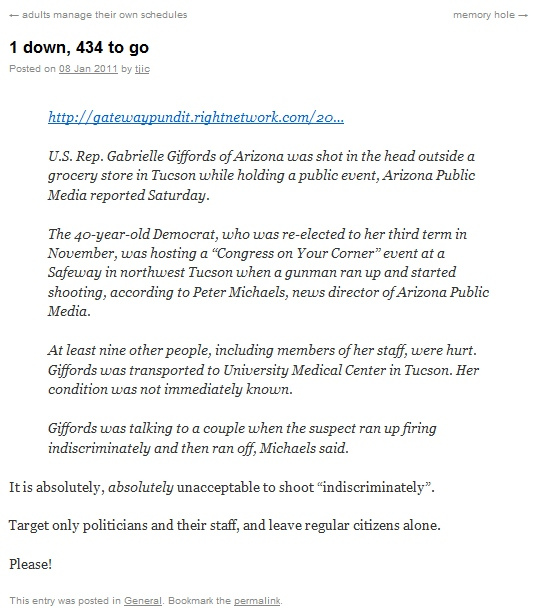
Corcoran lives in Arlington, Mass., and till July 4 of this year, the self-described “anarcho-capitalist” made his living running comic book store Heavy Ink. He first ran into trouble after the shooting of Congressman Gabby Giffords, when he posted the following:
In response, the police apparently temporarily took Corcoran’s firearms license, and some customers of Heavy Ink organized a boycott.
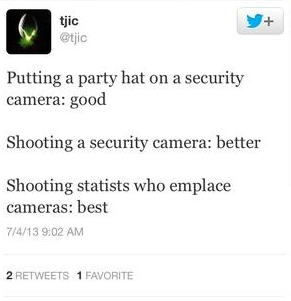
On July 4, in an apparent response to the heavy security measures proposed for the Esplanade, he made another violently-themed tweet:
Unlike with the Long Island case, Corcoran was not simply searching for something that someone malevolent might also search for: anybody could do that. He was fantasizing about violence, but in a way that is not specific to any named individual. So let’s have a look at the law on such threats, and then I’ll let you know what has happened to Corcoran. I’d welcome your thoughts on what should have happened.
Long Island freelance writer Michele Catalano reported two days ago on a deeply disturbing incident where six officers from an undisclosed agency came to her family home:
At about 9:00 am, my husband […] saw three black SUVs in front of our house; two at the curb in front and one pulled up behind my husband’s Jeep in the driveway, as if to block him from leaving. Six gentlemen in casual clothes emerged from the vehicles and spread out as they walked toward the house, two toward the backyard on one side, two on the other side, two toward the front door. […] He could see they all had guns holstered in their waistbands. “Are you [name redacted]?” one asked while glancing at a clipboard. He affirmed that was indeed him, and was asked if they could come in. Sure, he said. They asked if they could search the house, though it turned out to be just a cursory search.
The “gentlemen” pepper her husband with questions about pepper cookers and backpacks; about where he’s from, about his wife, about their parents and their reading habits. They say that “they do this about 100 times a week. And that 99 of those visits turn out to be nothing.”
How reassuring.
It appears that Suffolk County CID had received a tip from “a Bay Shore based computer company” about the Google searches of a former employee, Ms. Catalano’s husband, who had searched while at work for terms including “pressure cooker bombs” and “backpacks” – the former because he was curious about how the Boston Marathon bombing had happened, and the latter because they were in the market for new backpacks.
It’s still unclear exactly what agency the “gentlemen” were from. The FBI and the Joint Terrorism Task Force are both denying involvement. Nor do we know exactly why such Google searches triggered a full-court press from no fewer than six officers. But there are two important points that arise out of this story.
One is how blunt the tools of Internet surveillance are. Your Google search for “pressure cooker bombs” tells the authorities only that you are interested in pressure cooker bombs at that moment. As part of my research for this article, I just put it into Google myself. It doesn’t tell them why, and by itself is not evidence of any criminal intent. Nor does separately searching on the word “backpacks” help to establish such an intent. If we were still operating in a world where the Fourth Amendment were consistently applied, this evidence alone would not be nearly enough to demonstrate probable cause to a judge that the person in question was engaged in or planning criminal activity. Instead, we’re operating in an environment of high governmental paranoia about people’s search activity, where agencies have to find ways of justifying an over-muscled and over-funded security state.
The second point is that we don’t know whether a warrant was issued, or whether the “gentlemen” felt that one was needed, because Ms. Catalano’s husband did not assert his Fourth Amendment rights (and may in fact have been afraid to do so). He could have refused them entry without a warrant; they may or may not have complied; but he had every right to refuse. It’s just not something many people think of doing, and in consequence law enforcement feels able to intrude on our homes at will. Like the “gentlemen” in Buffy, their success depends on our silence.
UPDATE: The author of this testimony has taken it down. Whether it was false, he had deeply misunderstood what was going on, or he was scared into withdrawing it, it can no longer be considered reliable.
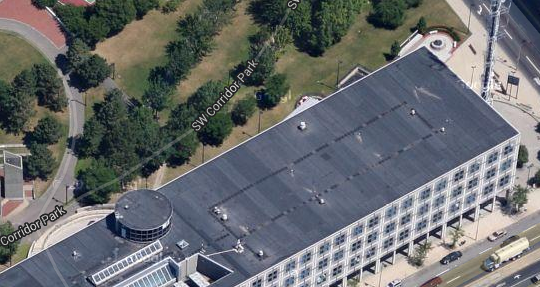
Join #MassOps, Restore the Fourth, and the Massachusetts Pirates on Sunday, August 4th (19-8/4) in the SW Corridor Park behind Boston Police HQ and the Boston Regional Intelligence Center (BRIC), just round the corner from the Ruggles T stop on the Orange Line. There will be food, training in cryptographic techniques, barbecue, and a series of great speakers.
Confirmed speakers include: Alex Marthews – President, Digital Fourth (that’d be me); Kinetic Theorist – Founder, MassOps; Chris Faraone – Journalist, Author, Mensch; Nadeem Mazen – Candidate, Cambridge City Council; Kade Crockford – ACLU activist; Jeffrey Nunes – Occupy activist; (Name withheld by request) – Activist targeted by the BRIC; Steve Revilak – Quartermaster, Mass Pirate Party; Joan Livingston – Veterans for Peace; Dan Consigli – Student; + Gabriel Camacho of the American Friends Service Committee.
From 5pm-6pm, the Mass Pirates will hold a “Cryptoparty”. Bring your laptops and find out how to protect yourself and your data from the surveillance state; if you have them, bring binoculars (quis custodet ipsos custodes?).
For background on the fusion centers issue, and on how they spy on innocent Boston residents and label them as extremists, see our previous reporting here.
The last few days have seen extraordinary scenes in the House of Representatives.
Arab-American Republican Congressman Justin Amash, who at the age of 33 should have almost zero influence in the House, brought forward an amendment to ensure that the government’s collection of records under Section 215 of the Patriot Act is limited to those records that pertain to a person who is subject to an investigation under that provision.
Senator Katherine Clark, the Senate Co-Chair of the Judiciary Committee who is also running for Congress in Ed Markey’s old district, is penning op-eds in defense of her positions on privacy legislation. She supports warrant protection for electronic communications, which is great news for the Fourth Amendment here in Massachusetts.
However, she also supports the Attorney-General’s proposed “update” to the wiretapping laws. Both she and the Attorney-General make the case for an update by relying heavily on a comment by Justice Gants in the Supreme Judicial Court’s 2011 ruling in Commonwealth v. Tavares. This decision overturned a (first) conviction of murderer Paulo Tavares, on the ground that the state’s evidence had been gathered in violation of the state’s electronic wiretapping laws.
Let’s look at that decision a little more closely.
Alex Marthews (Digital Fourth), Pat Scanlon (Veterans for Peace), Kit Walsh (Harvard Law) and Carol Rose (ACLUm) testifying at Judiciary hearing
Yesterday, starting at 1pm and stretching long into the night, the Massachusetts Legislature’s Joint Committee on the Judiciary held a hearing on pending legislation, including on many privacy and surveillance-related bills. Members of the public started lining up more than an hour beforehand, trying to get on the list to testify not just on the privacy bills but on domestic violence protections, transgender rights, immigrant rights and animal cruelty. By 1pm, the crowd numbered in the hundreds, and the room was obviously not going to hold all of us, so we got moved to the much larger Gardner Auditorium which (just about) held everybody.
Over 150 people are already coming to the rally to Restore the Fourth tomorrow in Boston. Thousands more will be rallying across the country. But this is Massachusetts. We invented the Fourth Amendment, and people will be watching Boston more than any other city tomorrow. Come with us and let the government know that we don’t need their fearmongering, and will not allow them to take our liberties.
Schedule
09:00 – 10:00: Gathering outside the Old State House in preparation for the day.
10:00 – 11:00: Listening reverently to the Declaration of Independence. Be respectful: save the protesting for after.
11:00 – 12:00: Talking with the crowds that gathered for the reading, followed by a peaceful “Cease and Desist” action at mobile stores to protest at their cooperation with the NSA. Then to Boston Common.
12:00 – 13:00: We’ll be demonstrating on the Common, as well as gathering signatures against the upcoming MA wiretapping bill. This bill aims to expand the Commonwealth’s use of electronic surveillance against its residents.
13:00 – 14:00: Make our way to Dewey Square.
14:30 – 17:00: March throughout Boston including Faneuil Hall and the Esplanade.
What to bring
Water (in clear plastic containers)
Fliers if you can print them (don’t print too many, they’ll likely get thrown away)
SIGNS. Lots of signs. Here are some ideas we came up with for some slogans.
Restore the Fourth!
No Warrant, No Search
Repeal the Patriot Act / NDAA
Don’t Spy on Me
Abolish DHS
No “Random” Searches
Save Edward Snowden
No Secret Courts
Are you a lawmaker? Maybe, a lawmaker with aspirations for higher office? Maybe you’d like to be President someday? Do you think the NSA spying programs are just peachy because Terrorism? Well, why don’t you just punch yourself in the face right now?
Let’s you and I have a little talk about those aspirations you have, with close reference to this week’s revelations from NSA whistleblower Russ Tice, shall we?
After I posted an article giving Digital Fourth’s view on the wiretapping law on Blue Mass Group, Massachusetts’ largest Democratic blog, we got some attention from Mr. Brad Puffer, Director of Communications for the Mass Attorney General’s office. They seem put out. Maybe they didn’t like the lede, “Coakley Channeling the NSA?” 🙂
The above blog post includes inaccuracies that are highly misleading about the changes our office has proposed to the currently outdated Massachusetts wiretap law. Updating the wiretap law is a critical tool to combatting gang violence, gun violence, human trafficking, and many other violent crimes that undermine public safety in our communities. And equally important to what it does, is what it does not do. One thing it does not do is alter in any way the many safeguards already put in place under the current wiretap statute to protect against abuse.
I will explain some of the benefits of this new law further below, but first want to correct some of the inaccuracies in this blog post:
1) The proposed update to the wiretap law does not legalize mass interception of telecommunication switching stations. Each wiretap must be applied for and authorized individually by a Superior Court judge.
2) Marijuana possession is not eligible for a wiretap. Only serious designated felonies in the statute would be covered. According to federal law, only crimes with a minimum one year prison sentence are eligible for a wiretap.
The current wiretap law has not been updated since 1968, back when criminal activity and technology was vastly different. In 1968, the law was focused on “organized crime.” A 2011 SJC decision that upheld the suppression of statements obtained by a wire interception during a murder investigation stated very clearly that the investigation and prosecution of some of today’s most destructive crimes, including street violence, are hampered by this antiquated statute. The SJC urged an update to the law.
The updates we seek are common-sense and concise, including:
• Bringing the law up to date with technology: The legislation acknowledges that today communication is largely electronic and wireless. By updating the definition of “wire communication,” the bill makes explicit the law’s application to cellular and text technology without tailoring the definition so narrowly as to foreclose future technological developments.
• Removing the organized crime requirement: Currently, criminal activity that is the subject of a wiretap must have a connection to organized crime. The majority of street violence and gun crimes today, though often tied to looser organizations, nevertheless lack the traditional hallmarks of organized crime.
• Including additional violent or egregious crimes as designated offenses: Prior to seeking a warrant for a wiretap, law enforcement must establish probable cause that a “designated offense,” as defined in the statute, has been committed. The current list of designated offenses does not include some of the most violent and egregious crimes that law enforcement must investigate and prosecute today—and that the Legislature has correctly passed since the law’s inception— including human trafficking; firearms offenses; and child pornography offenses.
The law also maintains extensive safeguards that already exist under current law. First, any wiretap must be requested and signed by either the elected Attorney General or District Attorney and then authorized by a Superior Court judge. The judge can only authorize a wiretap for serious felonies where there is probable cause that a designated offense has been committed, and after all other investigative techniques have been exhausted or will not be successful. There are additional safeguards that ensure that only the conversations with direct correlation to the alleged crime are recorded and then permissible in any legal action.
For all of these reasons, these updates are supported by district attorneys, police, mayors, and many other community leaders who know that the only way that we will be able to better keep our communities safe is to give our investigators effective tools, with proper safeguards, to take the most dangerous criminals off the streets.
You can find more information about the proposed bill here:
http://www.mass.gov/ago/news-and-updates/press-releases/2013/2013-01-28-wiretap-legislation.html
Sincerely,
Brad Puffer
Director of Communications
Office of Massachusetts Attorney General Martha Coakley
Did we hit a nerve here?
Let’s take the assertions in the Puffer piece one by one.
In a week of devastating disclosures about government surveillance, here’s one ray of light.
The ACLU of Massachusetts reports the Massachusetts Supreme Judicial Court‘s verdict in Commonwealth v. Rousseau. In separate trials, John Rousseau and Michael Dreslinski were each convicted of four charges relating to a spree of burning and vandalizing properties. As part of their case, law enforcement had obtained a warrant to place a GPS tracker on Dreslinski’s truck for 15 days, which was then renewed twice. Two issues came up: whether GPS tracking needed a warrant anyway, and whether Rousseau had standing to challenge the warrant as he had no property interest in Dreslinski’s car.