The long-running case Panagacos v. Towery deals with the two-year-long infiltration by fusion center employee John Towery of peace groups including Students for a Democratic Society, the Olympia Movement for Justice and Peace, the Industrial Workers of the World, Iraq Veterans Against the War, and an anarchist bookstore in Tacoma (probably this one). Towery is technically a military employee, and courts are typically highly deferential to the military. However, the most recent ruling at the Ninth Circuit Court of Appeals allows the plaintiffs from these organizations to continue with their First and Fourth Amendment claims against the military. The National Lawyers Guild, which is involved in the case, believes this to be “the first time a court has affirmed people’s ability to sue the military for violating their First and Fourth Amendment rights”.
Good.
There are obvious analogies here to the Boston PD’s gross violations of protesters’ rights documented in the ACLU of Massachusetts’ Policing Dissent report this fall. Again, we see the fusion centers act as a nexus for the investigation and disruption, not of actual terrorist plots, but of peaceful opponents of the military-industrial complex here at home.
Science Daily reports that one of the technological limitations on cellphones’ tracking capabilities is about to be lifted.
A research team led by Professor Dong-Soo Han of the Department of Computer Science at the Korea Advanced Institute of Science and Technology has developed a way of locating cellphones using their WiFi fingerprints to within 10 meters in indoor locations in cities.
The article is pretty gung-ho about the capabilities of this new technology, though they also report Professor Han as suggesting that “There seems to be many issues like privacy protection that has [sic] to be cleared away before commercializing this technology.”
Yes, Professor Han. That may be something of a concern.
In particular, may I ask, pretty please, that legislators considering bills to protect the privacy of cellphone users’ location data, bear in mind that this kind of indoor location detection has been shown to be possible? I give law enforcement oh, about five minutes after the commercial release of this technology before they start using it in investigations.
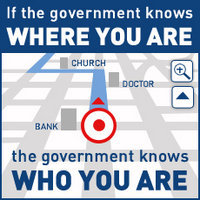
H/T to the ACLU for this graphic
The obvious Fourth Amendment issue here is that the current rulings allowing law enforcement use of cellphone data tend to rely heavily on the fact that when you are outdoors, you are not generally held to have a reasonable expectation of privacy, and that your location is reasonably observable to members of the public. If cellphones become capable of tracking you indoors, where you do typically have a reasonable expectation of privacy, then judges will have to choose whether to weaken the Fourth Amendment further by not requiring a warrant for the seizure of cellphone data, even though it contains data that would be considered private, or to strengthen the Fourth Amendment in the light of cellphones’ increased capabilities by barring its use without a warrant. These are rough waters for any jurist, which is part of why we strongly support cellphone location privacy laws that unambiguously require law enforcement to obtain a warrant before being allowed to collect cellphone location data.
The research is reported as Hyunil Yang, Giwan Yoon, and Dongsoo Han, “Floor Accuracy Improvement of Wireless LAN based Large Scale Indoor Positioning”, IEEE MTT-S IMWS-IRFPT 2011, KAIST, Daejeon Korea, p.89-90 (2011).
Hey, kids! Worried about law enforcement using drones for surveillance? Well, maybe you oughta just shut your goddamn piehole on that, because here in the New America, complaining about that shit can get you arrested.
That’s right. In the home of the First Amendment (my third favorite Amendment, after the Fourth (obvs) and the Ninth (link provided)), if the NYPD doesn’t like you challenging their use of drones by, say, putting up satirical posters on a few phone booths in downtown Manhattan, they’ll throw the book atcha.
I’m just guessing here, but “forged instrument” presumably means “satirical posters using the NYPD logo for First-Amendment-protected political speech”. The most serious charge, for possession without a license of a small-caliber unloaded handgun, wouldn’t even be a crime in most jurisdictions; Attia claims that the gun is an antique, which under New York state law would not require a permit.
Let’s sum up. The NYPD, in the course of an investigation into an extremely minor crime (described as “kiosk vandalism”, though the kiosks were not in fact damaged), go through every inch of the suspect’s apartment, and find material that under current laws can be used to support over fifty criminal charges. There’s no word from the NYPD or any press source about what the alleged stolen property is. If Attia is correct that the gun is an antique, there’s no basis for the charge. And yet they are still able to launch in, lock him up, and submit him to all the terror and trouble of the criminal justice system, because he embarrassed them in public. They have loaded him up with charges purely to serve as a deterrent to others thinking about criticizing the NYPD – and this is even before the NYPD has any actual drones out in the field.
Maybe this is just the NYPD’s artistic response to Attia’s artistic critique. And maybe they should just drop the charges, already. Jeez, people.
UPDATE: My own Congressman, Ed Markey, has just introduced the Drone Aircraft Privacy and Transparency Act. It’s surely a good idea; but note that even one of the House’s most liberal members can offer up only that law enforcement agencies should be careful about their use of drones, not that we should stop or reverse the process of approving the use of drones for domestic law enforcement purposes.
Just because one part of the government has a certain set of data, doesn’t mean that all other parts of the government should have it. Your tax return is kept privately within the IRS; records of your immigration applications stay with USCIS; Medicare keeps your health records private; and so on. This kind of data confidentiality used to be routine; but once again, in the service of terrorism, the normal limitations on government power are considered expendable.
This is what happened.
NCTC asked the Department of Homeland Security for access to a database on terror suspects. DHS gave NCTC the disks, on the condition that NCTC, within 30 days, remove information regarding “innocent US persons” (innocent non-US persons are apparently fair game).
Possibly terroristic non-US person Malala Yousafzai.
NCTC couldn’t do it. In fact, after 30 days they had barely been able to download the database from the disks. Even with another 30-day extension, they couldn’t do it, and in response to this failure, they have demanded, and gotten, even broader access to even more government databases. The only constraint is that any time they access a new database, they have to publish that fact in the Federal Register.
Their problems in removing “innocent US persons”‘ data are completely understandable, because NCTC was anxious that today’s innocent person may not turn out to have been innocent tomorrow. How do you remove innocent people, when nobody is provably innocent?
Your government, protecting you. With science!
From a resource standpoint, how could NCTC possibly deploy enough skilled analysts to prove the innocence of the (at minimum) hundreds of thousands of people this one database contained? And that’s just one of the many databases to which they will now have access!
This is an example of what, over at EFF when I was interning there in 2000, we used to call “Data Valdez”. The amount of data being created is enormous and essentially impossible to thoroughly analyze. The federal government has, in its various parts, access to data on every part of our lives, but no matter how fast its computers, it will never, ever have the human resources necessary to process it properly. Demanding access to ever greater oceans of data is not going to help. It’s a processing problem, not a data problem.
That’s why, at Digital Fourth, we recognize the wisdom for law enforcement of aggressively applying the constraints identified in the Fourth Amendment. Even if you have the ability to collect more data, it works better to consciously commit to collecting less. Law enforcement should, for its own sanity and ours, collect, retain and use in investigations only data that is related to investigations of actual, well-defined crimes committed by previously identified people. Only then will the volume of data collected be low enough that law enforcement will be able to process it thoughtfully and intelligently. Yes, that means that connections will be missed that will only become apparent after the fact of an attack. But we cannot insure perfectly against the probability of future attacks. We have to invest our resources rationally, and we have vastly over-invested in preventing terrorist attacks relative to other things that kill many more Americans.
Nearly one thousand news sources are now avidly following the details of the Petraeus sex scandal. Turn on the TV, and you’d be forgiven for thinking that some kind of cosmic hero had fallen to earth. In reality, Petraeus was pumped up from the beginning. His hero status was always a media creation, and it’s only really the media that now feels “betrayed” by the “surprise” that he was not the new Captain America that they had imagined him to be.
While his fall matters less than the coverage would suppose, it does raise a couple of questions that should make us all uneasy.
First, Petraeus and Broadwell worked hard to conceal their affair from prying eyes – setting up a dedicated Gmail account, not emailing from home, and so on – but their precautions were pathetically inadequate in the face of an FBI that has gleefully abandoned any pretense at respecting the communications privacy of Americans. Get on the government’s radar, the Petraeus case seems to tell us, and every secret you have will be spilled, whether or not any crime was actually committed.
Second, Broadwell herself had ambitions of running for office someday. That so ain’t happening now. Political opponents would barely have to lift a finger to discredit her candidacy. You can easily argue that she brought it on herself; but in this new digital age, your past humiliations stay with you all your life. There are no fresh starts and no redemptions. If past generations of presidential candidates had had all their sins – with pictures! – held against them, then scarcely a one (except perhaps Carter) would have passed the test. New generations, who have lived all their lives online, are going to be deterred from entering public life by spectacles like this, and we should expect many more. We are rapidly approaching the point where only Pralite monks will be able to risk entering public life.
Some surveillance activists might feel satisfaction in the fact that a leading figure of the surveillance state has been laid low by apparently warrantless surveillance from a competing agency. The surveillance revolution is indeed beginning to consume its own children. Truthfully, it arouses only pity in me.
Use every man after his desert, and who should escape whipping?
As usual, Glenn Greenwald hits the nail on the head:
I have steered off of discussing the presidential race so far, because on most Fourth Amendment matters the candidates of the two major parties are in complete agreement. Topics to do with surveillance, such as the NSA’s massive warrantless surveillance program, the National Defense Authorization Act, and aerial surveillance by drones and satellites equipped with high-resolution digital cameras, have been largely absent from the presidential debates and from discussions by surrogates on TV and radio. However, so that there’s no doubt on the matter, it’s worth making Digital Fourth’s position clear in advance of knowing who the president will be.
I opposed Clinton’s abuses of the Fourth Amendment under the ECHELON and Carnivore programs. After 9/11, I opposed Bush’s disregard of FISA and his massive expansion of warrantless wiretapping. I opposed Congress’s retroactive legalization of the telecommunications companies’ participation in warrantless surveillance of Americans. Under Obama, I still oppose his continuing and in some respects expanding upon Bush’s legacy.
Our stand does not depend on which party is in power. Whether the US President for the next four years is Romney or Obama, we will vigorously oppose the bipartisan effort by the deep state to disregard the Fourth Amendment. We will support efforts to hold administration officials, past and present and of either party, accountable for the abuses they have committed. Within Massachusetts, and in New England more generally, the dominance of Democrats in state office has regrettably not prevented the abusive surveillance conducted by the Boston Police Department of peaceful activists, or the futile waste of tax dollars represented by the Commonwealth Fusion Center. We are, and will continue to be, willing to work with elected officials and activists within and outside of the party system who have an interest in the meaningful restoration of US residents’ Fourth Amendment rights.
We may be frustrated by the failure of Democrats and Republicans to address this issue, but we still encourage people to go vote. Let your representatives know how you feel on these issues. Write letters, make calls, and let them know that we’re watching them watching us. If you want to help directly with Digital Fourth’s legislative efforts, sign up here. And on Election Day, may the incrementally better guy win.
Come to our nonpartisan Election Watch Night, watch the results roll in, and talk tech and surveillance stuff with Digital Fourth volunteers. There will be also a mock election for non-US Citizens.
These identical bills were brought forward by Senate Majority Whip Harriette Chandler (D-Worcester) and Rep. Jason Lewis (D-Winchester and Stoneham) and strongly advocated for by the ACLU of Massachusetts in the last two legislative sessions.
The bills are mainly concerned with limiting the activities of the Commonwealth Fusion Center and Boston Regional Intelligence Center, and restricting the surveillance of peaceful activists. There’s a lot of reason to suppose that the main effect of the work of these centers is to chill peaceful efforts to petition the government for redress of grievances (as the First Amendment puts it).
If the bills pass, CFC and BRIC will be required to not retain criminal intelligence information or personal data if there is no reasonable suspicion that the individual is involved in criminal conduct or activity. They must adopt information security practices that minimize retransmission of such information, provide an annual report to the secretary of state, and conduct an annual audit of their information collection, which will be a public record. No state or local law enforcement agency, prosecutorial office, criminal intelligence system, police or peace officer, or agent thereof shall track, collect or maintain information about the political, religious or social views, associations or activities of any individual, group, association, organization, corporation, business or partnership or other entity unless such information directly relates to an investigation of criminal activities, and there are reasonable grounds to suspect the subject of the information is involved in criminal conduct. There are further rules specified to limit the dissemination of such “protected information” and to require individuals to sign off on such dissemination so that they can be held accountable for violations.
You can find out here who your state senator and state representative are. Please call them to let them know that you support these bills. This is the list of current supporters:
SENATE: Harriette L. Chandler, Cynthia S. Creem, Kenneth J. Donnelly, James B. Eldridge, Susan C. Fargo, Thomas M. McGee, Karen E. Spilka, Jennifer E. Benson, Steven L. Levy, Martha M. Walz
HOUSE: Frank I. Smizik, William N. Brownsberger, Peter V. Kocot, John P. Fresolo, Kay Khan, Denise Andrews, James Arciero, Cory Atkins, Ruth B. Balser, Jennifer E. Benson, Linda Campbell, Gailanne M. Cariddi, Thomas P. Conroy, Carolyn C. Dykema, James B. Eldridge, Christopher G. Fallon, Linda D. Forry, Sean Garballey, Jonathan Hecht, Bradley H. Jones, Jay R. Kaufman, Stephen Kulik, Steven L. Levy, Elizabeth A. Malia, James J. O’Day, George N. Peterson, Byron Rushing, Jeffrey Sánchez, John W. Scibak, Carl M. Sciortino, Theodore C. Speliotis, William M. Straus, Benjamin Swan, Chris Walsh, Martha M. Walz, Thomas M. Petrolati, Paul Adams, Alice K. Wolf
Nobody’s interested in the Social Science Research Council. Or the Milk Marketing Board. Or the Advisory Committee on Dental Establishments. Or the Dumping At Sea Representation Panel. But Government still pays money to support them.
– Don’t they do a lot of good?
– Of course they don’t. They hardly do anything at all.
– Then let’s abolish them.
– No, no, Prime Minister. They are symbols. You don’t fund them for doing work. You fund them to show what you approve of. Most government expenditure is symbolic.
The fusion centers are the signature initiative of Homeland Security Secretary Janet Napolitano. They were supposed to collate and report quickly on terror threats. The report makes clear that whatever amount – maybe as much as one billion dollars – has been spent on them, has been wasted. Investigators were unable to find a single case where a fusion center had supplied information that thwarted a terrorist threat. Instead, our money has been spent on collecting a heterogeneous mass of partially reliable information on the activities of peaceful activists.
At the same time, the ACLU of Massachusetts’ new report on the Boston Police Department’s Boston Regional Intelligence Center paints a very similar picture, with more casual person-to-person oppression thrown in (video here).
It’s no surprise if ordinary people who oppose the increased power of government to scrutinize our lives, feel anxious about putting their heads above the parapet. I was anxious myself till I became an American citizen this year. Who wouldn’t feel angry at their taxes being wasted investigating groups like Veterans for Peace?
This isn’t about any rational threat assessment. This is about symbolism and fear. The US government has spent roughly one trillion dollars on anti-terrorism efforts since September 11, 2001. That trillion dollars could have saved any number of lives if deployed on useful things. Our roads and bridges are falling apart, our public school have to scrape for money for sports, arts and field trips, and tens of thousands of Americans die each year for lack of basic preventative health care. Rather than helping with those things, our politicians wrap themselves in the flag and pour tax dollars into a black hole labeled “Anti-Terrorism”, without bothering to find out whether we’re spending too much or too little, or what’s working and what’s not. What’s it to them? It’s not their money. It’s your money and mine, and the party has got to stop.
If the fusion centers can’t demonstrate that they are providing a useful service, they should be closed. The entire intelligence, counter-terrorism and defense budget should be audited every year. We should reimpose Constitutional limits on the deep state, requiring government officials to actually justify what they are doing to neutral third parties in the judiciary. No-one gets a get-out clause, in the name of “terrorism” or anything else.
This isn’t a “far-left” thing or a “far-right” thing. Seems like any issue on which the main parties agree gets ruled out of bounds for discussion. The Sunday talk shows are all about the horse race, who’s up and who’s down and who gaffed and who didn’t. But the sad fact that most Republicans and most Democrats agree on wasting our money on stuff like this, doesn’t make it right.