Categories
News

Alex Marthews, Digital Fourth President, and Jamie O’Keefe of the Mass Pirates, on Two Hotheads Radio discussing the Mass. electronic wiretapping bill

Transcript runs from around 11-20 minutes:

HEATHER MACK (host): We have some guests in the studio. We have Jamie from the Mass Pirates Party, whom we’ve had on before. We also have a new guest, Alex Marthews, from the Campaign for [Digital] Fourth Amendment Rights, also from the Pirate Party [sic], here to talk a little bit about Massachusetts and the new Coakley bill, “An Act Updating the Electronic Wiretapping Laws”, and generally about Fourth Amendment rights, particularly online. So tell us a little about that, about this new Coakley bill, and why we should be very afraid!

ALEX: The main thing to understand about this bill is that this is not a new thing. This is something that the Attorney-General’s office in Massachusetts and law enforcement in Massachusetts tries to do very regularly. Every two-year session, they try to what they call “update” the electronic wiretapping law. And, by “update”, they mean, “remove all reasonable constraints on” electronic wiretapping in Massachusetts. They’ve been trying to do this for a long time. Every time it comes back, it comes back a little different. Last session, it was all about financial crime. This time, because of the terrible tragedy in Newtown, it’s all about gun crime…

HEATHER: Oh, yep.

ALEX: …and keeping us safe from school shootings. It’s exactly the same ideas. So what they want is removal of all constraints on electronic wiretapping, but they’ll hang it on whatever the controversy of the day is, in order to get it done.

HEATHER: Absolutely.

ALEX: So what the law involves, what they’re proposing, is that it won’t just be that they can do electronic wiretapping when it’s in connection with organized crime or other very serious crimes. It could be in connection to things that are not really terribly serious. Simple marijuana possession is one. Manufacturing…

HEATHER: You know how much of a threat that is. [laughs]

ALEX: It’s an incredible threat, and anyone who possesses marijuana is a terrorist by definition.

HEATHER: [Laughs] We all know that.

ALEX: I know, I know.

HEATHER: It’s quite the terrorist bunker we’re operating out of here.

ALEX: I, for one, welcome our new attorney-general overlords, and I hope they’ll be doing something about that. The…if you manufacture arrowheads in the Commonwealth, then that will count as a weapon, and therefore make you subject to an electronic wiretapping warrant…

HEATHER: What is the point? What is the point? [Laughs]

ALEX: The point? Well, they like to say…

MIKE CANN [host]: Unlimited government power.

ALEX: Yeah, that is exactly it. It is not about reducing crime. Crime is about as low in the Commonwealth as it has ever been.

MIKE: Record lows.

ALEX: It’s lower than at any time since before 1968. And so, you gotta ask yourself, it’s gotta be about the power. It’s not the case – they try to argue that criminals have “got the upper hand” here in Massachusetts. Well first, if they have the upper hand, doesn’t that reflect poorly on them? Isn’t that their job?

JAMIE: But they don’t have the tools, is what they’ll say.

ALEX: Ach. But they do not need these tools!

HEATHER: Where’s the evidence of these far-reaching underground criminal syndicates that are…

MIKE: Well, now it’s about the guns. Now they’re saying that because of the school shootings and the gun violence…

HEATHER: Oh, because Adam Lanza needed the Internet…

ALEX: Adam Lanza basically didn’t use the Internet.

HEATHER, MIKE: No.

ALEX: He didn’t even have a Facebook profile. Electronic wiretapping would not have done a thing.

HEATHER: Exactly.

ALEX: But let me tell you one thing that is in this law that is very interesting that I’ve come across. They’ve introduced specific language trying to legalize electronic wiretaps in “switching stations”. Switching stations are phone company facilities.

MIKE: Wow.

ALEX: What they wanna do, it appears, is to be able to put a wiretap in your local AT&T facility which will then tap everything coming through that facility. We are a long way here from the protections of the Constitution.

HEATHER: Yeah, it’s true.

MIKE: And that means no oversight by a judge, right? You see, that’s what –

ALEX: Well –

MIKE: – a warrant is, having a judge having some reasoned suspicion to look through your papers, right?

ALEX: Well, let me be clear about this. The electronic wiretapping warrants would be reviewed by a judge. They’ve backed off from the stuff they were doing in previous sessions, where they were saying, no, no, it doesn’t really need to be done by a judge. But this is the first time they’ve introduced this idea of mass surveillance at phone company facilities, and I am very disturbed by this.

MIKE: And what rules would they have about how long they would keep those files, and the record-keeping, I mean…

ALEX: Well, I’m sure they will have rules…

MIKE: Right.

ALEX: but they’re not telling you what they are yet.

MIKE: I know.

JAMIE: Neither does the NSA, and they already do that.

MIKE: I know. Isn’t that a problem with a lot of this stuff, that there’s no…you know, to back into the TSA thing we’re doing today, it’s about the oversight. I mean, the fact that we had this protest, we found out more information on what they’re doing, because now they have to answer to the press, ’cause they’re being asked about it, and I think a lot of this activism is all about that – is to get them to give us information, ’cause we never – when the Feds do stuff, and now the states wanna be like the Feds, I mean, this is what it comes down to in a lot of respects, is these federal laws have been around for awhile now, and now states are doing civil practices, no warrant needed. They’re gonna be able to spy on us, on anyone they want. I mean, look at the marijuana movement that we – Heather and I have been, you know, championing and part of. You have medical marijuana in Massachusetts. How easy is it for them to claim that anyone involved in medical marijuana – supplying cannabis to patients – now I’m a money-launderer – they’re gonna trace all your phone calls, they’re gonna read all your emails, they’re gonna document everything about you with no warrant needed, in the State of Massachusetts. Is that what we want?

JAMIE: Well, it’s not what we want, but one of the things you have to remember of course is that the Attorney-General now, or even…

MIKE: Right now…

JAMIE: …can go, in different counties even, can go to Twitter, and say, “Give us all of your direct messages”, can go to Facebook and say, “Give us all this information”, and they don’t even – Facebook, or Google, or Twitter, doesn’t even need to tell you that all of this information is being gotten.

MIKE: Yeah, this is what’s so…you know, I’m glad you brought that up, Jamie, ’cause it seems like in so many of these cases, not only should we be saying no to the government, allowing them more of a reach, allowing them more power in this situation. We should be hassling them to help us and protect us, and come up with some laws to actually protect our privacy, protect our rights, from a lot of the – like, there’s no oversight on any of this, anywhere, and it’s just getting out of control.

JAMIE: But that makes their job harder, and they certainly don’t want their job to be harder.

MIKE: I know, it’s a Catch-22, isn’t it? [crosstalk]

ALEX: But we’ve gotta get…we’ve gotta develop the discussion. We gotta make it a more mature discussion. It can’t be simply the discussion that we’ve been having here in Massachusetts, where law enforcement comes up with something that will make their life easier, and we all go, oh, it makes life easier for law enforcement, therefore we must do it. No. The Fourth Amendment would not exist, and the Fifth and Sixth and Eighth Amendments would not exist, if all that mattered was making life easy for law enforcement. If…There are plenty of things that law enforcement wants to be able to do, there are plenty of things that would make life easier for them to do, that are not allowed because of the Constitution. And I’m sorry guys, it takes you longer, it costs you more money, but them’s the breaks. You’re in America, you’re not in North Korea, you have to put up with it.

HEATHER: [laughs] Not yet.

Categories
Mission News

By 2020, Terahertz Surveillance Will Be Here, and the NYPD Will Love It

Once again, Mayor Bloomberg’s private army is in the vanguard of new surveillance technologies. The NYPD has just taken delivery of a portable machine capable of detecting the terahertz radiation emitted by every human being. It allows them to remotely detect guns or other inorganic illegal materials being concealed under people’s clothing. Suspects! We meant suspects’ clothing! We didn’t mean accidentally to suggest that the NYPD would search people just for standing around and not being guilty of anything. That would be ridiculous.

ure, it looks clunky now, but by 2020 it'll be handheld and have ten times the resolution.
Sure, it looks clunky now, but by 2020 it’ll be handheld and have ten times the resolution.

This raises some fascinating Constitutional issues, and as usual, Fourth Amendment legal superstar Orin Kerr is right on top of it:

Use of this technology raises two primary Fourth Amendment questions. First, does it constitute a search under Kyllo v. United States? More specifically, does Kyllo apply when the device is used to obtain details from inside a person’s clothes rather than inside a home? And second, if use of the device is a “search” under Kyllo, what is the standard for when such a search is reasonable? Do you match the Fourth Amendment standard for a “virtual frisk” with the existing standard for a physical frisk? Or is the virtual frisk more or less invasive than the physical frisk in a way that would require more or less cause? Interesting questions. […] A fair starting point would be to treat the virtual frisk just like they treat a physical frisk — allowing it and forbidding it in the same circumstances. Using the scanner would be a search that is reasonable only if there are specific and articulable facts to believe that the suspect is armed and dangerous. That way, the new technology does not considerably alter the preexisting balance of government power and individual rights. The government’s counterargument presumably would be that scanning to detect a gun is less invasive than actually patting someone down to find a gun: Scanning is less obtrusive because it does not involve any physical invasion or retrieval. But Kyllo suggests that this sort of more or less intrusive analysis may not apply in the case of sense-enhancing devices. And given the fact that the scanning technology itself can change over time, it’s problematic to generate a constitutional rule that may only apply to the current version of the technology — assuming that it does for that.

The problem here is that, as is the case with many digital technologies, the individual scan may be less intrusive than a hands-on frisk; but that the low cost and simplicity of digital frisking may result in mass scanning, which would pose (we think) a Fourth Amendment issue separate from and much more serious than whether a single scan was constitutional. The courts may not be ready to grapple with it, but it’s coming, so the people better be ready.

Thanks to The Volokh Conspiracy and the New York Daily News for materials used in this post.

Categories
Mission News

The new Coakley bill, “An Act Updating the Wire Interception Law”, under a microscope

Want to know the details of what the new Coakley bill, An Act Updating the Wire Interception Law, really includes? Wonderful. I can already tell we’re going to be friends.

Here’s an advance hint: What do marijuana possession, annoying telephone calls, burglary, neglecting to depart a public assembly on the orders of police, failing to display the correct posters relating to the illegality of firearms and explosives in your school, and the sale of arrowheads used for hunting, have in common?

If you guessed “It isn’t legal in Massachusetts right now to take out an electronic wiretapping warrant for offenses this minor, but it would be under this bill”, then congratulations, you win the Grand Prize.

On, to a more detailed discussion!

There are three main points of this legislation:

1) To remove the requirement that an electronic wiretapping warrant be connected with organized crime, or indeed with serious crimes more generally.

2) To legalize mass interception of communications at telecommunications switching stations, rather than through individual wiretaps on individual phone numbers.

3) To double the length of an authorized wiretap, from 15 to 30 days.

A long-standing frustration of law enforcement in Massachusetts has been that the electronic wiretapping statute was drafted in response to the problem of organized crime specifically, rather than being devised to cover a certain set of the most serious crimes. So, in order to take out an electronic wiretapping warrant, law enforcement has first had to demonstrate that there is an ongoing investigation connected to organized crime, of which the wiretap would be a part.

From Digital Fourth’s analysis of nine US states (CT, FL, NJ, NV, NY, PA, RI, VA, WA), it is not unusual for the list of offenses to only include offenses characteristic of organized crime; it is unusual to require a prior demonstration that the specific offense under investigation is connected to organized crime. However, neither the AG nor the bill’s sponsors have yet been able to point to any case where a criminal was not brought to justice because of the lack of connection of his crime to organized crime, suggesting that this limitation on police activity has little actual effect on convictions.

Going beyond this, the bill before us implements a much broader list of offenses for which electronic wiretapping with a warrant is legal than is currently the case. We’re no longer talking about arson, rape, murder and witness intimidation in connection with organized crime. We’re talking about a wide array of offenses, down to the very minor ones listed above. Coakley proposes expanding the designated offenses to cover every possible firearms and drug offense, down to simple marijuana possession, and also every kind of illegal threat, harassment and hazing, or conspiracy to commit such crimes. This could be read as a response not only to the Newtown massacre and associated calls for gun control, but also to the sad cases of cyberbullying that Massachusetts has seen in its schools.

The most worrying new element in this bill is the conscious inclusion of language allowing wiretaps to be placed at phone companies’ switching stations. Let me show you what I mean.

Old language:

1. The term “wire communication” means any transfer made in whole or in part through the use of facilities for the transmission of communications by the aid of wire, cable, or other like connection between the point of origin and the point of reception

New language:

1. The term “wire communication” means any transfer made in whole or in part through the use of facilities for the transmission of communications by the aid of wire, cable, or other like connection between the point of origin and the point of reception, including the use of such connection in a switching station, furnished or operated by any person engaged in providing or operating such facilities for the transmission of such communications and shall include: any transfer of signs, signals, writing, images, sounds, data or intelligence of any nature transmitted in whole or in part by a wire, radio, electromagnetic, photo-electronic or photo-optical system, but shall not include: (i) any communication made through a tone-only paging device; (ii) any communication from a tracking device, defined as an electronic or mechanical device which permits the tracking of the movement of a person or object; or (iii) electronic funds transfer information stored by a financial institution in a communications system used for the electronic storage and transfer of funds. 

Surveillance activists are well aware that one of the biggest surveillance-related cases of recent years has involved the activities uncovered by whistleblower Mark Klein, where the NSA installed an electronic intercept for all phone traffic at an AT&T switching station in San Francisco (Jewel v. NSA). The conscious inclusion of such language by Coakley here suggests that law enforcement in Massachusetts would like to be able to start doing such things under color of law. A ruling is still pending on this case, but it is hard to square such activities with the Fourth Amendment’s requirement that:

no Warrants shall issue, but upon probable cause, supported by Oath or affirmation, and particularly describing the place to be searched, and the persons or things to be seized.

This “particularity” requirement is a settled part of Fourth Amendment law, and there is no question that in trying to legalize this practice, Coakley is opening the AG’s office to being sued on constitutional grounds, which could cost the Commonwealth a bundle.

The provision to double the length of an authorized wiretap is unsurprising, and is pretty much a matter of convenience for law enforcement. Here at Digital Fourth, we have obtained through public records requests a complete list of the electronic wiretaps taken out in Massachusetts by the AG’s office and DAs’ offices during 2011 (information on 2012 is being collected). Of the total of 16 warrants issued, 9 had to be renewed, though none appear to have had to have been renewed twice. Presumably this fact is motivating the proposal to extend the date. However, neither the AG’s office nor the DAs’ offices report any denials of renewal applications. This implies that a renewal takes effort on the part of the prosecutor, but that there is no plausible doubt that an application to renew, once received, will be denied. Therefore, we are once again out of the zone of “reducing the ability of prosecutors to get convictions” and back into the zone of “increasing administrative convenience for prosecutors”.

Thankfully, relative to prior years, the AG appears so far to have dropped her previous suggestion to expand the list of “designated offenses” to an array of financial crimes, down to kiting checks and violating codes of ethics. For the moment, there’s also no sign of her previous unconstitutional proposal to substitute after-the-fact “certificates” for proper warrants signed before the fact by a judge. However, the bill still has serious defects as presented.

Here at Digital Fourth, we believe that if electronic wiretapping warrants are to be legal, they should be restricted to very serious crimes. While philosophically the organized crime requirement seems outdated, in practice it doesn’t seem to affect convictions. What it does do is to impose a high bar on launching an electronic wiretapping investigation, and that high bar is useful in itself. We feel that it would be a waste of police resources to mount electronic wiretaps of peaceful activists, conduct mass surveillance of traffic at phone switching stations, or turn every insulting comment on a schoolkid’s Facebook page into a criminal matter, all of which this bill would allow. Any surveillance that moves away from a particularized target towards generalized suspicion, or that chills people’s freedom of speech, is constitutionally suspect. The AG should accept, just as the federal government should accept, that there are activities that they and we may not like, that cannot realistically be suppressed by the government without violating the Constitution. Legislators thinking of cosponsoring this legislation should likewise be aware of the major problems it presents.

Categories
News Uncategorized

Won’t Somebody Think of the Children!!!1!!!: Mass Law Enforcement Proposes Massive Expansion of Wiretapping Powers

Some folks might be ashamed to use the bodies of dead kids as cover for a power grab. That clearly doesn’t include Massachusetts Attorney-General and failed Democratic Senate candidate Martha Coakley.

The Globe reports that Coakley, along with state senator Gene O’Flaherty (D-Chelsea) and state rep John Keenan (D-Salem), have introduced a new bill to massively expand law enforcement’s power to conduct electronic wiretaps of our communications (S. 1726 / HD 1194).

In her press conference, Coakley cited the school shooting in Newtown, and a 2011 case where a murder conviction was overturned because it rested on evidence obtained under a wiretap that was not valid under current Massachusetts law. What the Globe doesn’t mention, but Waltham’s Daily News Transcript does, is that the murderer in question was convicted later anyway (good reporting, Andy Metzger!).

There is not one scrap of evidence that easier electronic wiretapping would have prevented the school shooting in Newtown, or would prevent school shootings here in Massachusetts. The Newtown shooter wasn’t on Facebook or Twitter, and nothing has emerged relating to his computer or cellphone use.

More importantly, if the best evidence Coakley and friends can come up with to justify expanding wiretapping powers is a case where they got a conviction in the end anyway, that changes their argument completely. Instead of “this will help us convict more criminals”, they’re really arguing “this will save us some time and expense”.

Sorry, guys. That won’t cut it. Any limit on government investigatory powers makes investigations longer and more expensive. That’s the point. If investigations are costless, everyone will be investigated, because why not?

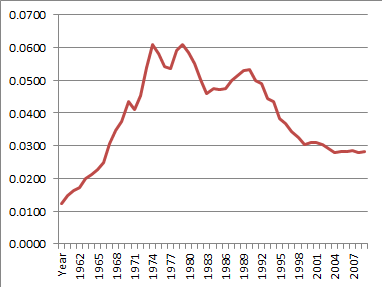
Last, and most laughably of all, both Coakley and O’Flaherty breathlessly told the press that “criminals have the upper hand” here in Massachusetts. Here’s a graph showing crime rates per head in Massachusetts, using federal crime statistics:

crime

The facts show that crime has been steady at less than 3 reported crimes per 100 residents per year since around 2002, and that that level is the lowest since 1968. Criminals don’t have “the upper hand” here in Massachusetts. Crime is about as low as it’s ever likely to go.

Let’s not kid ourselves what this is about. This is not about reducing crime. Remember, they can’t think of a single case where there’s a criminal walking free today because electronic wiretapping is only allowed under narrow circumstances here in Massachusetts. This is about power. The AG’s office knows that it’s technologically possible for them to monitor more of our electronic communications, and it bugs them that it’s illegal to do, whether or not that monitoring will result in more convictions. So, they’re ginning up false fears of crime, calling this an “update”, and trying to get the people of Massachusetts to agree to join them in the brave new mass-monitored world – which they, not us, would control.

Guys, you’ve been rumbled. Your arguments don’t make sense. Find better ones or go home.

Why not let them know how you feel?

To contact the Attorney General’s office, try here.
To contact State Senator Eugene O’Flaherty, try here.
To contact State Representative John Keenan, try here.

Categories
News Uncategorized

Yay of the Day: In Ninth Circuit, Fusion Center Employee Not Completely Unaccountable for Infiltrating Peaceful Anti-War Group

The long-running case Panagacos v. Towery deals with the two-year-long infiltration by fusion center employee John Towery of peace groups including Students for a Democratic Society, the Olympia Movement for Justice and Peace, the Industrial Workers of the World, Iraq Veterans Against the War, and an anarchist bookstore in Tacoma (probably this one). Towery is technically a military employee, and courts are typically highly deferential to the military. However, the most recent ruling at the Ninth Circuit Court of Appeals allows the plaintiffs from these organizations to continue with their First and Fourth Amendment claims against the military. The National Lawyers Guild, which is involved in the case, believes this to be “the first time a court has affirmed people’s ability to sue the military for violating their First and Fourth Amendment rights”.

Good.

There are obvious analogies here to the Boston PD’s gross violations of protesters’ rights documented in the ACLU of Massachusetts’ Policing Dissent report this fall. Again, we see the fusion centers act as a nexus for the investigation and disruption, not of actual terrorist plots, but of peaceful opponents of the military-industrial complex here at home.

All my heroes have FBI files.
“All my heroes have FBI files”, by Jimi G.
Categories
News

By 2020, Cellphones Will Be Able To Track You Inside Buildings Too

Science Daily reports that one of the technological limitations on cellphones’ tracking capabilities is about to be lifted.

A research team led by Professor Dong-Soo Han of the Department of Computer Science at the Korea Advanced Institute of Science and Technology has developed a way of locating cellphones using their WiFi fingerprints to within 10 meters in indoor locations in cities.

The article is pretty gung-ho about the capabilities of this new technology, though they also report Professor Han as suggesting that “There seems to be many issues like privacy protection that has [sic] to be cleared away before commercializing this technology.”

Yes, Professor Han. That may be something of a concern.

In particular, may I ask, pretty please, that legislators considering bills to protect the privacy of cellphone users’ location data, bear in mind that this kind of indoor location detection has been shown to be possible? I give law enforcement oh, about five minutes after the commercial release of this technology before they start using it in investigations.

H/T to the ACLU for this graphic

The obvious Fourth Amendment issue here is that the current rulings allowing law enforcement use of cellphone data tend to rely heavily on the fact that when you are outdoors, you are not generally held to have a reasonable expectation of privacy, and that your location is reasonably observable to members of the public. If cellphones become capable of tracking you indoors, where you do typically have a reasonable expectation of privacy, then judges will have to choose whether to weaken the Fourth Amendment further by not requiring a warrant for the seizure of cellphone data, even though it contains data that would be considered private, or to strengthen the Fourth Amendment in the light of cellphones’ increased capabilities by barring its use without a warrant. These are rough waters for any jurist, which is part of why we strongly support cellphone location privacy laws that unambiguously require law enforcement to obtain a warrant before being allowed to collect cellphone location data.

The research is reported as Hyunil Yang, Giwan Yoon, and Dongsoo Han, “Floor Accuracy Improvement of Wireless LAN based Large Scale Indoor Positioning”, IEEE MTT-S IMWS-IRFPT 2011, KAIST, Daejeon Korea, p.89-90 (2011).

Categories
News

Free Essam Attia, Political Artist

Hey, kids! Worried about law enforcement using drones for surveillance? Well, maybe you oughta just shut your goddamn piehole on that, because here in the New America, complaining about that shit can get you arrested.

That’s right. In the home of the First Amendment (my third favorite Amendment, after the Fourth (obvs) and the Ninth (link provided)), if the NYPD doesn’t like you challenging their use of drones by, say, putting up satirical posters on a few phone booths in downtown Manhattan, they’ll throw the book atcha.

essam-attia-drone-poster

After a no doubt thorough tossing of his apartment, Maine-born artist and former military geospatial analyst Essam Attia has been charged with “56 counts of criminal possession of a forged instrument, grand larceny, possession of stolen property and weapons possession after allegedly having an unloaded .22-caliber revolver under his bed“.

I’m just guessing here, but “forged instrument” presumably means “satirical posters using the NYPD logo for First-Amendment-protected political speech”. The most serious charge, for possession without a license of a small-caliber unloaded handgun, wouldn’t even be a crime in most jurisdictions; Attia claims that the gun is an antique, which under New York state law would not require a permit.

Let’s sum up. The NYPD, in the course of an investigation into an extremely minor crime (described as “kiosk vandalism”, though the kiosks were not in fact damaged), go through every inch of the suspect’s apartment, and find material that under current laws can be used to support over fifty criminal charges. There’s no word from the NYPD or any press source about what the alleged stolen property is. If Attia is correct that the gun is an antique, there’s no basis for the charge. And yet they are still able to launch in, lock him up, and submit him to all the terror and trouble of the criminal justice system, because he embarrassed them in public. They have loaded him up with charges purely to serve as a deterrent to others thinking about criticizing the NYPD – and this is even before the NYPD has any actual drones out in the field.

cartman-autorita

Maybe this is just the NYPD’s artistic response to Attia’s artistic critique. And maybe they should just drop the charges, already. Jeez, people.

UPDATE: My own Congressman, Ed Markey, has just introduced the Drone Aircraft Privacy and Transparency Act. It’s surely a good idea; but note that even one of the House’s most liberal members can offer up only that law enforcement agencies should be careful about their use of drones, not that we should stop or reverse the process of approving the use of drones for domestic law enforcement purposes.

Categories
News Uncategorized

Joined-Up Government Can Be A Bad Thing

The National Counterterrorism Center is now being allowed access to all governmental databases to trawl for suspicious activity. The Wall Street Journal (“U.S. Terrorism Agency to Tap a Vast Database of Citizens”) and the Volokh Conspiracy (“DHS Dresses Up A Turf Fight as a Privacy Issue While Ignoring the Lessons of 9/11”) both report on this development, from opposing perspectives.

Just because one part of the government has a certain set of data, doesn’t mean that all other parts of the government should have it. Your tax return is kept privately within the IRS; records of your immigration applications stay with USCIS; Medicare keeps your health records private; and so on. This kind of data confidentiality used to be routine; but once again, in the service of terrorism, the normal limitations on government power are considered expendable.

This is what happened.

NCTC asked the Department of Homeland Security for access to a database on terror suspects. DHS gave NCTC the disks, on the condition that NCTC, within 30 days, remove information regarding “innocent US persons” (innocent non-US persons are apparently fair game).

Possibly terroristic non-US person Malala Yousafzai.

NCTC couldn’t do it. In fact, after 30 days they had barely been able to download the database from the disks. Even with another 30-day extension, they couldn’t do it, and in response to this failure, they have demanded, and gotten, even broader access to even more government databases. The only constraint is that any time they access a new database, they have to publish that fact in the Federal Register.

Their problems in removing “innocent US persons”‘ data are completely understandable, because NCTC was anxious that today’s innocent person may not turn out to have been innocent tomorrow. How do you remove innocent people, when nobody is provably innocent?

Your government, protecting you. With science!

From a resource standpoint, how could NCTC possibly deploy enough skilled analysts to prove the innocence of the (at minimum) hundreds of thousands of people this one database contained? And that’s just one of the many databases to which they will now have access!

This is an example of what, over at EFF when I was interning there in 2000, we used to call “Data Valdez”. The amount of data being created is enormous and essentially impossible to thoroughly analyze. The federal government has, in its various parts, access to data on every part of our lives, but no matter how fast its computers, it will never, ever have the human resources necessary to process it properly. Demanding access to ever greater oceans of data is not going to help. It’s a processing problem, not a data problem.

That’s why, at Digital Fourth, we recognize the wisdom for law enforcement of aggressively applying the constraints identified in the Fourth Amendment. Even if you have the ability to collect more data, it works better to consciously commit to collecting less. Law enforcement should, for its own sanity and ours, collect, retain and use in investigations only data that is related to investigations of actual, well-defined crimes committed by previously identified people. Only then will the volume of data collected be low enough that law enforcement will be able to process it thoughtfully and intelligently. Yes, that means that connections will be missed that will only become apparent after the fact of an attack. But we cannot insure perfectly against the probability of future attacks. We have to invest our resources rationally, and we have vastly over-invested in preventing terrorist attacks relative to other things that kill many more Americans.

Categories
News

Symbolic Spending to Combat Terror: Or, Let’s Spend Your Tax Dollars on Snooping rather than on Anything Useful

The new US Senate report on the uselessness of fusion centers reminds me irresistibly of an old episode of “Yes Prime Minister”:

Nobody’s interested in the Social Science Research Council. Or the Milk Marketing Board. Or the Advisory Committee on Dental Establishments. Or the Dumping At Sea Representation Panel. But Government still pays money to support them.
– Don’t they do a lot of good?
– Of course they don’t. They hardly do anything at all.
– Then let’s abolish them.
– No, no, Prime Minister. They are symbols. You don’t fund them for doing work. You fund them to show what you approve of. Most government expenditure is symbolic.

The fusion centers are the signature initiative of Homeland Security Secretary Janet Napolitano. They were supposed to collate and report quickly on terror threats. The report makes clear that whatever amount – maybe as much as one billion dollars – has been spent on them, has been wasted. Investigators were unable to find a single case where a fusion center had supplied information that thwarted a terrorist threat. Instead, our money has been spent on collecting a heterogeneous mass of partially reliable information on the activities of peaceful activists.

At the same time, the ACLU of Massachusetts’ new report on the Boston Police Department’s Boston Regional Intelligence Center paints a very similar picture, with more casual person-to-person oppression thrown in (video here).

It’s no surprise if ordinary people who oppose the increased power of government to scrutinize our lives, feel anxious about putting their heads above the parapet. I was anxious myself till I became an American citizen this year. Who wouldn’t feel angry at their taxes being wasted investigating groups like Veterans for Peace?

This isn’t about any rational threat assessment. This is about symbolism and fear. The US government has spent roughly one trillion dollars on anti-terrorism efforts since September 11, 2001. That trillion dollars could have saved any number of lives if deployed on useful things. Our roads and bridges are falling apart, our public school have to scrape for money for sports, arts and field trips, and tens of thousands of Americans die each year for lack of basic preventative health care. Rather than helping with those things, our politicians wrap themselves in the flag and pour tax dollars into a black hole labeled “Anti-Terrorism”, without bothering to find out whether we’re spending too much or too little, or what’s working and what’s not. What’s it to them? It’s not their money. It’s your money and mine, and the party has got to stop.

If the fusion centers can’t demonstrate that they are providing a useful service, they should be closed. The entire intelligence, counter-terrorism and defense budget should be audited every year. We should reimpose Constitutional limits on the deep state, requiring government officials to actually justify what they are doing to neutral third parties in the judiciary. No-one gets a get-out clause, in the name of “terrorism” or anything else.

This isn’t a “far-left” thing or a “far-right” thing. Seems like any issue on which the main parties agree gets ruled out of bounds for discussion. The Sunday talk shows are all about the horse race, who’s up and who’s down and who gaffed and who didn’t. But the sad fact that most Republicans and most Democrats agree on wasting our money on stuff like this, doesn’t make it right.

Categories
News

The Public Is Now “The Enemy”

Newly leaked documents show that a US Air Force network operations manager was investigated last year after expressing sympathy for Wikileaks and for Pfc. Bradley Manning, under a charge of “Communicating with the Enemy”. This charge is technically punishable with death.

Glenn Greenwald reports on the case here, but I want to explore a curious element of it. For the charge of “Communicating with the Enemy” to hold water, the servicemember in question would have to have done the following:

“(a) That the accused, without proper authority, knowingly gave intelligence information to the enemy; and
(b) That the intelligence information was true, or implied the truth, at least in part.”

“Enemy” is further defined as including:

“organized forces of the enemy in time of war, any hostile body that our forces may be opposing, such as a rebellious mob or a band of renegades, and includes civilians as well as members of military organizations. “Enemy” is not restricted to the enemy government or its armed forces. All the citizens of one belligerent are enemies of the government and all the citizens of the other.”

The obvious question is: who is the “enemy”?

The simple answer is that the US government now sees Wikileaks itself as a non-state enemy organization, perhaps along the lines of SPECTRE in the James Bond movies with Julian Assange in the role of Count Blofeld; or, as a real-world analogy, like the bloodthirsty fanatics of al-Qaeda. It’s unprecedented for the US government to class as an “enemy” an organization that does not advocate, promote or use violence to further its aims, and the USAF documents themselves show the ridiculousness of the charge:

Air Force investigators were unable to come up with any actual victims that would result from helping Wikileaks, so they simply listed under “VICTIM:”, “Society” itself. This is further proof that the current exercise of American power is alien to the spirit of the Constitution. If there was no definable harm, why was there an investigation at all?

Let’s add into the mix the risible letter from NSA last month responding to Sen. Ron Wyden’s request to fund out how many US nationals’ communications were being spied upon, and saying that to inform Sen. Wyden of that would “violate the privacy of US persons.”

I ask again, who is the “enemy”?

Wikileaks is, like the New York Times, a mechanism for getting information out to the public, whether in America or elsewhere. The real “enemy” is not Wikileaks; it’s the American people itself. We have to be saved from ourselves. If we come to know too much – if information that embarrasses the American government were allowed to spread unchecked – then it would significantly undermine the ability of the American government to project its power unilaterally both at home and abroad.

Imagine a world where the government couldn’t take the country to war based on manufactured evidence, or a world where people realized that the use of American power in certain poor and Muslim areas of the world kills many innocent people and creates more new terrorists than are killed.

The real crime here isn’t “Communicating with the Enemy [sic]” We need a new term, and fortunately history gives us a clear precedent. So, in honor of the Soviet dissident Solzhenitsyn, I’m christening this crime “Anti-American Agitation”, or Triple-A.

We have got to get over the fact that there will always be, somewhere on the Earth, people who are harboring negative thoughts about the United States. Such feelings are a natural corollary of empire. We can’t stop people feeling that way by showering them either with propaganda or with bombs. We can, however, act to undermine anti-American sentiments by not actively supporting oppressive and undemocratic governments. For some reason, though, this cheap, safe, and effective alternative to current American policy never seems to occur to people in power.

To those who seem to be hastening to have America emulate the might and decadence of Rome: empires always fall. Rome fell, the British Empire fell, the Soviet empire fell. Trying to control too much engenders rebellion, and efforts to suppress rebellion make people lose faith in the empire’s reason for being. Let us not therefore, O Lord, become like the empire Tacitus describes, in the mouth of a British rebel:

“The terrible Romans, from whose oppression escape is vainly sought by obedience and submission. Robbers of the world, having by their universal plunder exhausted the land, they rifle the deep. If the enemy be rich, they are rapacious; if he be poor, they lust for dominion; neither the east nor the west has been able to satisfy them. Alone among men they covet with equal eagerness poverty and riches. To robbery, slaughter, plunder, they give the lying name of empire; they make a solitude and call it peace.”