Categories
Mission News

Drowning in Data, Starved for Wisdom: The surveillance state cannot meaningfully assess terrorism risks

In this movie, we're Brad.
Pity the analysts.

The NSA has just vigorously denied that their new Utah Data Center, intended for storing and processing intelligence data, will be used to spy on US citizens. The center will have a capacity of at least one yottabyte, and will provide employment for 100-200 people. With the most generous assumptions [200 employees, all employed only on reviewing the data, only one yottabyte of data, ten years to collect the yottabyte, 5GB per movie], each employee would be responsible on average for reviewing 4500 billion terabytes, or approximately 23 million years’ worth of Blu-ray quality movies, every year.


Must...keep...watching...my...country...needs...me
Must…keep…watching…my…country…needs…me

This astounding and continually increasing mismatch shows that we are well beyond the point where law enforcement is able to have a human review a manageable amount of the data in its possession potentially relating to terrorist threats. Computer processing power doubles every two years, but law enforcement employment is rising at a rate of about 7% every ten years, and nobody’s going to pay for it to double every two years instead. Purely machine-based review inevitably carries with it a far higher probability that important things will be missed, even if we were to suppose that the data was entirely accurate to begin with – which it certainly is not.

So why is anybody surprised that Tamerlan Tsarnaev, the elder of the Boston Marathon bombing suspects and one of around 750,000 people in the TIDE database, was not stopped at the border? That facial recognition software wasn’t able to flag him as a match for a suspect? That the fusion centers, intended to synthesize data into actionable “suspicious activity reports”, flag things too late for them to be of any use? That the Air Force is panicking a little at not having enough people to process the data provided by our drone fleet?

It’s in this context, then, that we should understand the calls for more surveillance after the Boston Marathon attacks for what they are. More cameras, more surveillance drones and more wiretapping, without many more humans to process the data, will make this problem worse, not better. These calls are being driven not by a realistic assessment that surveillance will help prevent the next attack, but by the internal incentives of the players in this market. Neither the drone manufacturers, nor law enforcement, nor elected officials, have an interest in being the ones to call a halt. So instead they’re promoting automation – automated drones, automated surveillance, and email scanning software techniques.

They are missing something very simple. We don’t need a terrorism database with 750,000 names on it. There are not 750,000 people out there who pose any sort of realistic threat to America. If the “terrorism watch list” were limited by law to a thousand records, then law enforcement would have to focus only on the thousand most serious threats. Given the real and likely manpower of the federal government, and the rarity of actual terrorism, that’s more than enough. If law enforcement used the power of the Fourth Amendment, instead of trying to find ways round it, it could focus more on the highest-probability threats.

Yes, they would miss stuff. That’s inevitable under both a tight and a loose system. But a tight system has the added advantages that it protects more people’s liberties, and costs a lot less.

UPDATE: With the help of a New Yorker fact-checker, the figure of “400 billion terabytes” above has been corrected to “500 billion terabytes”.


Categories
News

Civil Liberties Commentary on the Boston Marathon Manhunt

A variety of excellent commentary over the weekend reflected on the civil liberties implications of the Boston Marathon attacks.

Over at Salon, Falguni Sheth and Robert Prasch used a thought experiment (What would have been different if the bombing had happened in 1977, before mass electronic surveillance?) to argue that the vast expenditure on the surveillance state has not had the net effect of either preventing terrorism or making apprehending terrorists more efficient; so why are we doing it, again?

At Popehat, Clark dissects the unprecedented, expensive and ineffectual lockdown of Boston and the western suburbs, and observes that it is only after the lockdown ended and citizens were back outside their doors that the suspect was located.

Last, there’s an excellent analysis and discussion of the Fourth Amendment issues raised by house-to-house searches for a fugitive by (once again) Orin Kerr at the Volokh Conspiracy. Enjoy!

Categories
Mission News

The Fourth Amendment and the Boston Marathon Attacks: Racialized “Reasonable Suspicion” and the Search of the Saudi Marathoner’s Apartment

The Boston Marathon attacks have brought to the surface some of the best and the worst in Massachusetts.

On the one side, many news sources reported responsibly and refused to speculate too quickly and without foundation about who the bombers were or why they might have done what they did. There seems at this stage good evidence on which to base the arrest of Dzhokhar Tsarnaev. Above all, he was taken into custody quickly and alive, and Bostonians will be able to learn more about the motivations behind the attacks.

On the other side, panic, prejudice and the needs of the news cycle fueled an almost certainly unconstitutional search of an innocent Saudi marathoner’s house, an attack on a Muslim doctor in Malden, a call for genocide of Muslims, and a martial law-style lockdown of a vast area of metropolitan Boston.

This is the blog for the Campaign for Digital Fourth Amendment Rights, so unsurprisingly I’m going to focus on some of the Fourth Amendment issues arising out of the attacks; principally, the stop of the Saudi marathoner and the search of his apartment in Revere, and the constitutional issues raised when a householder refuses entry to law enforcement during house-to-house searches for a fugitive.

Follow me below the fold for the first of these!

Categories
News

Security Mania and the Threat to Civic Life: Tom Brokaw, Edward Davis, and the West Stockbridge Zucchini Festival

Tom Brokaw, who in his long career has received every accolade a TV news journalist could receive, reacted on Monday to the Boston Marathon attack as follows:

Everyone has to understand tonight, however, beginning tomorrow morning early there’s going to be much tougher security considerations across the country. However exhausted we may be by them. We have to live with them and get along and go forward and not let them bring us to our knees.

Boston Police Commissioner Edward Davis’s less panicky reaction was much better:

We’ve done as much as we can. Our aim is not to turn this into a police state. We have to allow commerce to occur.

It’s easy to call for more security after what happened on Monday. It’s much harder to recognize that in truth, we were already doing all that we reasonably could to thwart attacks and more.

Categories
Mission News

The Boston Marathon: Generalized Surveillance Fails To Thwart Attack

Headline updated [x2].

Today, by the finish line of the Boston Marathon, on the same city block as the church I go to, two bombs went off. I feel shocked and sad beyond belief.


Photo credit: KVLY
Photo credit: KVLY.

My thoughts and prayers are with those who died or were hurt, with their families, and with all the people stranded in Boston on this cold night.

The former district attorney of Middlesex County, Gerry Leone, has taken to the airwaves to talk about how great the efforts have been before this attack to get a Joint Terrorism Task Force going, how well it has been working together, how smooth the state and federal collaboration has been, and how the appropriate response will be to increase random surveillance. Governor Patrick has also echoed his perspective, talking about the need for increased vigilance and random bag searches on the MBTA, which we have covered, and opposed, before.

It won’t surprise regular readers to know that my perspective on this is a little different and more skeptical. Even while massively and systematically abusing the Fourth Amendment, law enforcement wasn’t able to prevent this attack. The amount of data collected through warrantless electronic means by the centers Leone is talking about has been vast, and none of it, none of it, has thwarted a terrorist attack. Now, once again, they have failed us all.

Categories
Mission News

The IRS Is Up In All Of Your Email, Warrantlessly; but Fret Not, Peons, It Is For Your Own Good

What kind of hippy would object to spending half of our taxes on war anyways?

The ACLU reported on Wednesday that the IRS may be reading Americans’ emails without a warrant, because all Americans are now terrorists tax evasion is just like terrorism look because they can OK jeez you people with all your Constitution this and Constitution that shut up already!

Categories
News

Stingrays Can Do More Than You Ever Imagined: Law Enforcement, Cellphone Interceptions, and Countermeasures

Previously, we reported on the existence of stingrays, also known as `IMSI catchers’, which are used by law enforcement as mobile cellphone towers. Stingrays intercept location and other data from all cellphones in the area, redirecting the traffic from regular cellphone towers. They can be used to get cellphone data without having even to go through phone companies to get it.

Thanks to the case US v. Rigmaiden and terrific reporting from Kim Zetter on the Threat Level blog at Wired, we now have a much more comprehensive picture of how they work and what they can do. It turns out that Stingrays have been around for longer, can do much more and are much more widespread than we might have supposed, and that how much they are really used may well be unknown to the courts.

Categories
News

By 2020, Law Enforcement Will Use Brain Scans To Identify Recidivists

clockwork orange
Alex from Anthony Burgess’s A Clockwork Orange, which you should read if you haven’t already.

A new study from the Mind Research Center in Albuquerque, N. M., uses functional MRI to predict the likelihood of whether a criminal will reoffend after release from prison. Inmates “with relatively low anterior cingulate activity were twice as likely to reoffend than inmates with high-brain activity in this region.”

Society is developing the ability to identify probabilistically ahead of time categories of people who are statistically more likely to commit crimes. In this case, the anterior cingulate cortex, according to the authors, is associated with error processing, conflict monitoring, response selection, and avoidance learning, and they are working on drug therapies to stimulate activity in that area of the brain.

Scholars have expressed serious and varied reservations about overinterpretation of fMRI, most notably that the brain’s ability to rewire itself creates serious limitations in our ability to interpret fMRI activity in a particular area of the brain as being connected with particular species of activity outside the brain. The astounding case of the French civil servant with no brain suggests that the brain is more plastic and more bizarre than we have yet begun to understand.

However, that will not stop policymakers from seeing the glitzy surface of studies such as this, and constructing on top of them a belief that they will be able to reliably detect crime ahead of time. Therefore, our prediction of the week for our ongoing feature “Privacy Concerns of 2020” is that whether the science supports it or not, law enforcement will be using brain scans to identify recidivists ahead of time.

More on what that would look like below the fold!

Categories
Mission News

Microscope Monday: Analysis of Massachusetts’ proposed Liberty Preservation Act, H. 1428

steampunk_microscope

The newly formed Massachusetts chapter of PANDA is bringing forward legislation on Beacon Hill to prevent the indefinite detention of American citizens under the National Defense Authorization Act, or NDAA.

The notion that the President should be allowed to detain US citizens without trial and without limit in time of war is a horrifying idea, but not a new one. President Lincoln suspended the writ of habeas corpus during the Civil War. President Roosevelt interned Americans of Japanese descent during the Second World War. It had seemed by the early 1990s that we were recognizing that shameful past and leaving it behind. Then came 9/11.

In the aftermath of the attack, 1,200 Muslim Americans were detained on `material witness warrants’ and interrogated, often without any evidence beyond their religion. American citizen and civilian Jose Padilla was arrested in 2002, committed to a military brig for three and a half years, tortured and possibly driven insane, before being transferred to civilian court and sentenced to 17 years in prison in 2008, for conspiracy to conspire to commit terrorist acts abroad.

The US government in these cases was exceptionally anxious to preserve authority to detain anyone for any length of time, provided they could be vaguely associated with al-Qaeda. Many people expected that President Obama would abandon such arguments and restore the rule of law. In reality, he has allowed the power of indefinite detention to pass into law. In 2012, he issued a signing statement to that year’s NDAA (it’s an annual thing), claiming that he would never use the power of indefinite detention. That’s not even legally binding on him, let alone on his successors. In 2013’s bill, even that signing statement has disappeared from view. Hence, people in many states have been proposing bills like the Liberty Preservation Act.

Over the fold, for the details of what the Liberty Preservation Act would do!

[Previous Microscope Mondays covered: the Free Speech Act; the Electronic Privacy Bill; the Drone Privacy Bill; and the infamous Act Updating the Wire Interception Law.]

Categories
News

Major Crimes Plunge, But AG’s Office Still Pressing To Wiretap All The Things

One Catch-22 of criminal justice reform is that law enforcement will always ask for more powers, whether crime is down or crime is up. If crime is up, they need more powers to deal with criminals who have “gotten the upper hand.” If crime is down, they need more powers to keep it from rising again.

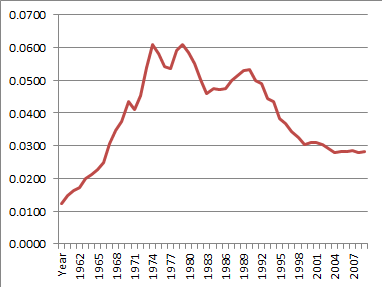
The Globe reports that major crimes in Boston are sharply down in the first three months of 2013 compared to 2012. In case you think this is a momentary glitch in the overall statistics, let’s look again at how crime per head in Massachusetts has been falling for a long time:

Martha Coakley's terrifying crime wave
Martha Coakley’s terrifying crime wave

Mayor Menino attributes the drop to community policing and neighborhood watch groups, assisted by the more severe winter. It’s almost as if militaristic and confrontational policing is actually less effective at reducing crime than people like to think.

So, we have a simple challenge for Attorney-General Martha Coakley. How far does crime have to fall, before you back off on your biennial demand for vastly expanded powers to take out electronic wiretaps when investigating minor crimes? Lazy, “one crime is too many” thinking is not enough when our Fourth Amendment rights are on the line. We don’t just need better community policing; we need an AG’s office that is willing to look at criminalization as a problem rather than looking at every person drawn into the criminal justice system as a victory for them.